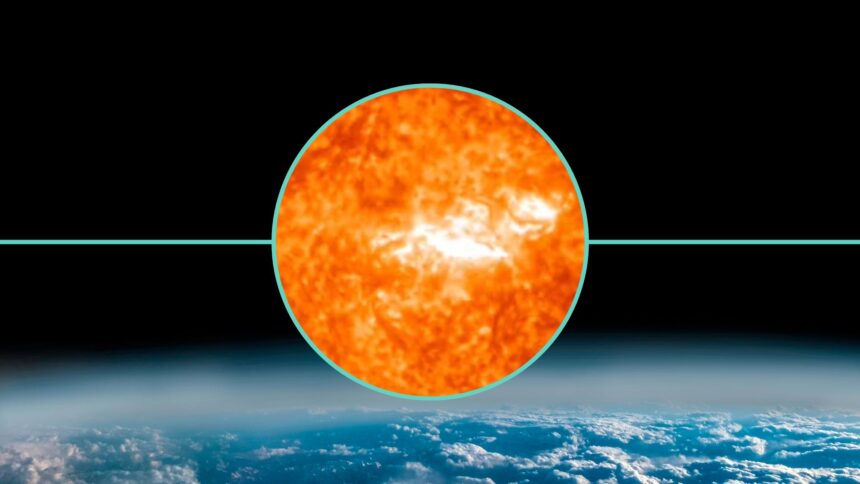

On August 25, the sun erupted with a significant M6.9 solar flare, triggered by the active sunspot region 4513. This event not only set off a coronal mass ejection (CME) aimed towards Earth but also caused a moderate radio blackout across some regions of the planet. With Earth potentially in the line of fire, the astronomical community is on high alert.
Understanding the Solar Flare
The M6.9 solar flare emanated from sunspot region 4513, peaking at 6 a.m. EDT (10 a.m. GMT). In the 24 hours leading up to this event, the sunspot was particularly active, registering a series of five M-class eruptions. Solar flares are categorized into different classes—A, B, C, M, and X—where M-class flares rank just below the most powerful X-class eruptions.
This specific eruption resulted in a moderate radio blackout, classified as R2, affecting high-frequency communication across parts of Africa, Europe, and the Arctic. Such disruptions can impact various sectors, including aviation and emergency services, which rely heavily on radio communications.
The Coronal Mass Ejection (CME) and Its Potential Effects
The CME resulting from the solar flare is set to reach Earth around August 28, with estimated arrival times between 6-7 a.m. EDT (10-11 a.m. GMT) plus or minus seven hours. Early predictions suggest a glancing blow to Earth, which may not pose significant threats, but is still being closely monitored.
Jure Atanackov, an aurora chaser, emphasized that although the CME is slow-moving, two factors may amplify its effects: the CME itself and a high-speed stream of solar wind expected to arrive around the same time. This combination could enhance geomagnetic activity, raising the potential for stunning auroras across higher latitudes.
Current Solar Wind Conditions
The Solar Influences Data Analysis Center (SIDC) has predicted that a high-speed stream of solar wind from a coronal hole will begin influencing Earth starting August 27. The forecast indicates unsettled to active geomagnetic conditions, with a minor chance of storm levels. If the CME’s arrival coincides with this stream, it could create conditions conducive for auroras, increasing the excitement among sky watchers.
However, the overall impact of the CME will hinge on its magnetic orientation upon arrival. If it possesses a strong southward magnetic field, the interaction with Earth’s magnetic field could intensify geomagnetic activity, leading to notable auroras and other phenomena.
Why This Is Trending
As solar activity increases, many are turning their eyes toward the skies, particularly those interested in astronomy and meteorology. With heightened solar flares and related phenomena, especially in light of the upcoming potential auroras, there’s significant interest among the Indian population. Additionally, the implications of solar weather can impact satellite communications and weather forecasting, making it a topic of considerable relevance for various sectors in India.
Frequently Asked Questions
What is a solar flare?
A solar flare is a sudden, intense burst of radiation from the sun’s surface, often associated with sunspots and solar explosions. These flares can affect communications and satellites on Earth.
What is a coronal mass ejection (CME)?
A CME is a significant release of plasma and magnetic field from the solar corona. When directed towards Earth, CMEs can lead to geomagnetic storms that influence electronics and create stunning auroras.
How often do solar flares occur?
Solar flares occur frequently, particularly during the solar cycle peaks, which can happen approximately every 11 years. The intensity and frequency of solar flares can vary significantly during different phases of the cycle.
Can solar flares impact Earth directly?
Yes, solar flares and associated CMEs can directly impact Earth by disrupting radio communications, altering satellite operations, and even affecting power grids during severe geomagnetic storms.