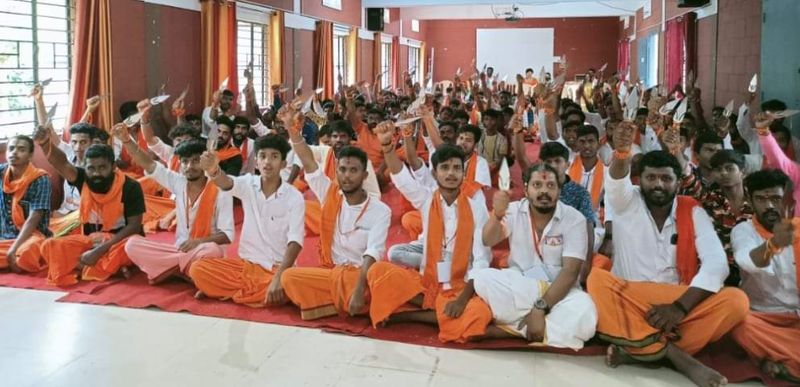

A complaint has been filed against two Bharatiya Janata Party (BJP) MLAs, one MLC, and leaders from Bajrang Dal and Vishwa Hindu Parishad (VHP) following allegations of an arms training camp that took place in Karnataka. This camp, which included young activists reportedly wielding air guns and tridents, has ignited significant debate about the legality and implications of such activities.
Incident Overview
The allegations concern an event named ‘Shaurya Prashikshana Varga’ held from May 5 to 11 at the Sai Shankar Educational Institute in Ponnampet, Kodagu district. Widely circulated images and videos showing camp attendees with what appear to be air guns and tridents raised legal concerns. Police became aware of the training camp primarily through social media after it gained public attention.
Following the viral dissemination of the images, the Social Democratic Party of India lodged a formal complaint resulting in the booking of notable political figures, including BJP MLAs K.G. Bopaiah and Appachuranjan, along with MLC Suja Kushalappa and Bajrang Dal regional convener Raghu Sakleshpur. Participating activists claim the camp focused on self-defense training, though statements about the distribution of arms vary, with some insisting none were given out.
Legal and Political Implications
The local Superintendent of Police M.A. Aiyappa noted that airguns do not require a license under the Arms Act, a justification echoing claims made by the camp organizers. However, the wider implications of the camp, especially regarding the involvement of political leaders, have drawn sharp criticism. Opposition parties have highlighted the event as a troubling sign of growing radicalization among youth tied to fringe groups like Bajrang Dal.
Former Karnataka Chief Minister Siddaramaiah and other Congress leaders decried the camp publicly, questioning the government’s silence and actions in response to what they deemed a blatant violation of law. Critics allege that such activities constitute a parallel process undermining public order and fostering violence based on religious affiliations.
Public and Media Reaction
The backlash against the training camp has been significant on social media and traditional news platforms. Prominent commentators like Mohammad Zubair shared images and videos questioning the encounter’s legality and the role of BJP leaders in endorsing such activities. The event has led to a flurry of political discussions and analysis, emphasizing that the involvement of political figures lends a disturbing legitimacy to what many see as a violation of democratic principles.
Reports have emerged suggesting that while the Bajrang Dal organized the camp, claims of attendance numbers vary significantly, with some estimates putting the figure at around 400 activists participating, while others suggest only about 116. This discrepancy only fuels further debate around the event’s nature and intent.
Why This Matters
The arms training camp controversy highlights several pressing issues within contemporary Indian politics, especially in terms of rising communal tensions and the political empowerment of youth organizations linked to extremist factions. The incident calls into question the responsibilities of political leaders and the potential for state-supported radicalization, as many young individuals are reportedly being groomed under the guise of self-defense training.
Moreover, the situation raises alarms regarding the current government’s accountability and willingness to address public safety concerns while navigating the delicate terrain of communal politics. It exemplifies the ongoing struggle between progressive forces in Indian society and those seeking to leverage religious sentiments for political gains.
Frequently Asked Questions
What was the purpose of the Bajrang Dal’s training camp?
The training camp, known as ‘Shaurya Prashikshana Varga’, was reportedly intended to provide self-defense training to its participants.
Why is the training camp controversial?
The camp has drawn criticism due to its association with political leaders and accusations of distributing arms without proper authorization, which some argue violates the Arms Act.
What has been the government’s response to the incident?
Authorities became aware of the camp through social media, and following complaints, police have registered cases against involved political figures. There has been public outcry from opposition leaders calling for accountability.
What legal ramifications might arise from this situation?
Given the allegations of arms training without permits and potential violations under the Arms Act, involved parties may face legal consequences depending on the outcomes of the police investigation.