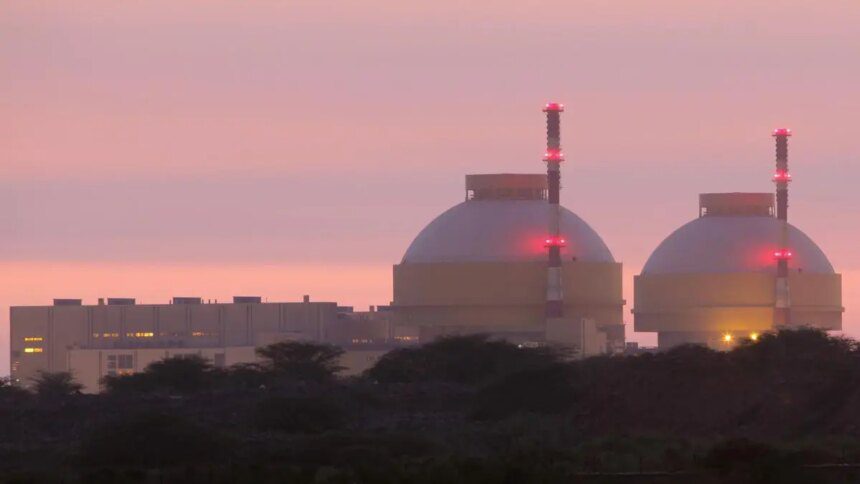

The recent passage of the SHANTI Act, 2025, allowing private entities to establish and operate nuclear power plants in India, has generated considerable enthusiasm. However, there is a pressing concern regarding the costs associated with nuclear energy.
Currently, India’s legacy nuclear power plants generate electricity at a competitive rate of ₹2.72–3.87 per kWh, as these facilities were constructed several decades ago. A closer examination of the costs involved in new nuclear power plants was recently discussed at a workshop organized by the Central Electricity Authority. Experts indicated that a Pressurized Heavy Water Reactor (PHWR) — for which the Nuclear Power Corporation of India plans to build 10 units, each with a capacity of 700 MW — will incur a cost of ₹21 crore per megawatt. Based on the established pricing formula—which includes a 15.5% return on equity and 2.33% annual depreciation—this would result in a tariff of ₹7.77 per kWh. For a Pressurized Water Reactor, the expected tariff rises slightly to ₹7.78 per kWh.
As the market evolves toward more affordable renewable energy sources—available around ₹4 per kWh—the question arises: who will opt for nuclear energy at these inflated rates? Discussions at the workshop also revealed potential avenues for cost reduction. For example, a decrease in Goods and Services Tax (GST) from 18% to 5% could lower costs by 20 paise per kWh, while eliminating the tax entirely could result in a reduction of 30 paise. Various factors contribute to this cost, including reductions in return on investment (an estimated 10 paise per 1 percentage point) and changes in normative interest rates.
The challenge of financing remains. The normative interest rates are pegged to a 30-year loan framework, but currently, such long-term loan options are unavailable. Recommendations made during the workshop included exploring rollover or refinance options to secure those terms. However, this introduces the risk of fluctuating future interest rates, complicating financing. Furthermore, enhanced operating efficiency could yield additional tariff reductions if plants exceed the normative Plant Load Factor (PLF) of 72.5%.
Despite these considerations, nuclear energy remains expensive in comparison to its renewable counterparts. Significantly, the indicative tariffs discussed are applicable only currently; future projects are expected to incur an annual increase of 10 paise due to normative operating and maintenance cost adjustments, and the construction of a nuclear project typically spans 13 years.
Turning to the private sector’s involvement, questions arise regarding the pricing of nuclear plants initiated by private companies. To date, the private sector has expressed interest in nuclear energy, but concrete plans remain to be finalized, pending regulatory frameworks. When these projects commence, they will confront significant market challenges.
Additionally, new nuclear power initiatives will rely heavily on imported uranium, with approximately 6,000 tonnes required annually for a 50 GW nuclear power output. Currently, the Nuclear Fuel Complex in India is only able to provide 2,900 tonnes even with projected expansions, primarily designated for the upcoming plants of NPCIL. The costs associated with importing uranium will be subject to global supply variables, geopolitical factors, and currency fluctuations.
Tariffs for nuclear power plants are determined through a cost-plus methodology. However, since nuclear power tariffs are not governed by the Electricity Act, they are instead set by the Department of Atomic Energy in consultation with the Central Electricity Authority. Private sector projects established under the SHANTI Act will follow this pricing mechanism.
In conclusion, given the financial landscape and regulatory environment, the competitiveness of nuclear power against firm renewable energy appears tenuous. As discussions of small modular reactors (SMRs) unfold, uncertainties regarding their costs complicate the scenario further. The impending question remains: will the SHANTI Act facilitate the development of enough nuclear facilities to escalate India’s nuclear capacity from 8 GW to 100 GW by 2047? The industry watches with anticipation.
Published on May 25, 2026.