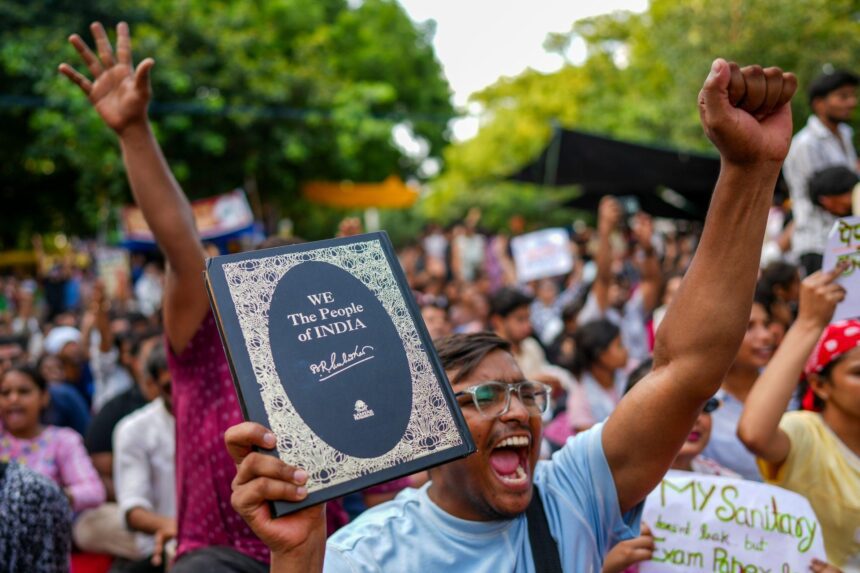

NEW DELHI, India (MNTV) – Recent nationwide protests in India culminated in the resignation of the country’s education minister, Dharmendra Pradhan, largely driven by public outcry over alleged exam paper leaks and perceived injustices in the education system. This unprecedented move signals growing discontent with governmental accountability in education, particularly among youth and marginalized communities.
Protests Sparked by Educational Inequalities
The protests were predominantly fueled by the newly established Cockroach Janta Party, representing a collective of citizens pushed to action by the provocative comments of the country’s chief justice who compared unemployed youth to cockroaches. In a diverse nation where millions aspire for educational and professional opportunities, such comments only intensified feelings of alienation and discrimination among marginalized groups, particularly Indian Muslims, who often find themselves on the fringes of educational advancement.
The resignation came after strategic protests mostly led by students, who felt their futures jeopardized due to systemic issues and perceived corruption. The police response to these protests included the use of tear gas and batons, further exacerbating tensions and illustrating the governmental repression faced by dissenters.
A Political Landscape in Flux
Indian politics is witnessing significant shifts as a result of public dissent. Mallikarjun Kharge, chief of the main opposition Congress party, hailed the minister’s resignation as a “victory of our millions of youth,” indicating a re-emerging political landscape that may shift focus toward addressing the systemic issues in education. This response not only reflects the immediate grievances of the youth but also positions the opposition to leverage this moment for broader reform in educational policies.
While Pradhan stated that unity must prevail and no student should face legal entanglements, critics argue that policies from the ruling Bharatiya Janata Party (BJP) have historically marginalized communities, particularly in the context of educational access and rights. This resignation could signify the beginning of deeper discourse around educational inequities exacerbated under the current regime.
Continued Struggles and Demands
Despite Pradhan’s resignation, the Cockroach party emphasized that vital demands remain unaddressed. Chief among them is a compensation of 10 million rupees (approximately $104,000) for families who have tragically lost children to suicide amid these educational crises. At least 11 aspirants committed suicide after the government invalidated examination results following allegations of corruption and leaks, spotlighting the devastating emotional and psychological toll on families and communities.
The protests also call for accountability for police actions during demonstrations, which adds another layer of urgency to discussions surrounding social justice, civil rights, and the treatment of marginalized youth, particularly within the context of the Indian Muslim community often left vulnerable by the socio-political environment.
Why It Matters
The resignation of the education minister reflects broader systemic issues within the Indian educational framework which often marginalizes specific communities, including Indian Muslims. These developments may serve as catalysts for significant reform, which could affect not only educational policies but also broader socio-economic measures that address discrimination and marginalization. Understanding these dynamics is essential for global observers interested in human rights, social justice, and the implications of governance on youth and educational access in India.
Frequently Asked Questions
What triggered the nationwide protests in India?
The protests were triggered by allegations of exam paper leaks and systemic irregularities in the education system, culminating in demands for the resignation of the education minister.
What are the main demands of the Cockroach Janta Party?
The party is demanding compensation for families of children who committed suicide due to educational pressures and seeking accountability for police misconduct during protests.
How did the government respond to the protests?
The government initially responded with police action using tear gas and batons to disperse protesters, demonstrating a heavy-handed approach towards dissent.
What implications does this resignation have for the future of education in India?
This resignation may push for reform in educational policies and greater accountability in the governance of educational institutions, potentially shaping future policy decisions that address systemic inequalities.