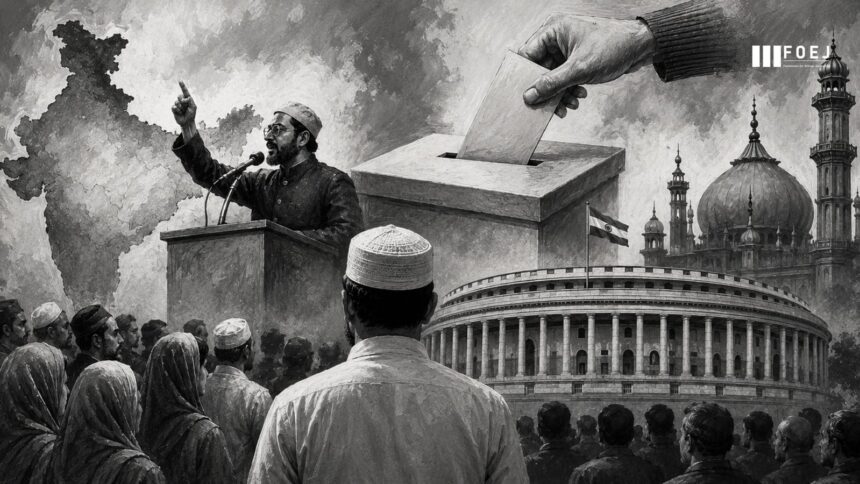

Economic and political discourse in India is increasingly shaped by competitive electoral politics, particularly as it affects the Muslim community. This article explores the dynamics of Muslim political participation, the formation of organizations like the Majlis-e-Mushawerat, and the impact of the Sangh and BJP governments on Muslim political identity and representation.
Emergence of Political Mobilization Among Muslims
In recent years, Indian Muslims have shown a marked increase in political engagement. Gopal Krishna notes that the community, which has historically distanced itself from the political process, is now participating more actively in elections. This shift is evidenced by a significant rise in Muslim candidates contesting Lok Sabha and State Assembly elections.
However, the assertion that this trend signifies a move towards secularization within the community overlooks the underlying motivations. Examining the rise of the Majlis-e-Mushawerat reveals that many Muslim leaders are, in fact, consolidating their political power to ensure that their community’s needs are represented. Established in 1964, the Majlis aims to bring attention to the unique issues faced by Muslims, particularly in the wake of communal violence in various states.
Goals and Actions of the Majlis-e-Mushawerat
The Majlis-e-Mushawarat emerged after incidents of communal riots, advocating for safeguards against communal violence, and calling for a nine-point mandate presented to national political leaders. Its goal is to ensure that the unique challenges facing Indian Muslims receive acknowledgment and are addressed within the larger political framework.
Despite the increasing assertion of political identity, the Majlis has maintained its self-proclaimed status as a non-political organization. Instead of directly fielding candidates, it has opted to support specific candidates from opposition parties—often Independents, Socialists, Communists, and even a Jan Sanghist. This reflects a strategic choice to influence political outcomes while still being wary of aligning too closely with any single political entity.
The organization has underscored that persistent support for the Congress Party will depend on their acceptance of the Majlis’s mandate. The Congress Party’s refusal to recognize this mandate can be seen as part of a broader pattern of marginalization that persists within mainstream political narratives, pressuring Muslim voters into coalition politics with opposition parties.
Challenges Within the Political Landscape
Despite increased visibility in electoral politics, Muslim candidates continue to face systemic challenges. Many contests occur in predominantly Hindu constituencies where Muslim candidates have little chance of winning, which indicates a persistent barrier in political integration. Gopal Krishna’s argument that Muslims are broadening their political base could be valid, yet it is essential to assess whether coalitions with other parties stem from genuine cooperative political integration or merely strategic positioning to ensure representation.
Historically, communal alliances have existed to bolster electoral chances rather than represent a shared vision. The alliance of Hindu and Muslim communal parties exemplifies this reality. Muslim solidarity is reinforced as a response to perceived threats, rather than an embrace of secular political ideals. As Imtiaz Ahmed suggests, the burden of secularism rests primarily with the dominant Hindu community, challenging whether true political integration is feasible under current circumstances.
Why It Matters
The evolution of Muslim political engagement holds significant implications for India’s socio-political trajectory. For the global audience, understanding this dynamic is crucial as it reflects broader trends of marginalization, where minority communities seek to establish their political identity and voice amidst overwhelming electoral competition. The situation underscores the importance of inclusive governance that is conscious of communal differences and aims to transcend historical grievances.
Furthermore, the intersection of political representation and community safeguarding introduces essential discussions on ethical governance and the responsibility of political entities to engage with minority constituencies genuinely. The outcome of this engagement will influence not only the stability of Indian democracy but also serve as a reference for global contexts dealing with multiculturalism and pluralism.
Frequently Asked Questions
What is the Majlis-e-Mushawarat?
The Majlis-e-Mushawarat is a key Muslim organization in India, established in 1964, aimed at addressing the specific concerns and safeguarding the interests of the Muslim community in the political landscape.
How has Muslim political engagement changed in India?
There has been a notable increase in electoral participation among Indian Muslims, with more individuals contesting elections and forming political coalitions to assert their community’s interests, despite historical marginalization.
What role do political alliances play for Muslims in India?
Political alliances are often formed by the Majlis-e-Mushawarat with opposition parties to amplify Muslim representation, especially when mainstream parties like the Congress fail to acknowledge the community’s specific needs.
Is there evidence of political integration among Muslims in India?
While there are trends indicating political mobilization, significant barriers still exist, particularly in predominantly Hindu constituencies, making it difficult for Muslim candidates to achieve electoral success, suggesting that true integration is still a challenge.