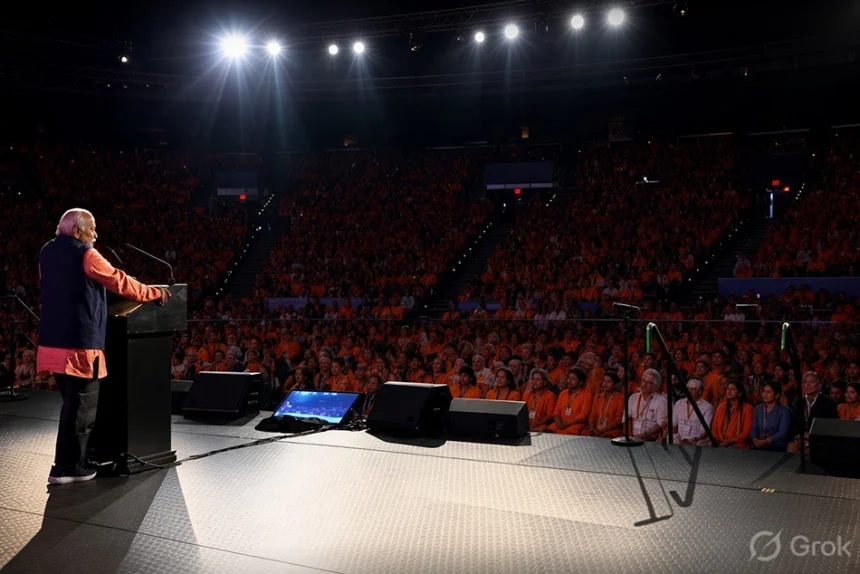

As India’s religious minorities face increasing persecution, recent remarks from RSS Chief Mohan Bhagwat in New York—that emphasize unity amid diversity—demand scrutiny. His statements come at a time when reports highlight systematic discrimination against Muslims, making the contrast between his words and actions particularly stark.
The Context of Bhagwat’s Statements
On August 30, 2026, during his speech at Madison Square Garden, Mohan Bhagwat called for a “Call to Action” for peace, emphasizing that “diversity is the rule of nature, but unity is the truth underpinning it.” He advocated for the protection of all identities, asserting that Hindu identity should not exclude others. His assertions concerning inclusivity appear dissonant given the current socio-political climate in India, marked by reports of escalating violence and discrimination against Muslims.
Notably, Bhagwat addressed concerns raised by Muslim individuals during a 2018 lecture, stating, “If any Hindu thinks that there should be no Muslim in Bharat, he ceases to be a Hindu.” This counterpoint to rising communal tensions raises questions about the sincerity of his message in the light of ongoing human rights abuses against Muslims throughout India.
Understanding the RSS’s Role
The Rashtriya Swayamsevak Sangh (RSS) is a pivotal organization in shaping the political landscape of India, promoting Hindu cultural values while actively participating in political mobilization that often results in religious polarization. The organization’s dual mandate—community service and political intimidation—exposes a complex agenda that undermines the peaceful and inclusive vision Bhagwat articulated in New York.
As highlighted by various reports, the RSS has been implicated in a broader pattern of marginalization targeting Muslims, with the India Persecution Tracker documenting 44 Muslim fatalities and extensive demolition of Muslim homes in the early months of 2026 alone. Such acts reflect a troubling environment that contradicts the unity that Bhagwat portrays while engaging with an international audience.
Reports Highlighting Rising Persecution
Recent findings from the India Persecution Tracker and the United States Commission on International Religious Freedom (USCIRF) provide alarming insights into the treatment of religious minorities in India. The USCIRF asserts that conditions for religious freedom are deteriorating, with systematic persecution reported against multiple minority groups, particularly focusing on Muslims.
The USCIRF’s findings indicate a troubling situation where individuals are arrested for advocating for their religious rights, and the state frequently employs internet shutdowns to suppress free speech critical of its policies. It accuses the Indian government of facilitating impunity for violent acts by Hindu nationalist groups, which contradicts the harmonious society Bhagwat proposes in his public declarations.
Why It Matters
Understanding the contrasting narratives around RSS’s activities and Bhagwat’s public statements is essential for fostering informed global discourse. The implications extend beyond India’s borders, affecting international perceptions of religious freedoms and human rights. As reports highlight systemic discrimination, global entities may need to reassess their diplomatic relations and policies toward India. Furthermore, those advocating for minority rights must navigate this complex political landscape to promote justice and equality.
Frequently Asked Questions
What is the RSS and what role does it play in Indian politics?
The Rashtriya Swayamsevak Sangh (RSS) is a Hindu nationalist organization in India that promotes Hindu cultural values and operates a vast volunteer network. It influences the policies of the Bharatiya Janata Party (BJP), the ruling party in India.
What are the main concerns regarding Muslim persecution in India?
Reports indicate a pattern of violence, discrimination, and intimidation against Muslims in India, including killings, home demolitions, and arrests. These actions are often linked to the activities of Hindu nationalist groups, including the RSS.
How does Mohan Bhagwat’s speech relate to ongoing discrimination?
Bhagwat’s speech promoting unity and diversity contrasts sharply with the documented systemic persecution of Muslims in India, raising doubts about the sincerity of his claims in light of the actions and rhetoric of the RSS and allied organizations.
What do international reports say about religious freedom in India?
Reports from the USCIRF and the India Persecution Tracker describe a deterioration in religious freedom in India, highlighting systematic persecution, denial of rights to minorities, and increasing violence by Hindu nationalist groups with government inaction or complicity.