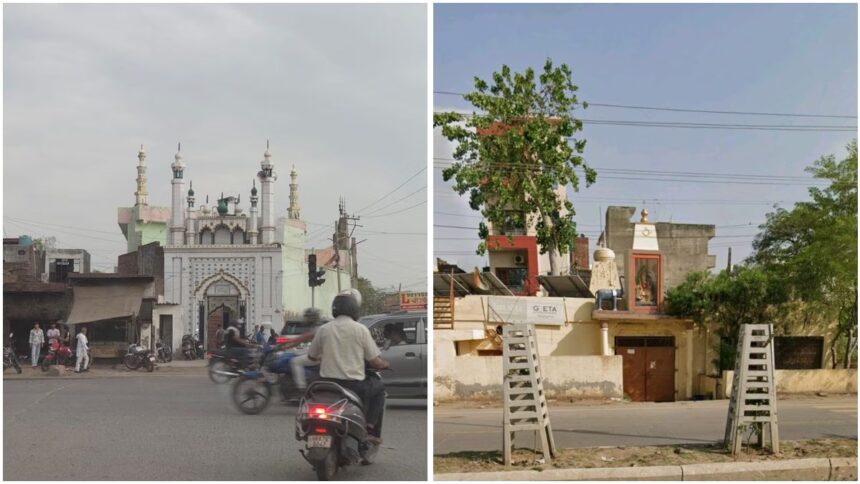

In recent years, infrastructure development in India has often come at the cost of religious structures, affecting vulnerable communities disproportionately, particularly Indian Muslims. A recent demolition incident in Faridabad exemplifies this troubling trend, highlighting the recurring pattern of marginalization and the state’s complicity in the erasure of community spaces.
The Faridabad Demolitions: A Disrespectful Pattern
On May 29, 2025, the Faridabad Municipal Corporation (MCF) demolished both a mosque and a temple in the New Industrial Township to clear land for the Gurugram-Faridabad-Noida Namo Bharat Regional Rapid Transit System (RRTS) corridor. This demolition was conducted under heavy police presence and a subsequent internet blackout, signaling an atmosphere of fear and repression. Dhanesh Adlakha, the Badkhal MLA, framed the demolition as necessary for traffic decongestion and urban transformation, dismissing the wider implications for the communities affected.
Such incidents are not isolated; they reflect a larger trend across India where religious structures—often situated in informal settlements—find themselves in the crosshairs of urban development projects. The Gujarat government’s demolitions of temples in 2008 echo the same troubling narrative where the state prioritizes infrastructure over faith and community, prompting protests and outcry from marginalized communities.
Judicial Responses and Governance Failures
The legal landscape surrounding religious demolitions in India indicates a precarious balancing act, where the Supreme Court has often upheld demolitions for “larger public interest.” For instance, the Gujarat High Court recently allowed the demolition of a 400-year-old mosque to facilitate road expansion. Legal experts suggest that courts frequently sidestep issues of land titles and protections for religious structures to favor state claims of public necessity.
Widespread demolitions often stir societal unrest, as seen in Rajkot, Gujarat, where overnight demolitions led to community uprisings. Residents of affected areas like Khori village in Faridabad—where over 100,000 people were left homeless due to regulatory failures—illustrate the human cost of such decisions. The Supreme Court had intervened only after public interest litigations, emphasizing both the environmental and social implications of encroachment policies.
The Politics of Marginalization
The demolitions in Faridabad reveal the complex intersection of urban planning, religious identity, and political gain. Many affected areas, like Nehru Colony in Faridabad, predominantly house laborers and the economically disadvantaged—communities that are frequently overlooked in governance. Professor Avinash Kumar argues that the crises of displacement align with a larger, systematic push to disenfranchise the urban poor, often labeling them as encroachers or outsiders.
This systematic marginalization reflects a broader political climate where the ruling BJP and affiliated groups like the Sangh Parivar have cultivated a narrative that prioritizes “development” at the expense of minority rights and community autonomy. In the case of the demolitions, MCF officials claimed they acted in compliance with environmental obligations, yet the abruptness and scale of the demolitions raise serious questions about due process and accountability.
Why It Matters
The significance of this issue extends beyond the physical act of demolition; it speaks volumes about social justice, governance, and community rights in India. The marginalization of certain communities often reveals systemic failures in urban planning and social welfare. Furthermore, the state’s tendency to prioritize development over religious rights fosters an environment of fear and resentment, undermining inter-community relations. As the country grapples with growing urbanization, a focus on equitable planning that respects the historical and social fabric of communities becomes crucial. This situation also serves as a pertinent case study for urban development policies worldwide, raising questions about inclusivity and sustainable growth.
Frequently Asked Questions
What were the reasons cited for the demolitions in Faridabad?
The Faridabad Municipal Corporation cited the need to clear land for infrastructure projects, specifically the Gurugram-Faridabad-Noida Namo Bharat Regional Rapid Transit System, and to alleviate traffic congestion in the area.
How have previous demolitions impacted the communities involved?
Previous demolitions, such as those in Khori village, led to significant displacement, leaving over 100,000 people homeless and prompting the Supreme Court to intervene for rehabilitation efforts, which have yet to be fully realized.
What role do courts play in these demolitions?
Courts in India often rule in favor of demolitions under the guise of larger public interests. They tend to exercise restraint in cases lacking formal land titles, thus prioritizing state claims over community rights.
How does the government’s approach reflect on communal dynamics?
The government’s focus on urban development at the expense of religious structures often fuels tensions between communities, particularly affecting marginalized groups like Indian Muslims, thereby deepening socio-political divides.