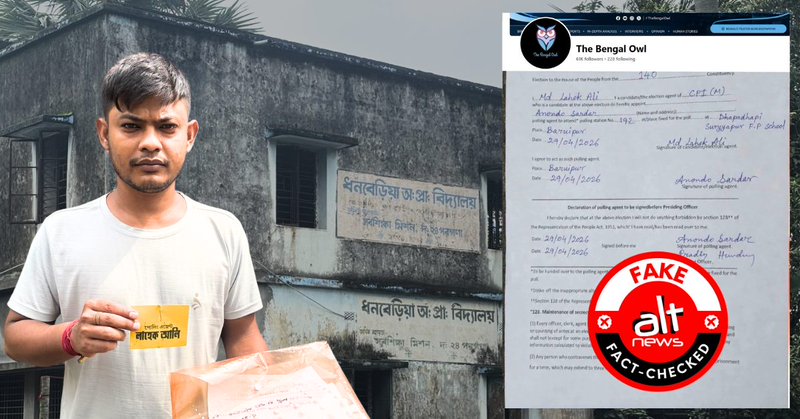

Summary
A viral claim on social media purports that Ananda Sardar, one of the accused in the rape and murder of a minor in Baruipur, was affiliated with the Communist Party of India (Marxist) as a polling agent. However, investigations have revealed that the document supporting this claim is fake, and the actual polling agent has been identified.
Understanding the Claim
Recently, a fake Form 10 circulated on social media, suggesting that Ananda Sardar was serving as a polling agent for the CPI(M). This false narrative has been shared widely, ostensibly to link Sardar’s heinous crime to a political party, creating an atmosphere of controversy. The claim appeared to gain traction due to the serious nature of the allegations against Sardar and the ongoing tensions surrounding political affiliations in India.
Investigative Findings
Prominent political commentator Anindya Hazra undertook a thorough investigation into the claims surrounding Sardar. Hazra pieced together official records and engaged with key sources to uncover the truth behind the allegations. His research led to the conclusion that the document being circulated was indeed fabricated. By identifying the legitimate polling agent, Hazra effectively dismantled the misleading association between Sardar and CPI(M), providing evidence-based clarity in a politically charged narrative.
Political Context and Backlash
The incident highlights the susceptibility of political entities to be drawn into narratives that may be orchestrated with the intent to defame or manipulate public perception. Political parties, particularly in the context of elections, are often targets of misinformation campaigns. Both the ruling and opposition parties can find themselves ensnared in such controversies, affecting their image and electoral prospects. As the situation unfolds in Baruipur, it underscores the need for vigilant fact-checking and responsible dissemination of information in an increasingly polarized political landscape.
Why This Matters
In India’s vibrant democracy, the intersection of crime and politics can have profound effects on public opinion and electoral outcomes. The false claims regarding Ananda Sardar serve as a reminder of how misinformation can be weaponized to influence political narratives. This incident also stresses the importance of media literacy and the role of investigative journalism in challenging disinformation. For Indian readers, understanding the dynamics at play is crucial; it not only informs their electoral choices but also shapes the future of political discourse in the country.
Frequently Asked Questions
What is the claim about Ananda Sardar?
The claim suggests that Ananda Sardar was a polling agent for the CPI(M) in connection with a rape and murder case involving a minor.
Is the document claiming Sardar was a CPI(M) agent true?
No, investigations have shown that the document is a fake and not an official Form 10.
Who investigated the claims surrounding Ananda Sardar?
Political commentator Anindya Hazra conducted the investigation, reviewing official records and verifying the actual polling agent.
Why is misinformation a concern in Indian politics?
Misinformation can significantly impact public perception, create social discord, and influence electoral outcomes, making it essential to address rapidly.