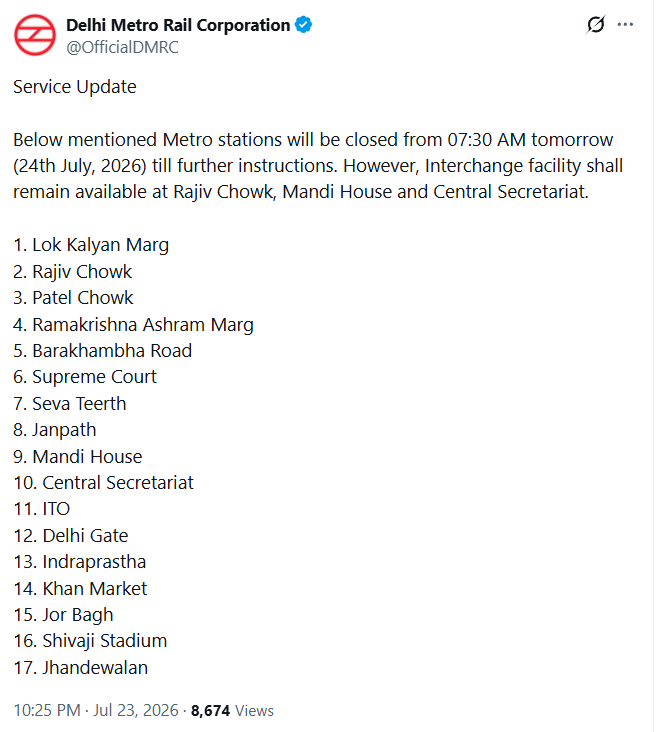

The Delhi Metro Rail Corporation (DMRC) has announced the closure of 17 metro stations, including the Supreme Court station, citing security concerns related to protests at Jantar Mantar. Critics argue that this action obstructs access to the judicial system and raises questions about the government’s commitment to democracy.
Metro Station Closures and Their Impact
On October 6, 2023, DMRC disclosed that various metro stations in the heart of Delhi would remain shut from 7:30 AM until further notice. The decision affects significant transit points such as Lok Kalyan Marg, Rajiv Chowk, and Central Secretariat, alongside others. These closures have been in place to manage safety during anticipated protests, but have drawn ire from the public and political opponents.
Among the most contentious aspects of this closure is the shutdown of the Supreme Court metro station. As one of the principal access points for those attending court proceedings, its closure is seen as a potential hindrance to citizens seeking justice. The DMRC’s reasoning has been critiqued for being arbitrary, particularly for its perceived goal of reducing the number of demonstrators at Jantar Mantar.
Public Outcry and Accountability
The decision to close the metro stations has sparked a significant backlash from civil society and political activists. Critics have pointed out that making access to the Supreme Court more difficult can be viewed as an obstruction of justice. Additionally, they argue that it reflects a broader trend of governmental overreach and suppression of public dissent.
In a democracy, actions taken by government bodies like DMRC could be challenged in the courts. Legal scholars and political analysts suggest that the judicial system will need to address the implications of such closures, especially when they can be interpreted as hindering constitutional rights. Observers emphasize the need for DMRC to provide transparent and reasonable explanations for its actions, lest it be seen as misusing power.
The Role of Protests in Democracy
Protests, particularly at locations like Jantar Mantar, play a vital role in the democratic fabric of India. They allow citizens to express dissatisfaction with government policies and advocate for reform. The current closures impede this crucial democratic process, leading to questions about the extent to which the government is willing to curtail public demonstrations for reasons of security.
Moreover, the juxtaposition of a democratic society with steps that seemingly limit civil liberties raises important discussions about governance in India. With protests often reflecting significant public sentiment, the government’s approach to managing dissent will ultimately influence the political atmosphere in the country.
Why This Matters
The current situation highlights a crucial intersection of public policy, civic engagement, and the rule of law. As metro station closures directly impact access to key judicial institutions, it raises concerns about the state of democracy in India. The balance between ensuring safety and preserving citizens’ rights to protest is a delicate one that the government must navigate carefully.
For Indian readers, this event serves as a reminder of the importance of civic spaces where people can gather and voice their opinions. As India grapples with various socio-political challenges, the ways in which citizens respond, and the government’s reactions to such responses, will define the nation’s democratic trajectory.
Frequently Asked Questions
Why are the metro stations being closed?
The DMRC has stated that the closures are due to security concerns related to planned protests at Jantar Mantar.
What implications does closing the Supreme Court metro station have?
Closing this station can hinder access for citizens attending court proceedings, raising concerns about obstruction to justice.
What do critics say about these closures?
Critics argue that the actions taken by DMRC are arbitrary and serve to prevent citizens from participating in democratic processes like protests.
How might this situation be challenged legally?
Legal experts suggest that citizens and activists could potentially challenge these closures in court, citing violations of their right to free expression and access to justice.