
Summary
Union Education Minister Dharmendra Pradhan has resigned amidst escalating protests related to the NEET-UG 2026 exam integrity, citing the needs of students and national interests. His departure comes after extensive public outcry over alleged examination irregularities linked to the Cockroach Janta Party’s (CJP) prolonged demonstrations, emphasizing the urgency for educational reform in India.
Protests and Allegations of Examination Irregularities
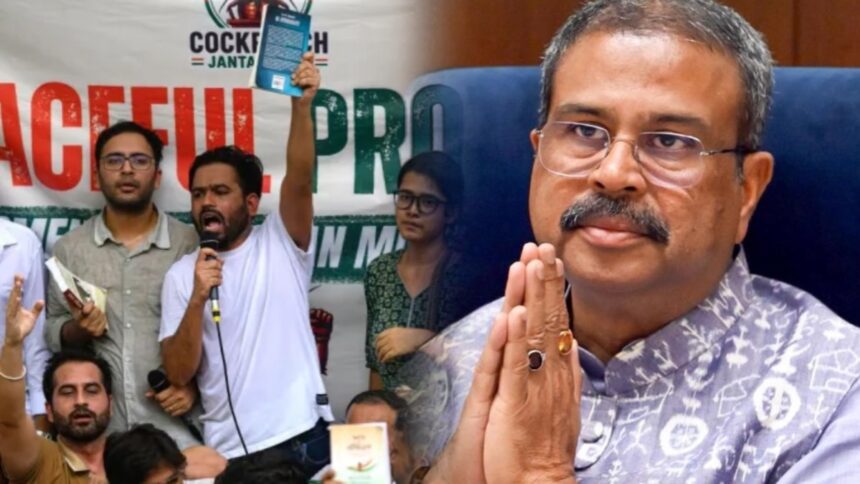
The resignation of Dharmendra Pradhan was catalyzed by significant unrest regarding the National Eligibility cum Entrance Test for Undergraduate (NEET-UG) that occurred on May 3, 2026. Accusations of a paper leak led to public distrust and demands for accountability. The CJP orchestrated a persistent sit-in protest at Delhi’s Jantar Mantar, calling for Pradhan’s resignation over ongoing examination discrepancies.
In response to the allegations, the Indian government took decisive actions, including transferring the investigation to the Central Bureau of Investigation (CBI) and canceling the controversial exam. A re-examination was conducted on June 21, 2026, instilled with support from various governmental bodies, which aimed to restore faith in the processes governing academic evaluations.
Pradhan’s Reflection and Commitment to Education
In his resignation statement on social media, Pradhan reflected on his decades-long dedication to educational reform, reiterating that a robust education system is pivotal for nation-building. He thanked Prime Minister Narendra Modi for the opportunity to serve and mentioned his commitment to the aspirations of the youth in India.
Highlighting that the results of the re-examination were declared on July 16, 2026, Pradhan underscored that this turnaround positively impacted numerous deserving candidates, particularly those from economically weaker segments. He acknowledged how misinformation continued to mislead students even post-examination results, indicating concerns about the broader implications of educational integrity for India’s future.
The Broader Implications of His Resignation
Pradhan’s resignation is positioned as a measure intended to de-escalate tensions and prevent any hindrance to student futures, with implications that extend beyond immediate political concerns. By stepping down, Pradhan sought to negate any opportunity for anti-national elements to exploit the unrest surrounding the NEET examination, reiterating the value of national unity.
Furthermore, his commitment to enhancing the educational landscape in India will continue to be a focal point. The government has announced a transition of the NEET exam to a computer-based format in the following year, signaling an effort to modernize academic assessments and potentially minimize future irregularities.
Why It Matters
The resignation of the Education Minister amid protests illustrates the intricacies of governance in India, particularly in relation to education—an essential pillar for societal development. Irregularities in significant exams can hinder social mobility and perpetuate inequities, particularly affecting marginalized communities. As India navigates its educational reforms, the outcome of this incident may set a precedent for accountability in public systems, affecting future governance and policy-making in the national context.
Frequently Asked Questions
What led to Dharmendra Pradhan’s resignation?
Dharmendra Pradhan resigned due to protests regarding alleged irregularities in the NEET-UG 2026 exam, with demands from the Cockroach Janta Party for accountability and transparency.
What actions did the government take regarding the NEET-UG exam?
In response to the allegations, the Indian government canceled the original NEET-UG exam, initiated an investigation by the CBI, and conducted a re-examination on June 21, 2026.
What changes are proposed for the NEET exam moving forward?
The government announced that NEET would transition to a computer-based format starting from the next examination cycle, aiming to enhance the integrity and efficiency of the testing process.
How does this resignation affect India’s education system?
Pradhan’s resignation is indicative of broader issues within the education system, highlighting the need for reforms and accountability, which may influence future policies and the integrity of academic assessments in India.