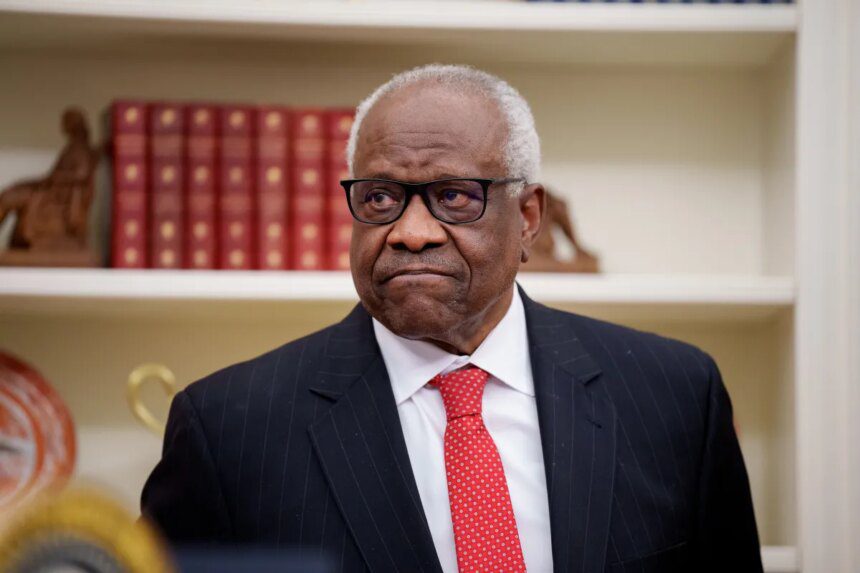

Justice Clarence Thomas may soon have the chance to overturn a two-decade-old Supreme Court ruling concerning scholarship funding for religious studies, a case that challenges the exclusion of theological degrees from public financial aid. A petition filed by a Virginia college student could have significant implications for religious education across various states.
The Locke v. Davey Case
In the landmark case Locke v. Davey (2004), the U.S. Supreme Court ruled that states could deny public funding to students pursuing degrees in devotional theology. This decision was made by a 7-2 vote, with the majority emphasizing that the state had a legitimate interest in preventing taxpayer money from supporting religious training. Justice Thomas, who dissented in this case alongside Justice Antonin Scalia, argued that the ruling constituted discrimination against students based on their religious choices. This dissent could now inform a new case, brought forth by Bethany Hall, a student at Liberty University in Virginia.
What’s New in Hall’s Petition?
In her recent petition, Bethany Hall contests the exclusion of her ministry-related major from Virginia’s Tuition Assistance Grant Program, known as VTAG. Although Hall initially qualified for funding, her change of major to Youth Ministries led to the revocation of her grant, as Virginia considers such programs ineligible for VTAG funding. Hall’s suit has recently gained traction due to the Supreme Court’s evolving stance on religious liberty. Recent decisions have suggested a trend toward expanding such protections, leading legal experts to believe that there might be significant legal grounds to revisit the Locke ruling.
Potential Impact of the Supreme Court Hearing
If the Supreme Court agrees to hear Hall’s case, its decision could reshape the landscape of scholarship funding in multiple states, not just Virginia. Legal analysts suggest that if the Court were to overturn the Locke decision, states may be compelled to either provide funding for all majors equivalently or eliminate scholarship programs that have historically excluded religious-focused degrees. This would have immediate implications for students across various educational institutions, particularly those pursuing religious studies.
Why This Is Trending
This topic is gaining traction in India and beyond due to its implications for educational equity and religious freedoms. As a nation that often grapples with issues of religious identity and educational access, the discussion around funding for religious studies resonates deeply with many Indians. Moreover, as the global dialogue around religious liberty continues to evolve, people are keenly interested in how similarities might manifest within their own educational policies and practices. With rising interest in religious higher education, the outcome of Hall’s petition is likely to influence debates locally, reflecting broader themes of justice and inclusion in education.
Frequently Asked Questions
What is the Locke v. Davey case about?
The case involved a Washington state scholarship recipient who sought funding for a degree in pastoral ministries but was denied because the state prohibits using scholarships for devotional theology degrees. The Supreme Court ruled that states can exclude such degrees without violating the Constitution.
Who is Bethany Hall?
Bethany Hall is a Virginia resident and student at Liberty University who is challenging the state’s decision to revoke her scholarship due to her pursuit of a ministry-related degree, arguing it violates her First Amendment rights.
What does the recent petition signify?
The petition suggests that recent Supreme Court decisions regarding religious liberty may allow for a re-evaluation of the Locke ruling, possibly expanding access to public funding for students in religious studies.
What could happen if the Supreme Court hears Hall’s case?
If the Supreme Court decides to hear Hall’s appeal, it could potentially overturn the Locke decision, altering how states approach funding for religiously affiliated educational programs and impacting millions of students.