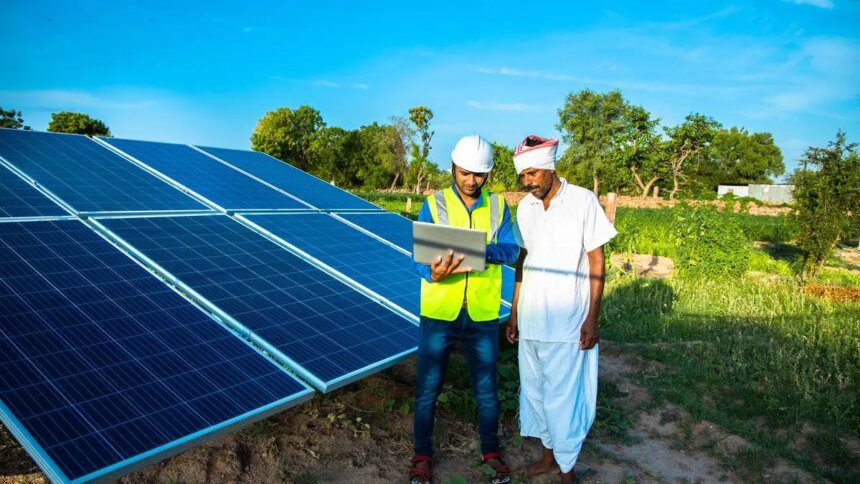

The scheme aims to add 34,800 MW of solar capacity by March 2026. | Photo Credit: Getty Images
An analysis put out last year by the Centre for Science and Environment (CSE) points out that the Pradhan Mantri Kissan Urja Evam Utthaan Mahabhiyaan (PM-KUSUM) scheme has only achieved about 30 per cent of its overall targets since inception.
According to replies given to a question in the Lok Sabha in August this year, as on 30 June, it is estimated that the installation of solar pumps has saved 580 million litres of diesel per annum and solar plants under PM-KUSUM have helped cut out 6 million tonnes of carbon dioxide emissions.
The scheme is structured around three main components: A (decentralised solar power plants), B (standalone solar pumps), and C (solarisation of grid-connected pumps). The highest achievement (71 per cent) against targets set has been under Component B, which covers standalone solar pump sets up to 7.5 HP.
Replacing diesel pumps with solar variants is straightforward, says Vivek Gupta, director, Oswal Pumps. “The technology is proven, deployment involves fewer regulatory hurdles, and generous subsidies are available.” Central financial assistance covers 30 per cent of the benchmark cost (or 50 per cent in special category States), allowing the farmer to contribute a manageable remaining portion.
Conditions applied
The CSE report points out that farmers who have moved from diesel or electric pumps to solar-powered pumps have found it profitable, but only if the pumps they have installed are of the correct size. Farmers in Haryana, according to the report, are saving up to ₹55,000 per year after making the shift. The other benefit for the farmer is the ability to irrigate fields during the day, instead of having to rely on power from the grid during the night in the time slot set apart for agricultural electricity supply.
The pace of solar pump installations contrasts with the slower uptake in the other major components, which are facing bottlenecks.
Component A, focused on setting up decentralised grid-connected solar or renewable energy plants (up to 2 MW) on farmers’ land, has achieved only 6.5 per cent of its target as of September 2025. This segment has been hampered by the need for significant capital expenditure. Other bottlenecks include securing land, challenging discom agreements, and time-consuming regulatory approvals.
Component C, which supports the solarisation of existing grid-connected pumps, is currently at 16.5 per cent penetration. Progress, on this front, has been dragged down by the local energy context, says Oswal’s Gupta. “Many areas have access to nearly zero running-cost grid connections, which dilutes the need to adopt solar solutions.”
He views the overall scheme as a valuable learning rather than a failure. “The variation in adoption across components reflects the differing complexity, economics, and farmer readiness rather than flaws in the scheme itself. Component B demonstrates that when incentives, simplicity, and execution converge, adoption can be rapid.”
The slower uptake in Components A, C, and D highlights areas where structural, regulatory, and awareness interventions are still needed. The scheme’s current performance validates what works and where focused efforts are needed in the final year to reach targets.”
Customised approach
The CSE report offers a roadmap to quicken implementation. It recommends that cheap electricity, while appreciated by farmers, diminishes the incentive to transition to solar and increases the State’s subsidy burden. Further inefficiencies arise from pump sizing. The report cites Dr Debajit Palit, Professor of Energy at the NTPC School of Business, as saying that to ensure financial viability, pump sizes must be tailored to the land size and water requirements of different areas, rather than maintaining a uniform national standard.
The CSE also recommends decentralised implementation. Agencies with knowledge of farmer demographics and their needs on the ground are best placed to cater to them, rather than a centralised body.
To address viability issues, the report states, farmers must be allowed the option to pay upfront costs in instalments, and seeks an increase in the Central Financial Assistance to account for the rise in solar module prices following the Covid-19 pandemic.
The Standing Committee on Energy, in its second report on demand for grants for FY25, had highlighted the fact that many districts in India have become water-deficient. Hence, the subsidy for solar pumps of only up to 7.5 HP (horsepower) proved insufficient for farmers. It had recommended that the Ministry conduct a detailed study to “understand the ground situation and accordingly modify the component.”
Published on October 13, 2025