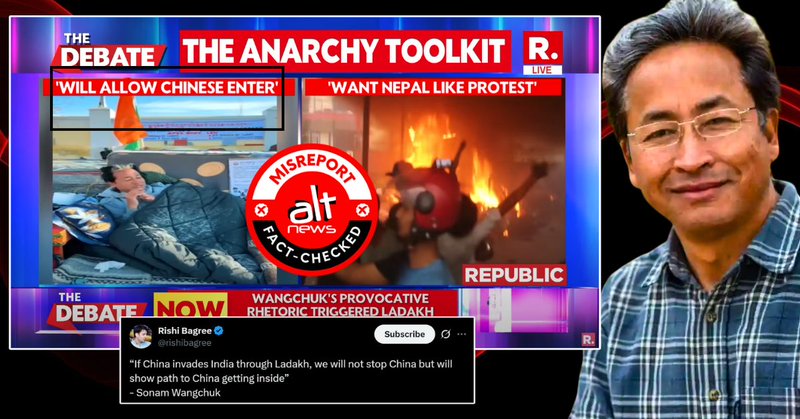

False Claims Surrounding Sonam Wangchuk’s Statements
A controversial claim has surfaced from BJP IT cell member Rishi Bagree, alleging that activist Sonam Wangchuk stated he would assist China in invading India. This assertion is part of a misleading narrative fueled by a clipped video that misrepresents Wangchuk’s actual words. The claim has been previously circulated in 2025, underscoring ongoing attempts at misinformation.
Background on Sonam Wangchuk
Sonam Wangchuk is a renowned environmental activist and engineer, known for his advocacy for sustainable development in Ladakh. He gained international recognition for his contributions to education and environmental sustainability, particularly in the Himalayan region. His efforts have emphasized the importance of preserving local culture and ecology against rapid industrialization and climate change.
The recent misinformation campaign seems to have arisen in the aftermath of riots in Leh. On September 24, violent confrontations occurred, leading to significant unrest in the region. The dissemination of Bagree’s misleading claim, suggesting Wangchuk’s alleged support for Chinese incursions, comes amid heightened tensions between India and China, particularly concerning disputed territories in Ladakh.
The Context of the Viral Video
The video in question was shared widely on social media platforms, purportedly showing Wangchuk making inflammatory remarks during a fast he undertook, which was intended to draw attention to critical societal issues in Ladakh. However, fact-checking organizations have determined that the video was heavily edited, stripping it of crucial context, which significantly alters its meaning.
Furthermore, Wangchuk’s actual comments were focused on addressing local issues rather than signaling support for any foreign military action. The misrepresentation in the video, highlighted by Bagree and shared across various channels, fuels mistrust and can exacerbate tensions in an already fraught geopolitical climate.
Political Repercussions and Misinformation
The propagation of such misleading statements can have serious political implications in India. Media narratives play a key role in shaping public opinion and can influence electoral dynamics. With elections on the horizon, misinformation campaigns can sway voter perceptions and distract from critical issues affecting citizens.
Moreover, the dissemination of false claims about figures like Wangchuk can undermine genuine activism and make it challenging for voters to discern truth from propaganda. This highlights the need for improved media literacy among the public and the importance of fact-checking to combat the effects of misinformation in political discourse.
Why This Matters
In the Indian political landscape, misinformation can be weaponized to discredit voices advocating for change or critique government policies. The ongoing tensions with China add urgency to the need for clear communication and factual reporting. Misinformation not only misrepresents individuals like Wangchuk but also threatens to escalate regional tensions by inciting fear and anger within communities.
For Indian readers, understanding the motivations behind such disinformation campaigns is crucial. It serves as a reminder to critically evaluate information sources, particularly in an age where social media can amplify disinformation rapidly. As India approaches elections, a well-informed electorate will be essential for maintaining a robust democracy.
Frequently Asked Questions
What are the main allegations against Sonam Wangchuk?
The primary allegation is that he stated he would help China invade India, a claim sparked by a misleading video edit shared by Rishi Bagree.
What is the significance of the viral video?
The video lacks context and has been heavily edited, leading to misinterpretations of Wangchuk’s actual statements during a protest and fast meant to address local issues in Ladakh.
Why does misinformation spread so quickly on social media?
Misinformation can spread quickly because of the viral nature of social media, where sensational or inflammatory claims garner attention and shares, often outpacing accurate information.
What should readers do when encountering such claims?
Readers should fact-check claims through reliable news sources and question the context and motivations behind sensational statements, especially regarding sensitive geopolitical issues.