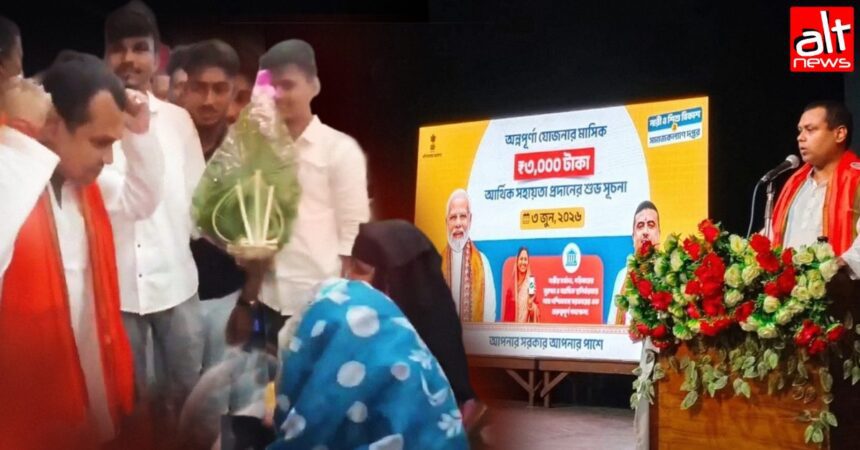

A recent incident highlighting societal tensions in India involves Koustav Bagchi, a BJP MLA from Barrackpore, who was seen pressuring a Muslim woman to chant nationalist slogans during the inaugural ceremony for the Annapurna Yojna, a women’s welfare scheme. This event has sparked widespread criticism, raising concerns over the treatment of marginalized communities in India under the current political climate.
Public Pressure and Coercion
The incident took place on June 3, 2026, during the launch of the BJP’s Annapurna Yojna in Sukanta Sadan, Barrackpore. Video footage shows Bagchi interacting with a Muslim woman in the audience, questioning her fidelity to the nation and demanding her compliance with slogans such as “Bharat Mata ki Jai” and “Vande Mataram.” Despite her discomfort, the woman eventually complied under significant pressure, indicating a troubling dynamic between political representatives and common citizens.
Bagchi’s remarks, such as “The BJP is not driving you out of the country, is it?” and “We are Indians. We have to behave like one,” further exemplify the implicit challenges faced by minority communities in asserting their identity while engaging with state-run welfare programs. For the woman and others like her, expressing dissent or hesitation could result in exclusion from crucial welfare benefits, creating an uncomfortable blend of welfare dependency and ideological compliance.
Implications for Minority Rights
This incident underscores a more profound issue regarding the representation and rights of Muslims in India, especially regarding access to government schemes and public services. The narrative pushed by Bagchi implies that nationalism and party loyalty are prerequisites for political and economic inclusion, marginalizing those who do not conform to these expectations. Such occurrences are not isolated but resonate with broader societal patterns that question the loyalty and patriotism of Muslims in India.
The case raises essential questions about whether benefits linked to state programs are contingent upon adherence to a specific ideological framework. By framing Muslim identity as something that must be continuously validated through public displays of allegiance, the ruling party perpetuates a cycle of marginalization that extends beyond individual incidents to affect community relations and social harmony.
A Shift in Welfare Dynamics
The launch of the Annapurna Yojna is significant as it replaces the previous Lakshmir Bhandar scheme, which was initiated by the former ruling party, the TMC. Under the Lakshmir Bhandar, women received financial assistance ranging from Rs 1500 to Rs 1800 per month. In contrast, the Annapurna Yojna offers Rs 3000 per month, but comes with the expectations of conformity that have sparked public backlash.
This transition reflects a strategic effort by the BJP to reshape welfare narratives while embedding political loyalty into the very fabric of state assistance. The shift raises concerns regarding the sustainability of welfare measures in a politically charged context, as beneficiaries might increasingly feel pressured to demonstrate ideological commitment to receive support.
Why It Matters
This episode serves as a critical reflection on the evolving relationship between governance and societal inclusion in India. For the global audience, it elucidates the challenges facing marginalized communities amidst rising populism and nationalism. Understanding these dynamics is essential for comprehending how political movements can shape governmental policies and their implementation, especially in contexts marked by ethnic and religious diversity.
Frequently Asked Questions
What incident involving Koustav Bagchi went viral?
Koustav Bagchi was recorded pressuring a Muslim woman to chant nationalist slogans during the launch of the Annapurna Yojna, highlighting significant societal and political tensions in India.
What is the Annapurna Yojna?
The Annapurna Yojna is a welfare scheme initiated by the BJP in West Bengal aimed at providing financial assistance of Rs 3000 per month to women aged 25 to 60, replacing the previous Lakshmir Bhandar scheme.
Why is this incident significant for minority rights?
The incident exemplifies the increasing pressures faced by marginalized groups in India to conform to specific ideological narratives in exchange for access to welfare benefits, raising broader questions about minority rights and inclusivity.
What are the implications for public welfare in India?
As political loyalty becomes intertwined with welfare access, marginalized communities may find themselves in a precarious position, risking exclusion if they do not publicly affirm their allegiance to the ruling party’s ideology.