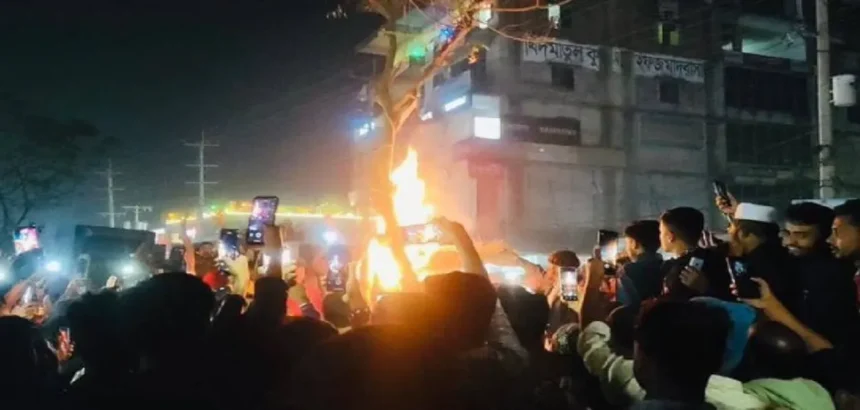

The brutal killing of a Hindu youth in Bangladesh has sparked significant outrage on social media, particularly among Indian Muslims, who are condemning the violence as a violation of human rights and the rule of law. This tragic incident has not only raised concerns for minority safety in Bangladesh but has also ignited discussions about religious extremism and mob violence across South Asia.
The Incident That Shocked a Nation
Reports emerging from Bangladesh detail the gruesome killing of a young Hindu man, identified as Dipu Chandra Das. Alleged to have made remarks that angered a segment of the population, he was reportedly assaulted by a mob, critically injured, and later executed by being set ablaze after being hung from a tree. The Taliban-like brutality of the incident has caused ripples of shock, not just within Bangladesh, but also across its border in India, where many express solidarity with the victim.
Voices of Condemnation from India
In India, social media has been flooded with statements and videos from Muslim youths, influencers, and scholars vehemently condemning the horrific incident. Figures like Mumtaz Sheikh have emerged as prominent voices against such acts, urging for accountability and denouncing mob violence. Sheikh stated, “There is no law in your country right now, only mob rule,” emphasizing that no religious scripture permits such brutality.
Numerous other activists have echoed Sheikh’s sentiments, noting that remaining silent amid such acts constitutes complicity. They are using platforms like Facebook to reach a wider audience, imploring viewers to share their messages to create pressure for justice and action against the perpetrators. Owais Ahmed Qasmi and Afser Raza Markazi are among others who explicitly called for robust action from the Bangladeshi government and highlighted the universal principle that targeting minorities is unacceptable.
Implications for Minority Rights and Tensions in South Asia
The killing of Dipu Chandra Das has unveiled longstanding tensions regarding religious extremism and minority rights in Bangladesh and resonates with broader concerns within South Asia about the treatment of minorities. In India, while minorities often face their own challenges, incidents like the one in Bangladesh evoke strong emotional responses from the Muslim community, leading them to draw parallels with injustices faced by Muslims in their own country.
As these discussions unfold, they highlight a crucial dimension of the social fabric of both countries, where inter-religious dialogue and respect for minority rights are increasingly vital. Observers note that there is a growing trend of Indian Muslims openly condemning religious extremism and violence, pointing toward a developing cross-border conversation that seeks to uphold the tenets of humanity over religious divides.
Why It Matters
The incident and the reactions to it represent a critical moment for discussions around religious extremism, minority rights, and social justice in South Asia. In an era where information spreads rapidly through social media, the condemnation from Indian Muslims serves as a reminder that communal tensions can have ripple effects across borders. This calls for focused international attention on the protection of minorities and the importance of rule of law in maintaining societal harmony. Such events can also influence diplomatic relations and socio-economic ties between India and Bangladesh.
Frequently Asked Questions
What led to the killing of Dipu Chandra Das?
The killing was reportedly sparked by allegations that Das made comments that offended a segment of the Bangladeshi population, leading to mob violence against him.
How have Indian Muslims reacted to this incident?
Indian Muslims have utilized social media platforms to condemn the violence, with various influencers and scholars openly calling it a crime against humanity and urging for justice.
What actions have been promised by the Bangladeshi government?
The Bangladeshi government has expressed intentions to take strict action against the perpetrators of the violence, and some arrests have reportedly already taken place.
Why is this incident significant for minority rights in South Asia?
The incident highlights ongoing issues related to religious extremism and violence against minorities, which are critical topics in South Asia, necessitating a reassessment of societal attitudes and policies towards communal harmony and justice.