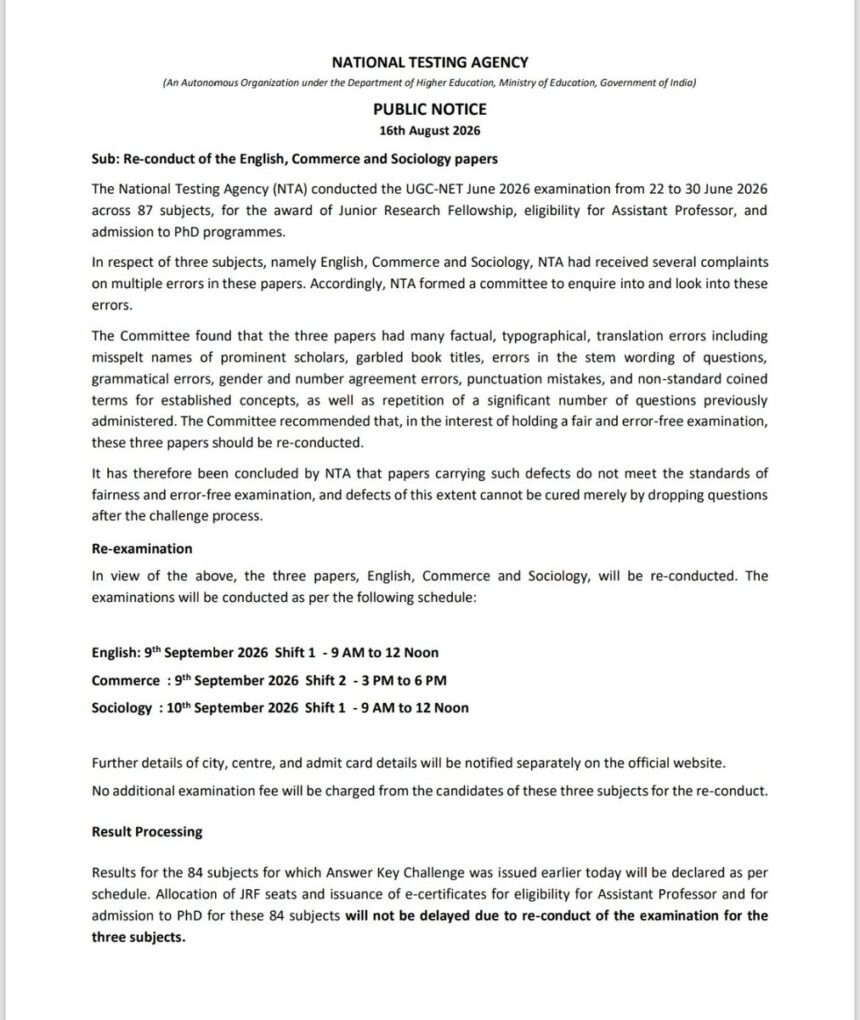

The National Testing Agency (NTA) has announced a re-examination for subjects found to have multiple errors during the UGC-NET June 2026. This decision raises important questions about the cost implications for the government and how taxpayer money is being utilized, especially in light of criticisms regarding the NTA’s competence.
Understanding the Role of NTA
The National Testing Agency was established to conduct efficient, transparent, and international standard examinations in India. By handling assessments like NEET and UGC-NET, the NTA aims to reduce the burden on educational institutions and promote fairness in the selection process. However, it faces scrutiny every time discrepancies arise in the exam papers, leading to re-examinations.
Cost Implications of Re-Exams
Conducting a re-examination incurs significant costs, which include arranging venues, hiring personnel, printing new question papers, and managing the logistics of scheduling and supervision. While the NTA does not charge candidates for re-examinations, the expenditures ultimately fall on the government and, by extension, the taxpayers. Specific figures about the total costs are often not disclosed, but estimates suggest that re-examinations could run into lakhs of rupees. These costs, when not accounted for properly, lead to a growing concern about efficient resource allocation.
Taxpayer Concerns and Accountability
Taxpayers are increasingly questioning the efficiency of the NTA after it has faced multiple complaints regarding examination errors. Citizens expect their taxes to fund competent governance and operational capabilities. The recurring errors in high-stakes examinations like UGC-NET and NEET, which impact thousands of candidates, spotlight the need for accountability within the agency. With every re-exam mandated due to incompetence, the burden on the national exchequer increases, complicating the dialogue around educational funding and governmental fiscal responsibility.
Why This Matters
The implications of the NTA’s operational challenges extend beyond mere financial concerns; they raise fundamental questions about the integrity of India’s educational selection processes. A significant lapse in an examination’s execution can lead to a loss of trust in the systems governing education, which is crucial for the development of the country’s human capital. Political leaders and policymakers need to address these setbacks to ensure that public confidence is not eroded, thereby safeguarding the future of India’s youth.
Frequently Asked Questions
What is the NTA?
The National Testing Agency is an autonomous organization established by the Ministry of Education to conduct entrance examinations for various educational institutions across India.
Why are re-examinations conducted?
Re-examinations are conducted when significant errors are found in examination papers that could compromise the fairness of the assessment process.
Do candidates have to pay for re-examinations?
No, candidates affected by the need for re-examinations are not required to pay any additional fees.
How do re-examinations affect taxpayers?
Re-examinations place a financial burden on the government, meaning that taxpayer money is utilized to cover the costs associated with organizing these tests, raising concerns about efficiency and accountability in public spending.