
Conflict Over Hindu-Muslim Unity: A Political Critique
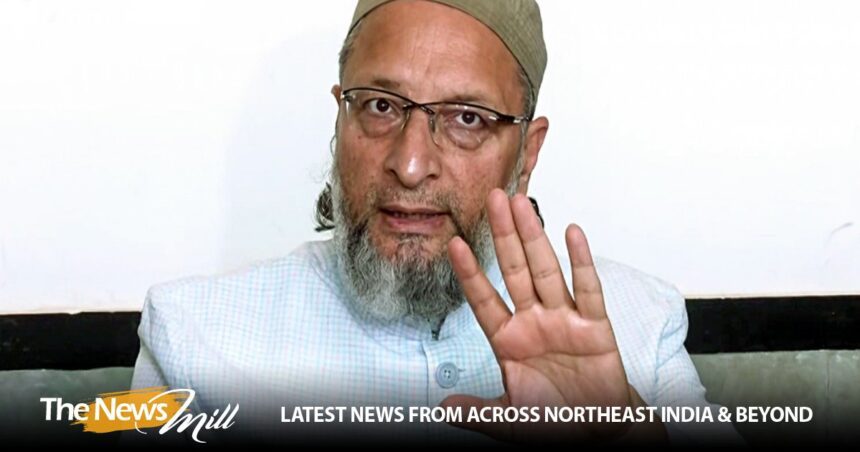
Asaduddin Owaisi, the President of the All India Majlis-e-Ittehadul Muslimeen (AIMIM), has strongly criticized the comments made by Rashtriya Swayamsevak Sangh (RSS) chief Mohan Bhagwat regarding Hindu-Muslim unity. Owaisi contends that the RSS is skillful in presenting a misleading image to an international audience, while its foundational thinkers hold views that are detrimental to minority communities in India.
Owaisi’s Rebuttal to Bhagwat’s Assertions
During an event titled ‘One World One Humanity’ in New York on August 29, Bhagwat stated, “If any Hindu thinks that there should be no Muslim in Bharat, he will not remain Hindu,” advocating for human unity and dignity. In response, Owaisi used social media to accuse Bhagwat of utilizing familiar tactics: stating one thing for the public while maintaining a different narrative internally. He remarked, “This is the oldest trick in the RSS playbook: some words are for the world, and some are for its own members.”
Owaisi emphasized that the RSS has not disavowed its historical thinkers, who have expressed views about Muslims and other minorities that can be interpreted as exclusionary. He pointed out that Bhagwat’s remarks are not reflective of the organization’s original ideologies, which often oppose inclusive narratives.
Historical Context and Modern-Day Implications
Owaisi further questioned the RSS’s dedication to integrity during India’s freedom struggle, claiming that the RSS founder, Keshav Baliram Hedgewar, separated from the Indian National Congress due to his opposition to inclusive participation in the anti-British movement led by Mahatma Gandhi. Citing an RSS-published biography of Hedgewar, Owaisi noted that Hedgewar expressed doubt about the efficacy of Hindu-Muslim unity, indicating a long-standing ambivalence within the organization regarding inclusivity.
Additionally, Owaisi invoked the writings of former RSS chief M.S. Golwalkar, who has articulated a vision of nationalism that emphasizes a singular ideology, defined as “one flag [saffron], one leader and one ideology.” This has significant implications, as it raises questions about the RSS’s commitment to democratic values and the treatment of minorities within its framework.
Allegations of Discrimination and Marginalization
In light of the 2002 Gujarat riots, Owaisi criticized the RSS and its affiliates for their alleged role during the violence, stating, “Should we forget what happened to the Muslims of Gujarat under the RSS’s proxy rule?” He described horrific acts of violence inflicted upon Muslims, including gang rapes and arsons, while accusing police forces of inaction. Such historical events continue to resonate in contemporary discussions among marginalized Indian Muslim communities.
Owaisi also cited Golwalkar’s writings as evidence that the RSS considers Indian Muslims—a significant portion of the population—as potential threats. He pointed out that Golwalkar placed Muslims under “perpetual suspicion” and asserted that Christians aimed to disrupt societal harmony. These assertions, according to Owaisi, legitimize policies that discriminate against these communities, particularly through proposed laws, such as the Uniform Civil Code, aimed at aligning Muslim civil rights with Hindu laws, and stringent anti-conversion regulations affecting Christians.
Why It Matters
The ongoing discourse surrounding RSS’s ideology highlights significant societal divisions in India, particularly concerning how minorities are perceived and treated. Awareness of these issues has implications for social cohesion and the country’s democratic fabric. Moreover, international observers and policymakers need to understand these dynamics when engaging with India on matters of human rights, social policy, and inter-community relations. The tensions surrounding Hindu-Muslim relations can have a profound impact on India’s global standing and its domestic stability.
Frequently Asked Questions
What are the primary concerns regarding the RSS’s treatment of minorities?
Critics, including Owaisi, claim the RSS perpetuates narratives that marginalize Muslims and Christians, portraying them as threats to national integrity and social order, which can lead to discriminatory policies against these communities.
What role did the RSS play during India’s independence movement?
Owaisi argues that the RSS did not participate actively in the freedom struggle and opposed inclusive efforts for Hindu-Muslim unity, with its founder expressing skepticism about such collaboration.
How do RSS ideologies influence current policies in India?
The RSS’s ideologies are thought to shape legal frameworks such as the Uniform Civil Code, which seeks to standardize personal laws across religions, potentially impacting the rights of Muslim citizens.
What historical events are referenced to highlight the RSS’s treatment of Muslims?
The 2002 Gujarat riots are frequently cited as a pivotal moment where the RSS’s actions were seen as marginalizing Muslims, with allegations of state inaction during widespread violence against the community.