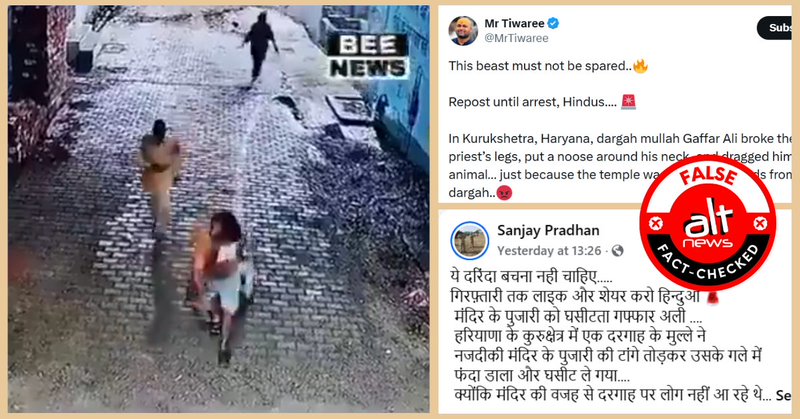

A recent incident in Kurukshetra, Haryana, has sparked significant controversy after a viral video depicted a man allegedly attacking a temple priest. Contrary to widespread claims, the assailants, identified as Pankaj Saini and his wife Manpreet, are Hindus, not Muslims, a fact confirmed by local police. This revelation challenges the narrative circulating online and highlights the complexities surrounding religious and communal tensions in India.
Context of the Incident
The incident unfolded in Adhoni village of Kurukshetra, where CCTV footage captured an alarming scene of one individual dragging another by a rope tied around his neck. Initially, the video was shared widely, accompanied by claims that it depicted a Muslim man assaulting a Hindu priest. This framing quickly ignited communal tensions, as it was interpreted through a religious lens that often exacerbates divisions within Indian society.
The police investigation, however, revealed that the accused are Pankaj Saini and his wife Manpreet, both of whom are Hindus. The clarification from law enforcement officials came as a response to public outrage and the rampant spread of misinformation through social media. This incident is part of a broader narrative in India, where communal identity often shapes the perception of criminal acts, making the religious background of individuals involved a focal point of media coverage and public reaction.
Role of Social Media in Shaping Narratives
The rapid dissemination of information via social media platforms has a profound impact on communal relations in India. Videos, images, and claims can go viral within hours, often before any factual verification occurs. In this case, the viral video contributed to a knee-jerk reaction, leading to calls for justice based on inaccurate representations of the events.
Communal narratives can quickly spiral out of control, resulting in real-world consequences such as violence, retaliatory attacks, and societal unrest. The incorrect labeling of the accused as Muslims not only misrepresented the situation but also posed a serious risk of inflaming communal tensions further. This incident underscores the urgent need for both social media users and journalists to verify information rigorously before sharing or reporting it.
The Broader Implications of Misinformation
The misidentification of the accused highlights a troubling trend in Indian society, where misinformation can have far-reaching consequences. Cases like this can lead to communal violence, deteriorate trust between communities, and contribute to an ongoing cycle of fear and suspicion. The potential for such incidents to escalate is heightened in a country that is already grappling with deep-seated issues of religious identity and political polarization.
This episode is also emblematic of a wider struggle for truth in the information age, where narratives are often shaped by identities rather than facts. The repercussions of misinformation are not merely theoretical; they have real implications for people’s lives, safety, and communal harmony in India.
Why This Matters
This incident holds significant political implications for India, a nation diverse in its religious and cultural practices. The incorrect characterization of the assailants can fuel communal polarization, which political actors often leverage for their gain. As the country approaches elections, the role of narratives shaped by misinformation becomes all the more critical.
The incident also underscores the responsibility of media platforms in managing the spread of misinformation. In an era where religious discord can quickly escalate into violence, it is essential for both traditional and social media to strive for accuracy and accountability in reporting. The trust deficit between communities can only be mitigated through diligent fact-checking and responsible journalism.
Frequently Asked Questions
Who are the accused in the Kurukshetra incident?
The accused are Pankaj Saini and Manpreet, both of whom are Hindus, contrary to initial claims suggesting that a Muslim man was involved.
What does the viral video depict?
The viral video shows an individual being dragged by a rope around his neck, leading to claims regarding the nature of the assault which turned out to be mischaracterized.
Why is the accurate identification of the accused important?
Accurate identification is crucial as it helps to prevent communal tensions from escalating and promotes a more truthful narrative surrounding events that can otherwise lead to violence.
What steps can be taken to combat misinformation?
To combat misinformation, it’s vital for media outlets and users on social media platforms to verify claims rigorously before sharing them. Initiatives centered on media literacy can also help the public discern fact from fiction.