
Escalating Anti-Muslim Sentiment in India: A Case Study of the Lynching of Nazir Ahmad
A recent verdict by a Madhya Pradesh court has highlighted ongoing issues of discrimination and marginalization affecting Muslims in India. Fourteen men were sentenced to life imprisonment for the lynching of Nazir Ahmad, a victim of cow vigilantism. As a direct consequence of this ruling, the presiding judge has faced a wave of online harassment linked to her religious identity, reflecting a broader pattern of hate and communal division under the current political environment.
The Lynching Incident: A Violent Confrontation
On August 2, 2022, Nazir Ahmad and two companions were transporting cows for sale to a cattle fair in Maharashtra when they were intercepted by approximately 50-60 cow vigilantes in Madhya Pradesh. The mob brutally assaulted the three men with sticks and iron rods. While Ahmad was taken to the hospital, he succumbed to his injuries after sustained trauma, including a fractured skull and multiple lacerations. Evidence gathered by police indicated that the cows were not intended for slaughter, countering the vigilantes’ justification for the attack.
The Aftermath: Threats and Hate Speech against the Judiciary
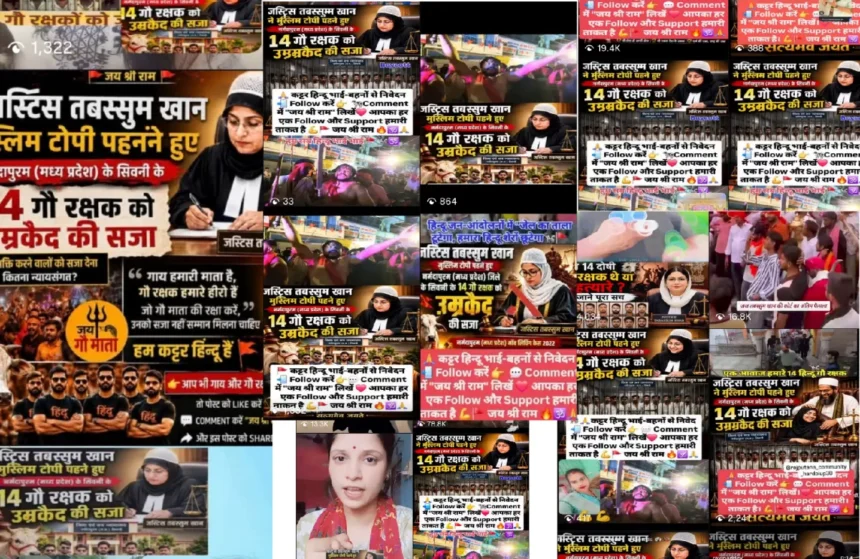
Following the conviction, Judge Tabassum Khan became the target of online abuse and threats. One viral clip featured an individual making explicit threats against her, suggesting mass violence if their imprisoned ‘brothers’ were not released soon. The discourse surrounding the case shifted predominantly towards the judge’s identity rather than the facts of the ruling, reinforcing a victim narrative promoted by certain Hindutva influencers. Posts circulating on social media placed her Muslim identity at the forefront, framing the verdict as a communal conspiracy rather than a legal decision based on the merits of the case.
Organized Response: Beyond Digital Walls
The online mockery and threats against Judge Khan quickly transitioned into organized protests across India, demonstrating how digital narratives can drive real-world action. Demonstrators rallied for the release of the convicted individuals, signaling a trend where online hate morphs into physical mobilization. Effigies of Judge Khan were burned, and banners demanding the overturning of the conviction were displayed. Influencers within the Hindutva community sought to rally support, framing the sentencing as an existential threat to Hindu values and cow protection efforts.
Why It Matters
The targeting of Judge Tabassum Khan and the broader communal narrative emerging from the lynching case underscores a troubling trend in India where legal judgments are increasingly reframed through a religious lens. This phenomenon not only risks deepening societal divisions but also undermines public trust in judicial institutions. In an environment where decisions rooted in the rule of law are questioned based on identity politics, the separation of judiciary and religion becomes increasingly tenuous, with potential implications for governance and civil rights in the country.
Frequently Asked Questions
What happened in the lynching case of Nazir Ahmad?
On August 2, 2022, Nazir Ahmad and two others were assaulted by cow vigilantes in Madhya Pradesh while transporting cows for sale. Ahmad later died from his injuries, leading to the conviction of 14 men who received life sentences.
What was the reaction to the court’s verdict?
The sentencing of the attackers led to widespread online abuse directed at Judge Tabassum Khan, including threats related to her religious identity. This sparked a wave of protests demanding the release of the convicted men.
How did social media influence the protests?
Social media played a significant role in shaping the narrative surrounding the case, amplifying communal sentiments and encouraging organized offline protests. Influencers promoted a victim narrative targeting the judge’s identity, framing the judicial decision as part of a broader community struggle.
What are the implications of this case for communal relations in India?
This case exemplifies the ongoing tensions between communities in India, where legal judgments can evoke intense communal responses. It raises concerns about the erosion of judicial independence and the potential for increased communal polarization in society.