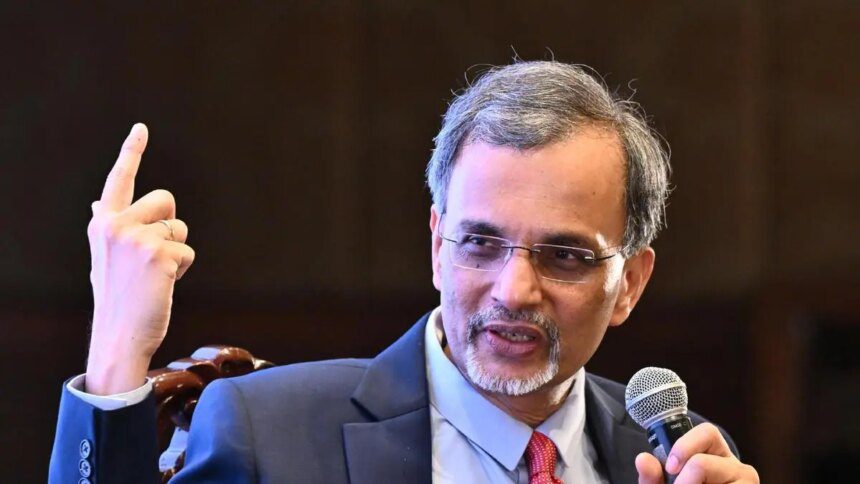

The Indian rupee’s recent fluctuations should be seen as a necessary adjustment within a complex global economic landscape, according to Chief Economic Adviser V Anantha Nageswaran. He emphasized that these movements should not be misconstrued as mere signs of weakness but rather viewed as mechanisms to absorb shocks from external pressures.
Understanding Currency Depreciation
Nageswaran characterized currency depreciation as an adaptive response to various macroeconomic factors including global uncertainty, energy price hikes, and geopolitical tensions. The Chief Economic Adviser argued that fixed currency thresholds, like the psychological 100-per-dollar mark, can cloud judgment. Instead, he suggested that a flexible exchange rate is vital for maintaining economic stability.
He stated, “The exchange rate is a natural shock absorber,” underlining the importance of allowing currency variations to occur without rigid interventions. Historical precedents show that undue defense of a specific currency level can hinder broader economic growth. During times of global financial stress, policymakers often face a difficult balancing act: maintaining currency strength versus fostering domestic economic conditions.
Impact on India’s Economy
Nageswaran pointed out that the dynamics of the rupee’s value interconnectedly relate to India’s import structure. Although a weaker rupee can heighten costs for essential imports, including crude oil, it also positions domestic producers more competitively in the export market. This dual effect can encourage local production while simultaneously addressing trade deficits.
With India’s ongoing focus on strengthening foreign exchange reserves, these currency movements take on an additional layer of significance. The government aims to create sustainable buffers rather than stifle short-term fluctuations. The approach may help curb excessive hedging behavior, which can lead to decreased capital inflows and delayed exporting, thus maintaining economic confidence.
Global Context and Policy Framework
Nageswaran articulated that India’s foreign exchange policy is designed to absorb shocks while promoting economic growth. He discussed how the interplay between capital flows and global market forces necessitates an adaptable exchange rate framework. “It is not about a particular number,” he clarified, emphasizing that the rupee’s trajectory is more descriptive of global trends than domestic fragility.
This perspective aligns with global economic patterns, where countries often see currency valuations adjust in response to external shocks. Moreover, Nageswaran advocated for a comprehensive assessment of risks rather than a singular focus on currency value thresholds, highlighting the importance of overall economic health.
What This Means
The insights provided by Nageswaran are critical for Indian businesses and investors alike. Recognizing that currency depreciation is not synonymous with economic weakness may encourage a more balanced approach to risk management. Companies reliant on imports could reconsider their pricing strategies, while exporters might find renewed opportunities in international markets due to improved competitiveness.
Government policies that reinforce foreign exchange reserves can offer added layers of security against future volatility. This strategic focus on adaptability may serve as a crucial fallback as global economic conditions continue to shift rapidly.
Frequently Asked Questions
Why is the rupee depreciating?
The rupee’s depreciation is largely due to external factors such as global economic uncertainty, rising energy prices, and shifting capital flows, rather than domestic economic weaknesses.
Should the government intervene to stabilize the rupee?
While some may advocate for intervention, Nageswaran suggests that allowing the rupee to adjust naturally may be more beneficial for long-term economic stability.
How does a weaker rupee affect imports and exports?
A weaker rupee can increase the cost of essential imports but may also enhance the competitiveness of Indian exports, potentially leading to increased market shares abroad.
What measures is the government taking to manage currency fluctuations?
The Indian government is focusing on strengthening foreign exchange reserves and managing the current account deficit, providing buffers against currency volatility and economic shocks.