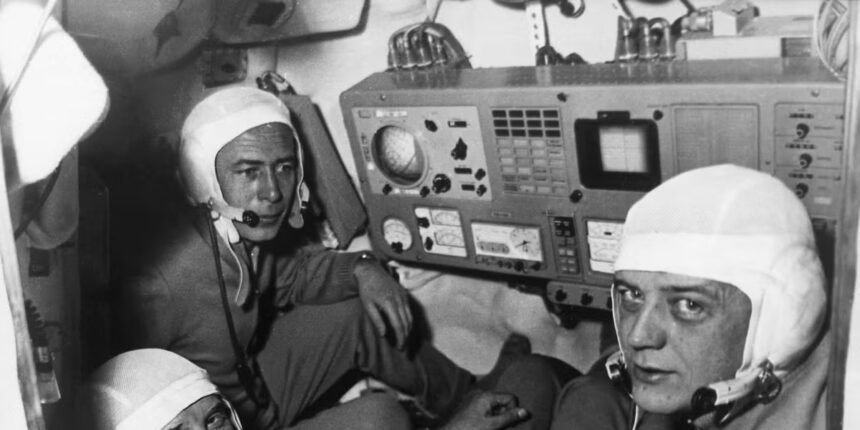

The tragic events surrounding the Soyuz 11 mission, which resulted in the first and only fatalities in space, resonate with the spirit of cooperation in the global space community. This incident not only marked a significant moment in the history of space exploration but also served as a turning point, prompting international collaboration between former Cold War rivals, particularly highlighted in the Apollo-Soyuz Test Project in 1975.
A Dark Chapter in Space Exploration
On June 30, 1971, Soviet cosmonauts Georgi Dobrovolsky, Vladislav Volkov, and Viktor Patsayev embarked on what would be a groundbreaking mission aboard Soyuz 11. Their objective was to dock with Salyut 1, the world’s first space station. The crew’s journey marked numerous achievements, including conducting essential experiments and accumulating valuable data about long-duration space travel.
However, upon reentry, a malfunction occurred when a faulty ventilation valve depressurized their capsule. Tragically, the crew was not equipped with pressurized suits, as was common practice at the time. They lost consciousness within 40 seconds, becoming the first and only men to die in space. This shocking event led to a reevaluation of safety protocols in manned space missions.
International Response and Cooperation
The aftermath of the Soyuz 11 tragedy led to an unexpected wave of mutual grief between the United States and the Soviet Union. President Richard Nixon expressed condolences and sent NASA’s Chief Astronaut, Tom Stafford, to attend the funeral, where he was honored to be one of the pallbearers. Nixon remarked, “The whole world followed the exploits of these courageous explorers of the unknown, and shares the anguish of their tragedy.”
This show of solidarity embodied a shift in the narrative of the Space Race. Rather than competing for dominance, countries began to realize the importance of cooperation in future space endeavors. This sentiment culminated in the Apollo-Soyuz Test Project in 1975, which saw American and Soviet spacecraft dock in orbit, symbolizing a newfound collaboration in space exploration.
Lessons Learned and Forward Thinking
The Soyuz 11 mission was not without its lessons. One of the crew members, Valeri Kubasov, was originally slated to fly but was replaced due to a health concern that was later diagnosed as a minor pesticide allergy. This pre-mission medical examination inadvertently saved his life, highlighting the importance of rigorous health protocols in spaceflight. The tragedy prompted both nations to enhance their focus on astronaut safety and equipment reliability.
The legacy of the Soyuz 11 crew serves as a reminder of the fragility of human life in the harsh realm of space and emphasizes the need for continuous improvement in technology and safety systems to ensure the well-being of astronauts. Their sacrifice paved the way for safer and more successful missions in the future.
Why This Is Trending
The resurgence of interest in the Soyuz 11 tragedy is partially driven by a global revival of interest in space exploration. Countries like India are making significant strides in their space programs, leading to renewed conversations about past missions, safety protocols, and international cooperation in space science. Additionally, as India celebrates milestones in its own space endeavors, discussions surrounding historical events that shaped current practices foster a greater understanding of the field.
Frequently Asked Questions
What happened during the Soyuz 11 mission?
The Soyuz 11 mission aimed to dock with Salyut 1, but tragically, the crew died during reentry due to a depressurization incident, making them the only men to die in space.
How did the international community respond to the Soyuz 11 tragedy?
The tragedy prompted expressions of grief and solidarity worldwide, notably from the U.S. government, which sent representatives to the funeral of the cosmonauts.
What safety lessons were learned from Soyuz 11?
The Soyuz 11 incident revealed the need for improved safety measures, including the provision of pressurized suits for astronauts during reentry stages.
How did this event affect future space missions?
The Soyuz 11 tragedy led to increased international cooperation in space exploration, culminating in projects like the Apollo-Soyuz Test Project, emphasizing collaboration over competition.