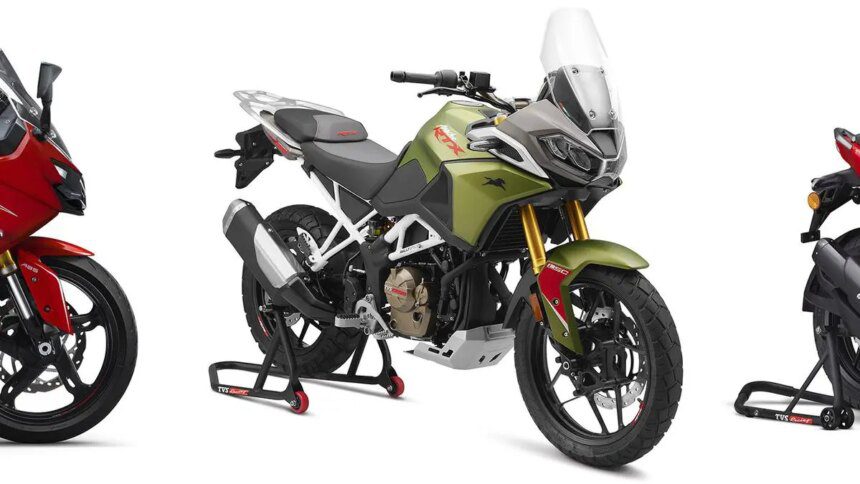

The global hierarchy of two-wheeler manufacturers experienced a significant change in 2025, with TVS Motor Company surpassing Yamaha to become the third-largest manufacturer by volume. This milestone reflects a notable achievement for India’s automotive sector but also highlights a structural gap as Indian manufacturers collectively lag behind their Japanese competitors by over 10 million units each year.
Honda leads with over 20 million units sold worldwide, while Yamaha and Suzuki together exceed the combined sales of India’s top three manufacturers—Hero MotoCorp, TVS Motor, and Bajaj Auto. In the domestic market, TVS faces the challenge of competing against Hero and Honda, where it has a smaller market share.
The gap, however, is beginning to close. TVS Motor’s growth strategy focuses on outpacing the industry’s overall growth. Managing Director KN Radhakrishnan expressed confidence during a recent earnings call, stating, “We are confident that we will do better than the industry growth, both in domestic and international markets.”
Retail trends reflect this outperformance, as per data from the Federation of Automobile Dealers Associations (FADA) for FY26, showing TVS increased its retail volume by 22.49%, significantly exceeding the industry growth rate of 13.4%. TVS’s market share rose to 18.89%, an increase from 17.49% the previous year, while Hero MotoCorp’s share decreased to 28.4%. Notably, the gap between Honda Motorcycle and Scooter India and TVS has reduced to 6.14 percentage points in FY26 from 7.88 percentage points in the previous year.
Central to this momentum is a strategic shift towards premiumization. TVS has emphasized feature-rich motorcycles and scooters, including models like the Raider, Apache range, Jupiter, and Ntorq. Radhakrishnan noted, “Premium and super-premium are growing faster,” a trend that appears to be structural rather than cyclical.
Axis Securities has indicated that growth is driven by an improved domestic vehicle mix and higher export volumes, which is also contributing to better realisations and product positioning. Kotak Institutional Equities has predicted continued earnings improvement stemming from this shifting mix.
The changes in strategy suggest that TVS’s growth is increasingly focused on both volume and quality, characterized by enhanced pricing and a broader presence in high-margin segments. Radhakrishnan stated, “We always look at the total portfolio contribution… we don’t look segment-wise.”
TVS is also adapting to shifting demand patterns, capturing urban demand through premium offerings while benefiting from a rural recovery. FADA data indicates rural growth at 13.05% and urban growth at 13.62% in FY26, suggesting a convergence favoring higher-spec models. Radhakrishnan remains optimistic about a sustainable growth rate of 8-9% CAGR, citing the development of infrastructure, mobility needs, and affordability in India.
International markets are becoming vital growth drivers for TVS, with expansion efforts in Africa and Latin America. Radhakrishnan acknowledged the growing demand in these regions, while analysts regard exports as a means to enhance both volume and margins, further elevating earnings quality.
Yet, Southeast Asia presents a formidable challenge with established Japanese competitors dominating markets like Indonesia and Vietnam, indicating that ASEAN remains a critical area for Indian manufacturers.
The shift towards electric mobility could further alter the competitive landscape, determining TVS’s ability to leverage its current momentum. In FY26, TVS emerged as the leader in India’s electric two-wheeler segment, selling approximately 341,513 units and capturing a 24% market share according to FADA data, achieving a 43.5% year-on-year growth and surpassing leading rival Ola Electric.
TVS’s cautious approach, particularly with its iQube platform, has enabled it to reach mainstream consumers, unlike many competitors who faced obstacles in this transition. FADA data shows electric two-wheelers constituted 6.54% of total volumes in FY26, with monthly penetration nearing double digits, indicating that EVs represent not just a new segment but a structural shift in the market.
However, this transition comes with challenges. Axis Securities has indicated that margins may face pressure due to the margin-dilutive nature of EV scooters. Nonetheless, Kotak has highlighted that the “operating leverage and improved product mix” continue to support margins, suggesting that traditional strengths are still relevant amidst rising EV investments.
Radhakrishnan’s overarching strategy remains consistent: “Continue to grow the top line… improve the product mix.” The challenge lies in maintaining early leadership while converting it into sustained growth as the market evolves from subsidy-driven adoption to demand-led growth.
At the premium end, TVS is further pursuing its global aspirations through its Norton Motorcycles brand, with Radhakrishnan affirming a differentiated strategy for this segment.
The ascent to the global top three marks a significant milestone for TVS, but it is not the final goal. Bridging the gap with Hero in the domestic market will test TVS’s scalability, succeeding in ASEAN will assess its international ambitions, and ensuring profitability in the EV sector will examine its operational execution.
The journey to third place demonstrated momentum; moving up to second place will necessitate strategic execution.