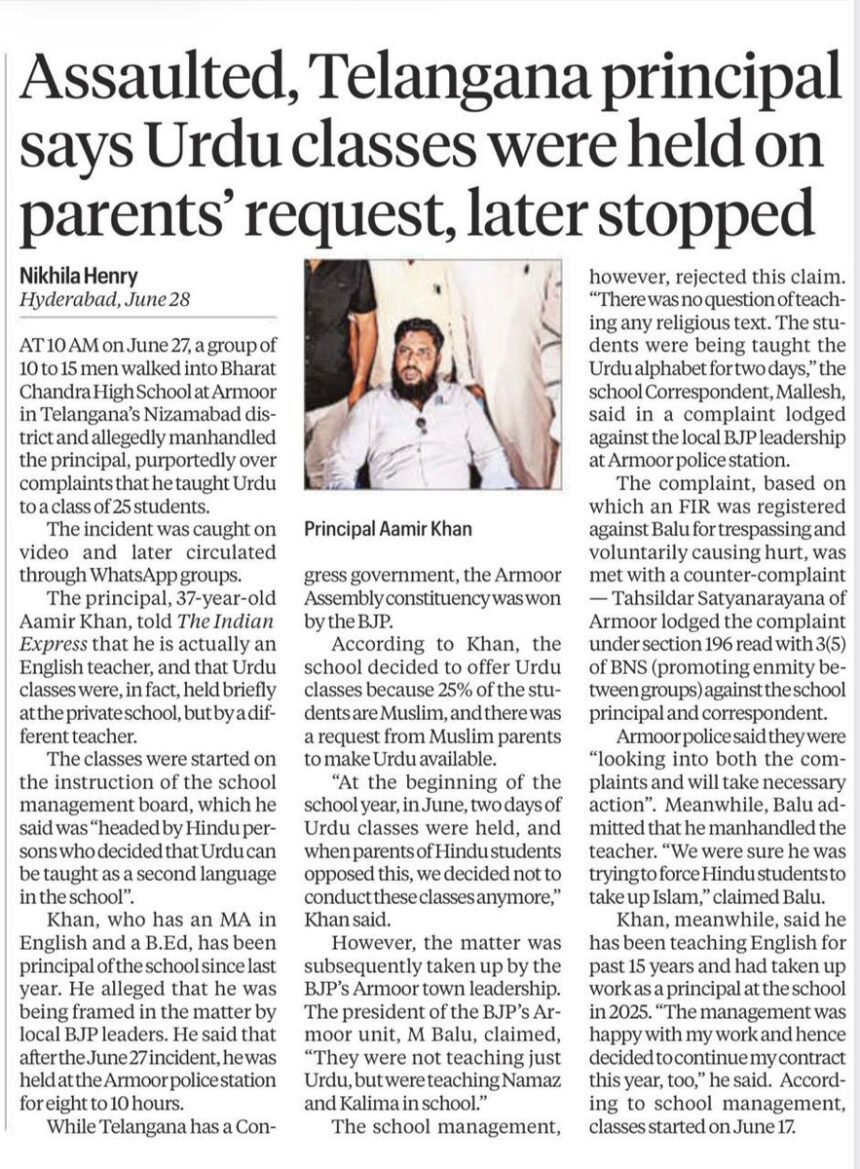

A recent incident in Telangana highlights escalating tensions surrounding the Urdu language in India. A Muslim Urdu teacher was reportedly slapped by a BJP leader for teaching Urdu, leading to significant outcry, especially given that Urdu is an officially recognized second language in the state. What followed raised eyebrows, as the police opted to detain the teacher instead of taking immediate action against the alleged assailant.
Background of the Incident
The incident occurred in Telangana, a state known for its rich cultural heritage that celebrates diversity, particularly through languages like Urdu. Despite Urdu being a language that transcends religious boundaries and is cherished by various communities in India, tensions have been growing amid politically charged environments. The teacher, who became a victim in this scenario, was merely fulfilling his role in educating students in a language that many hold dear.
Political Context
Under the leadership of the Bharatiya Janata Party (BJP), there have been increasing attempts to push cultural narratives that sometimes marginalize minority languages and communities. The BJP has often been criticized for its stance on issues pertaining to Muslims and Urdu, which are seen as part of a broader strategy aimed at consolidating Hindu nationalism. The slap incident epitomizes the kind of intimidation some Urdu teachers and speakers may face in today’s political climate.
Community Reaction and Implications
The public outcry following this incident was swift. Many commentators, including notable voices on social media, condemned the incident and expressed concern over the growing intolerance towards Urdu. Activists emphasized that Urdu is not just a language but an essential component of India’s cultural fabric, often comparing its sweetness to that of “milk and sugar.” This incident has also sparked conversations around freedom of education and expression, raising questions about the state’s role in safeguarding the rights of all communities.
Why This Matters
The implications of this incident extend beyond the immediate incident and speak to larger themes in Indian politics. The treatment of Urdu in public spaces bears witness to the ongoing struggle over India’s linguistic and cultural identity. For Indian readers, it serves as a reminder of the importance of protecting linguistic diversity as a key ingredient of India’s democratic ethos. In an increasingly polarized environment, understanding and respecting all languages, including Urdu, becomes essential for social cohesion and political stability.
Frequently Asked Questions
What happened to the Urdu teacher after the incident?
After being slapped by a BJP leader, the teacher was detained by local police, which led to public outrage and calls for accountability against the assailant.
Why is Urdu considered important in Indian culture?
Urdu is recognized for its lyrical beauty and is a symbol of India’s rich cultural heritage. It has been celebrated in poetry, literature, and music, fostering unity among diverse communities.
How does this incident reflect broader political trends?
This incident reflects rising intolerance towards minority languages and communities in India, often coinciding with efforts to reshape national identity under Hindu nationalism, which poses challenges to the pluralistic fabric of Indian society.
What is the official status of Urdu in Telangana?
Urdu is recognized as the second official language in Telangana, symbolizing its significance within the state’s cultural landscape and its role in education and governance.