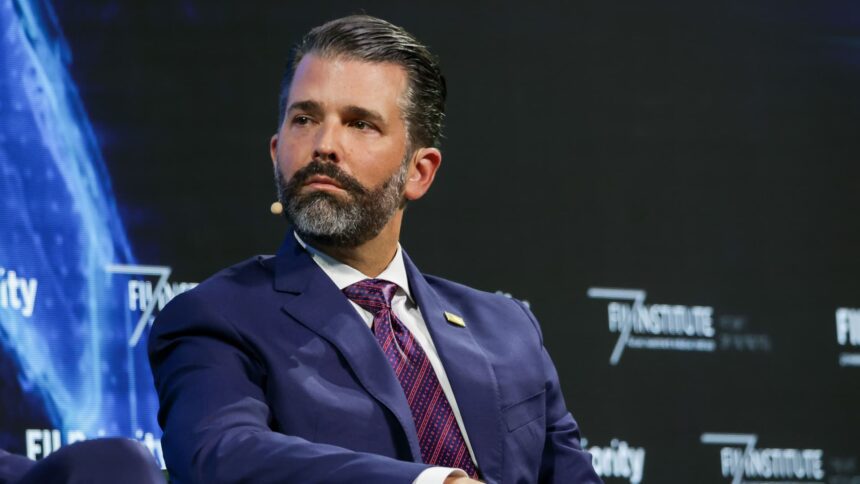

Donald Trump Jr. recently advised Republican state attorneys general against targeting prediction markets, a move tied to rising tensions between state and federal regulations. As discussions intensify around the regulatory future of event contract exchanges like Kalshi and Polymarket, this situation is especially significant for those interested in financial markets and potential regulatory changes.
Trump Jr.’s Call for Federal Oversight
During a recent conference in New Orleans, Donald Trump Jr. urged state attorneys general not to pursue legal action against prediction markets. According to reports, he believes that gambling companies mislead states in an effort to protect their monopolies. Trump Jr. suggested that federal authorities should oversee these exchanges rather than state regulators, stressing the need for a standardized regulatory framework.
His involvement is particularly noteworthy given his advisory roles with Kalshi and Polymarket, two of the leading prediction market platforms. The federal government is currently embroiled in disputes regarding who has the authority to regulate these markets, which have become a hot topic in discussions about the future of trading and forecasting in various sectors.
Ongoing Legal Battles
The regulatory landscape for prediction markets is turbulent, with the Commodity Futures Trading Commission (CFTC) filing lawsuits against nine states that are attempting to impose their regulations on these platforms. Notably, eight of these states have Democratic attorneys general, showcasing a growing divide along party lines regarding the regulation of digital financial products.
Adding complexity, 44 state attorneys general have reached out to the CFTC, contesting the federal body’s authority over sports-related event contracts. This mounting legal pressure on prediction market operators signifies a crucial juncture in the evolution of financial regulations and tax structures applicable to this emerging industry.
Response from Prediction Market Operators
Kalshi and Polymarket have both responded to recent media coverage, defending their operational frameworks and refuting the notion that they engage in traditional gambling practices. Kalshi specifically characterized state actions as unprecedented aggression against federally licensed exchanges, comparing it to a hypothetical state attempt to shut down the stock market.
Kalshi’s spokesperson emphasized the distinction between their services and those of traditional sportsbooks, highlighting that their model is designed to provide clear market predictions, not merely betting mechanisms. Furthermore, they stated a lobbying effort that helped shape legislation in North Carolina, favoring a lower tax rate on prediction markets compared to sportsbooks. This example illustrates the intricate ties between market operators and legislative processes.
Why This Is Trending
Interest in prediction markets is surging in India, primarily fueled by the rising fascination with fintech and alternative investment channels. As more individuals seek diverse methods for income generation and investment, the regulatory framework governing these products becomes increasingly relevant. Furthermore, global events and uncertainties are prompting discussions about risk management and market forecasting, making prediction markets a subject of keen interest among Indian investors and entrepreneurs alike.
Frequently Asked Questions
What are prediction markets?
Prediction markets are financial markets where traders can buy and sell contracts based on the outcomes of future events. These markets allow participants to speculate on a variety of outcomes, from elections to sports events, essentially attempting to predict future trends.
Why is federal regulation important for prediction markets?
Federal regulation would create a more uniform framework for prediction markets, which currently operate under varying state laws. This uniformity can lead to more stable market conditions and help protect consumers while fostering innovation in the sector.
How do state and federal regulations differ for prediction markets?
State regulations often differ significantly in terms of requirements and restrictions compared to federal regulations. This inconsistency can create confusion for operators and consumers alike, leading to legal disputes as seen in recent lawsuits.
What role does Donald Trump Jr. play in this sector?
Donald Trump Jr. is an advisor to Kalshi and Polymarket, where he provides insights into their marketing strategies. His recent comments advocating for federal oversight reflect his vested interest in shaping the regulatory environment that governs these platforms.