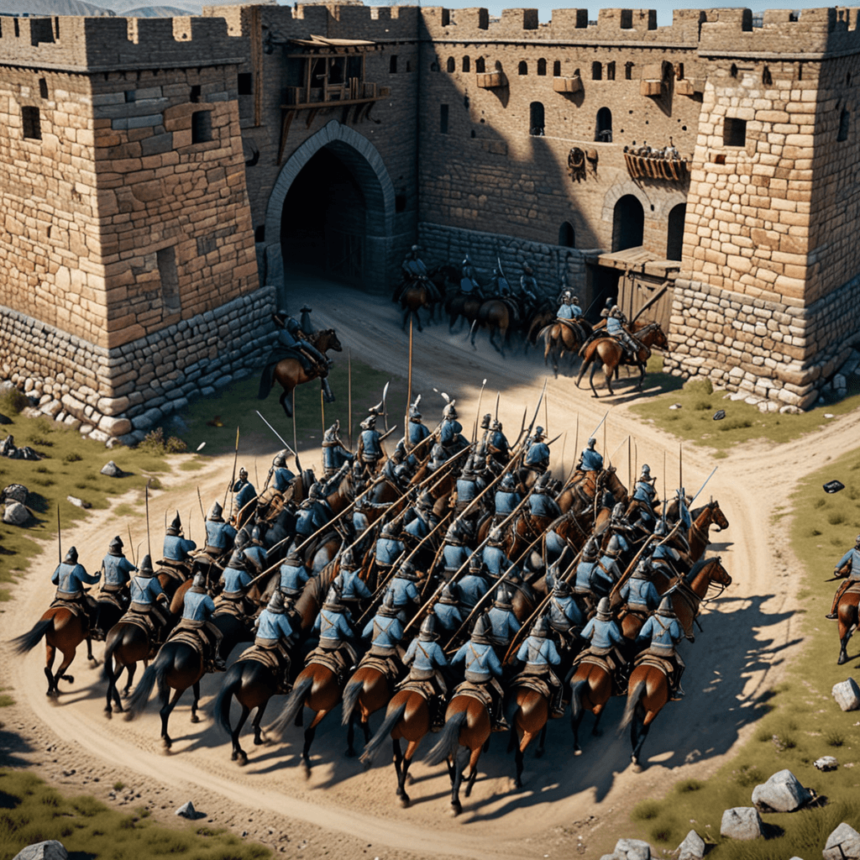

In the waning years of the 12th century, one of medieval India’s most dramatic military conquests unfolded at the gates of Nabadwip, the capital of the Sena dynasty in Bengal. According to the famous account, Bakhtiyar Khalji, with just 18 mounted soldiers, managed to capture one of Bengal’s most fortified cities. The story, as traditionally told, unfolds like a military thriller:
The Initial Approach : Khalji and his small band approached Nabadwip’s gates disguised as horse traders. This was a common sight in the prosperous trading city, and the guards, accustomed to such merchants, reportedly gave them only cursory attention. The small number of riders – just 18 – seemed to preclude any military threat.
The Decisive Moment: What happened next has become legendary in Indian military history. Instead of proceeding to the trading quarters, Khalji’s group suddenly charged toward the palace. The speed and audacity of the attack caught the city’s defenses completely off guard. According to chronicles, King Lakshman Sena was so surprised by the attack that he fled while having his meal, leaving through the palace’s back entrance.
The Inexplicable Collapse:
The city’s response to the attack presents a historical puzzle. Nabadwip was a major capital with:
- &]:mt-2 list-disc space-y-2 pl-8″>
- Multiple layers of fortification
- Professional guard contingents
- Established military protocols
- Substantial garrison forces
Yet, faced with just 18 attackers, this elaborate defense system crumbled. The traditional explanation – that defenders mistook the small group for the vanguard of a larger army – seems inadequate when subjected to scrutiny. How could a sophisticated court system, with its intelligence networks and military experience, make such a fundamental error?
The Psychological Dimension: The key to understanding this conquest lies not in military tactics but in psychological warfare. Several factors combined to create a perfect storm of psychological collapse:
Shock Effect The very audacity of the attack created a psychological disruption that military training hadn’t prepared defenders for. The shocking violation of established security protocols triggered a cascade of confusion and disarray.
Command Paralysis The targeting of the royal center and the king’s immediate flight created a leadership vacuum. Without clear command, the city’s substantial military resources remained uncoordinated and ineffective.
Rumor Amplification: In the densely populated urban environment, initial confusion quickly transformed into mass panic. The speed of rumor transmission likely outpaced any attempt to organize a coherent defense.
Historical Pattern Recognition This psychological aspect of the Nabadwip conquest finds echoes in other significant military events of medieval India:
Devagiri (1294) Alauddin Khilji’s conquest of the supposedly impregnable Devagiri fortress succeeded largely through psychological impact. The defenders’ certainty of their invulnerability made the psychological shock of its violation particularly devastating.
Talikota (1565) The collapse of Vijayanagara’s forces following rumors of Rama Raya’s death, despite having significant military strength still in the field, demonstrates how psychological factors could override military realities.
Modern Analysis and Implications Contemporary historical analysis suggests the “18 horsemen” story is best understood not as a literal military account but as a crystallization of how psychological warfare could overcome overwhelming odds. The number “18” might be more symbolic than literal, emphasizing the attackers’ audacity rather than their actual strength.
The success of this conquest likely involved:
- &]:mt-2 list-disc space-y-2 pl-8″>
- Careful exploitation of established trading patterns
- Possible internal collaborators or intelligence
- Strategic targeting of command structures
- Understanding of urban psychology
Psychological Warfare during Mysore Kingdom Tipu Sultan, the ruler of Mysore, once remarked about his adversaries: ” Those Marhatas have put on the clothes of men, but in fact will prove to be women.” This cutting observation reveals a sophisticated understanding of psychological warfare that echoed the lessons of Nabadwip. Like Bakhtiyar Khalji before him, Tipu recognized that martial reputation often rested more on psychological foundations than military reality. His statement sought to shatter the fearsome reputation of Maratha warriors, attempting to expose what he perceived as a gap between their intimidating image and their actual resolve.
Legacy and Lessons: The enduring significance of the Nabadwip conquest lies in its demonstration of psychological warfare’s power. It revealed how even the strongest fortifications could fall when psychological defenses collapsed. The story serves as a reminder that in medieval warfare, the battle for minds often proved more decisive than the clash of arms.
This famous episode teaches us that military history must be understood not just through the lens of tactics and numbers, but through the complex psychology of human response to crisis. In medieval Indian warfare, the ability to create and exploit psychological vulnerability often proved more valuable than numerical superiority or physical fortification.