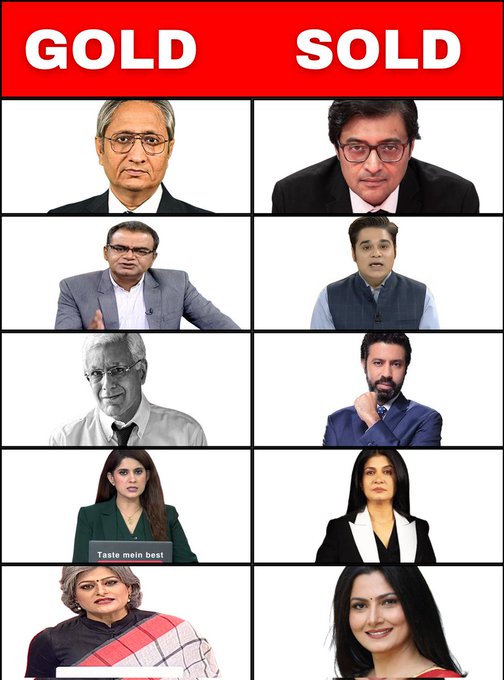

In recent years, the term “Godi media” — a sarcastic Hindi phrase meaning “lapdog media” — has gained widespread currency in Indian political discourse. Coined by veteran journalist Ravish Kumar, it refers to sections of mainstream Indian media perceived as uncritically supportive of the ruling Bharatiya Janata Party (BJP) and its ideological parent, the Rashtriya Swayamsevak Sangh (RSS). While many explanations have been offered — corporate ownership, fear of state reprisal, ideological alignment — one increasingly discussed, though controversial, argument centers on caste: that a significant proportion of mainstream journalists belong to upper castes, benefit from the existing social hierarchy, and thus see the BJP as a protector of their interests.
The claim — “Maximum mainstream journalists are from upper caste, they want the caste system to be maintained and they see that BJP is doing it. So they feel that BJP is their own and they support BJP blindly…” — is provocative, uncomfortable, and demands serious engagement. It is not merely an accusation; it is an invitation to examine the structural composition of Indian media and its relationship with power.
Caste and the Newsroom
There is no comprehensive, publicly available caste census of Indian newsrooms. However, anecdotal evidence, academic studies, and industry surveys consistently suggest that upper castes — particularly Brahmins, Kayasthas, Banias, and other “forward” communities — are disproportionately represented in senior editorial, anchor, and decision-making positions in mainstream television and print media.
A 2019 study by the Centre for the Study of Developing Societies (CSDS) and the Hindu Centre for Politics and Public Policy found that over 70% of journalists in Hindi and English newsrooms belonged to upper castes. In contrast, Other Backward Classes (OBCs), Scheduled Castes (SCs), and Scheduled Tribes (STs) — who together constitute nearly 85% of India’s population — remain severely underrepresented, especially in leadership roles.
This demographic imbalance is not accidental. Journalism, like many other elite professions in India, requires access to quality education, English fluency, urban networks, and cultural capital — advantages historically monopolized by upper castes. Even today, caste networks often play a role in hiring, mentorship, and career advancement.
BJP and the Preservation of Social Hierarchy
The BJP, while projecting itself as a modern, development-oriented party, has never disowned its roots in Hindutva — an ideology that, critics argue, reinforces Brahminical social order under the garb of cultural nationalism. The party’s core support base includes dominant castes across regions — Jats in Haryana, Marathas in Maharashtra, Patidars in Gujarat, and Bhumihars and Rajputs in Bihar and Uttar Pradesh — all of whom have historically benefited from caste hierarchy.
While the BJP has made electoral inroads among OBCs and even some Dalit communities through welfare schemes and symbolic gestures, its ideological core remains aligned with a vision of India that privileges Hindu majoritarianism and traditional social structures. The RSS’s long-standing opposition to caste-based reservations, its promotion of Sanskrit and Vedic culture, and its discomfort with radical social justice movements are well documented.
For many upper-caste journalists, this alignment is not seen as regressive but as “cultural pride” or “national unity.” Criticism of the BJP’s stance on caste is often dismissed as “vote-bank politics” or “anti-national.” The discomfort with caste-based discourse — especially when it challenges Brahminical norms — is palpable in prime-time debates, where anchors frequently interrupt Dalit or Muslim voices, framing their concerns as “divisive.”
The “Godi” Mentality: Beyond Fear, Toward Identity
It would be simplistic to reduce media bias solely to ownership or state pressure. While corporate interests (Adani, Ambani-linked media houses) and regulatory threats (IT raids, license cancellations) play a role, the deeper, more insidious factor may be identity.
When a journalist sees the ruling party as “their own” — not just politically, but culturally and socially — objectivity becomes secondary. Criticizing the BJP feels like criticizing one’s community, one’s values, one’s worldview. The media then doesn’t just report the news — it performs loyalty.
This is not unique to India. Globally, media often reflects the class and cultural biases of its producers. But in India, caste adds a uniquely entrenched dimension. The upper-caste journalist may genuinely believe that “national interest” aligns with BJP’s agenda, because for them, the status quo — where their caste holds social, economic, and cultural capital — is the “natural order.”
The Consequences
The result? Critical scrutiny of the government is replaced by cheerleading. Investigative journalism on issues like lynching, manual scavenging, or caste atrocities is sidelined. Dissenting voices — especially from marginalized communities — are delegitimized. The media becomes not a watchdog, but a megaphone for power.
This has dangerous implications for democracy. When media fails to hold power accountable — not because of coercion alone, but because of internalized bias — it erodes public trust and deepens social fractures.
The Way Forward
Addressing this requires more than just calling out bias. It demands structural reform:
- Caste census in media organizations — to acknowledge and quantify the problem.
- Affirmative action in hiring and promotion — to ensure representation from SC, ST, OBC, and minority communities.
- Sensitization programs — to confront caste privilege and unconscious bias in newsrooms.
- Support for independent, community-based media — to amplify marginalized voices.
C onclusion
The claim that “Godi media” protects the BJP because its journalists are upper caste and invested in preserving caste hierarchy is uncomfortable — but not unfounded. It reflects a deeper truth about Indian media: it is not just politically compromised, but socially stratified. Until newsrooms reflect the diversity of India — not just in token hires, but in editorial power — the dream of a truly independent, representative media will remain elusive.
The media doesn’t just report society — it shapes it. If it continues to speak for the privileged few, it betrays its democratic mandate. The fight for media freedom in India is also a fight for caste justice — and the two cannot be separated.
—