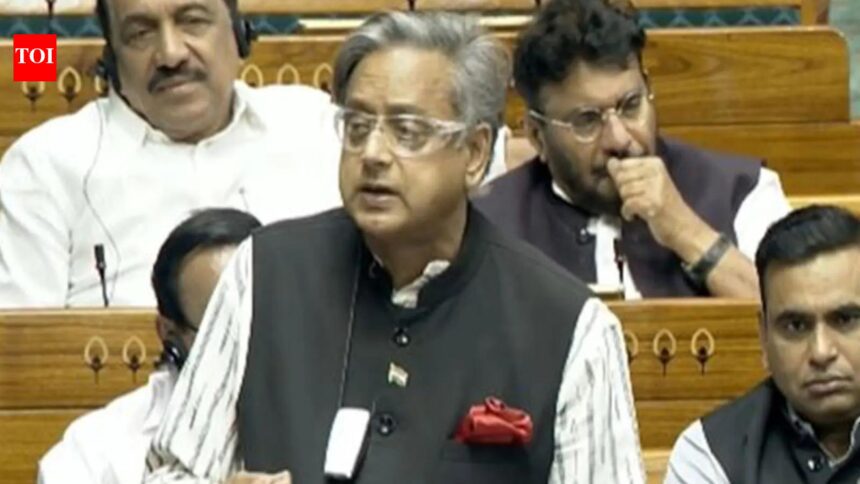

Senior Congress leader Shashi Tharoor has criticized the proposed delimitation process, labeling it as “political demonetisation.” During a Lok Sabha debate on Friday concerning three bills related to women’s reservation, Tharoor expressed discontent with the government’s decision to tie the implementation of women’s reservation to the expansion of Parliament and the redrawing of constituencies based on the 2011 Census.
Tharoor stated that there is near-universal political support for women’s reservation and argued for its immediate enforcement without association with the delimitation process. “Today we stand at a threshold where there is near unanimous political consensus in favour of women’s reservation,” he asserted. He emphasized the need for concrete action rather than mere token efforts.
Referencing Prime Minister Narendra Modi’s support for women’s representation, Tharoor criticized the additional conditions imposed on the proposal. He remarked, “The prime minister says he has brought ‘nari shakti’… but he has wrapped it in barbed wire,” highlighting the complications that may arise from linking women’s empowerment to contentious demographic adjustments.
According to Tharoor, implementing women’s reservation based solely on current parliamentary strength should not necessitate waiting for redistricting. “Women’s reservation is ready for harvest and can and should be implemented immediately based on existing parliamentary strength,” he stated.
He also warned that delimitation involves a significant political power shift, asserting, “Delimitation is not a mere bureaucratic rearranging of maps; it is a profound shift in political power.” Tharoor cautioned against the potential risks to federalism and political stability that could result from the delimitation process.
He drew a parallel between the rapid implementation of delimitation legislation and the hasty rollout of demonetisation, which he noted caused substantial disruption in the past. “Delimitation will turn out to be political demonetisation. Don’t do it,” he cautioned.
While Tharoor acknowledged the opposition’s support for women’s reservation, he maintained that it should not be contingent upon future delimitation. He called for broader consultations among political parties, emphasizing that both women’s representation and delimitation hold significant ramifications for India’s electoral apparatus and federal dynamics.
The debate followed the introduction of the Constitution (131st Amendment) Bill in the Lok Sabha, aimed at amending the women’s quota law, alongside two additional bills—the Delimitation Bill and the Union Territories Laws (Amendment) Bill—designed to facilitate the amended women’s quota law in the Union Territories of Delhi, Puducherry, and Jammu and Kashmir.