Breaking India News Today | In-Depth Reports & Analysis – IndiaNewsWeekBreaking India News Today | In-Depth Reports & Analysis – IndiaNewsWeek
  • Home
  • Nation
  • Politics
  • Economy
  • Sports
  • Entertainment
  • International
  • Technology
  • Auto News
Reading: Temperature Surge Expected: North India Faces Intensified Heat After Recent Lull
Share
Breaking India News Today | In-Depth Reports & Analysis – IndiaNewsWeekBreaking India News Today | In-Depth Reports & Analysis – IndiaNewsWeek
  • Home
  • Nation
  • Politics
  • Economy
  • Sports
  • Entertainment
  • International
  • Technology
  • Auto News
© 2024 All Rights Reserved | Powered by India News Week
Trending Now: Stay updated with the latest breaking news from India and around the world
After a lull, why temperature spikes are likely to intensify in north India
Breaking India News Today | In-Depth Reports & Analysis – IndiaNewsWeek > Economy > Temperature Surge Expected: North India Faces Intensified Heat After Recent Lull
Economy

Temperature Surge Expected: North India Faces Intensified Heat After Recent Lull

Indianewsweek By Indianewsweek May 2, 2026 4 Min Read
Share
SHARE

India is experiencing climate change like many other nations; however, it is warming at a comparatively slower rate. According to a recent study featured in a compilation by Harvard University’s Salata Institute for Climate and Sustainability, the monthly maximum temperature has increased, on average, by approximately 0.28 degrees Celsius per decade since 1980. The average temperature change from 2015 to 2024 has reached 0.88 degrees Celsius relative to the 1980–1990 period, with 2025 projected as the warmest year on record.

Notably, India’s average temperature increase is less than the global average of around 1.4 degrees Celsius during the same timeframe. This disparity is significant, as it may not persist in the future due to several influencing factors.

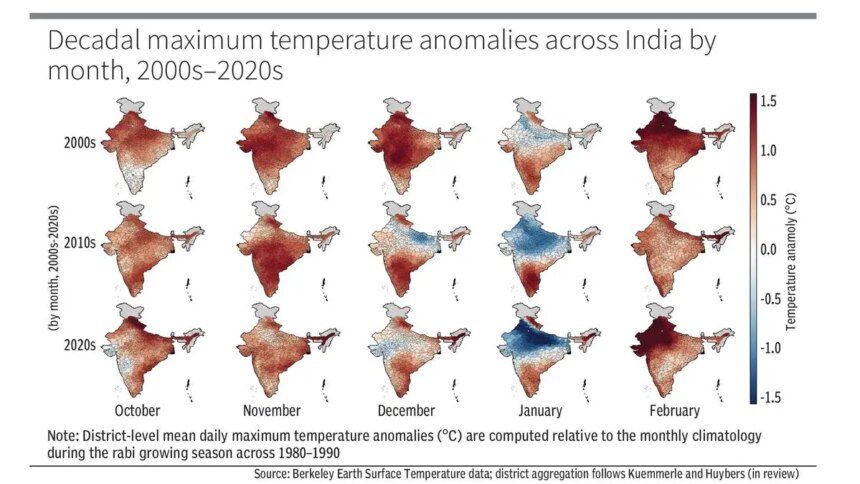
Temperature increases are not uniform across different regions or time periods, varying by month and time of day. For example, winter daytime temperatures in northern India are warming at a slower rate than the national average, with certain areas even experiencing a pronounced cooling trend.

While this phenomenon might be dismissed as natural climate variability, the “widespread and significant winter daytime cooling” noted in large areas of northern India since 1980 cannot be fully accounted for by such short-term fluctuations.

The study identifies “aerosol forcing” and irrigation as underlying contributors to this cooling trend. Aerosols—tiny particles released through activities such as burning crop residue, industrial emissions, traffic, and cooking—are typically viewed as harmful. However, they can have a beneficial effect by reflecting sunlight back into space or absorbing energy.

During the night, the Earth releases the heat gathered during the day via longwave radiation. Aerosols can impede the escape of this heat, redirecting it to the Earth’s surface. Furthermore, northern India is heavily irrigated; the energy from the sun is utilized by plants and soil to convert irrigation water into vapor, which prevents air from heating up, resulting in cooling effects. This mirrors the natural cooling seen historically in the American Midwest, an area with extensive irrigation.

However, the persistence of this trend is questionable. Both aerosol concentrations and irrigation practices may change, which could lead to increased warming across northern India.

The paper notes, “Aerosol loading may decline under a clean air policy. India’s National Clean Air Programme and accompanying state-level initiatives aim to reduce ambient particulate matter.” Although diminishing aerosols will enhance public health, it may also eliminate the masking effect on greenhouse warming, potentially leading to a rise in winter daytime temperatures in northern India. Conversely, cleaner air might result in cooler nights due to the ability of heat to dissipate more freely into space, thereby increasing the temperature range.

Irrigation is closely tied to groundwater availability, particularly in the Indo-Gangetic plain, which is situated above one of the fastest-depleting groundwater systems globally. Future irrigation practices may shift as a consequence of groundwater depletion, enhanced efficiency, or crop diversification. As transpiration—the moisture loss from plants—and soil evaporation decrease, so too will the related cooling effects, which may accelerate warming in the northern plains beyond the changes observed since 1980.

Published on April 27, 2026.

TAGGED:Economy NewsNews
Share This Article
Twitter Copy Link
Previous Article The Honda Shine 100 DX review: Light work Honda Shine 100 DX Review: A Lightweight Champion for Effortless Commuting
Next Article Assam polls: Can governance trump anti-incumbency against Himanta Sarma Assam Elections: Will Governance Overcome Anti-Incumbency Challenges for Himanta Sarma?
Leave a comment Leave a comment

Leave a Reply Cancel reply

Your email address will not be published. Required fields are marked *

Latest News

Assam polls: Can governance trump anti-incumbency against Himanta Sarma

Assam Elections: Will Governance Overcome Anti-Incumbency Challenges for Himanta Sarma?

May 2, 2026
After a lull, why temperature spikes are likely to intensify in north India

Temperature Surge Expected: North India Faces Intensified Heat After Recent Lull

May 2, 2026
The Honda Shine 100 DX review: Light work

Honda Shine 100 DX Review: A Lightweight Champion for Effortless Commuting

May 2, 2026
Kerala assembly election results 2026: Pinarayi Vijayan's welfare rule -- Will it fare well or get a farewell?

Kerala 2026 Election Results: Will Pinarayi Vijayan’s Welfare Policies Secure His Political Future?

May 2, 2026
CDSL Q4 profit slips to ₹80 cr, demat accounts cross 18 cr

CDSL Reports ₹80 Cr Q4 Profit Dip as Demat Accounts Surpass 18 Crores

May 2, 2026
Will Matheesha Pathirana play for KKR against Sunrisers Hyderabad in IPL 2026? Southee shares update

Matheesha Pathirana’s Participation in IPL 2026: KKR vs. Sunrisers Hyderabad Update from Southee

May 2, 2026

You Might Also Like

Indian Cabinet nod for 1 mt white rice export to IndonesiaL, says Shivraj Singh Chouhan
Economy

India approves 1 mt white rice export to Indonesia, announces Shivraj Singh Chouhan

2 Min Read
Nepal, India to discuss supply of aviation fuel through pipeline
Economy

Nepal and India to Explore Aviation Fuel Pipeline Supply Agreement

2 Min Read
In letter to NHRC, rights group alleges Rohingya mother, infant held beyond jail term in West Bengal
Nation

Rights Group Claims Rohingya Mother and Infant Detained Beyond Sentence in West Bengal

3 Min Read
“I cannot bear this inhuman pressure anymore,” another BLO in West Bengal dies by suicide
Nation

Tragic Loss: West Bengal BLO Takes Life Amidst Unbearable Pressure

6 Min Read

About IndiaNewsWeek

IndiaNewsWeek is your trusted source for breaking news, in-depth analysis, and comprehensive coverage of India and the world. We deliver accurate, timely reporting across politics, economy, sports, entertainment, and technology.

contact@indianewsweek.com

Quick Links

  • Nation
  • Politics
  • Economy
  • International
  • Sports
  • Entertainment

More Sections

  • Technology
  • Auto News
  • Education
  • About Us
  • Contact
  • Privacy Policy

Stay Connected

Follow us on social media for the latest updates and breaking news.

Facebook
X (Twitter)
YouTube
Follow US
© 2026 IndiaNewsWeek. All Rights Reserved.
Welcome Back!

Sign in to your account

Lost your password?