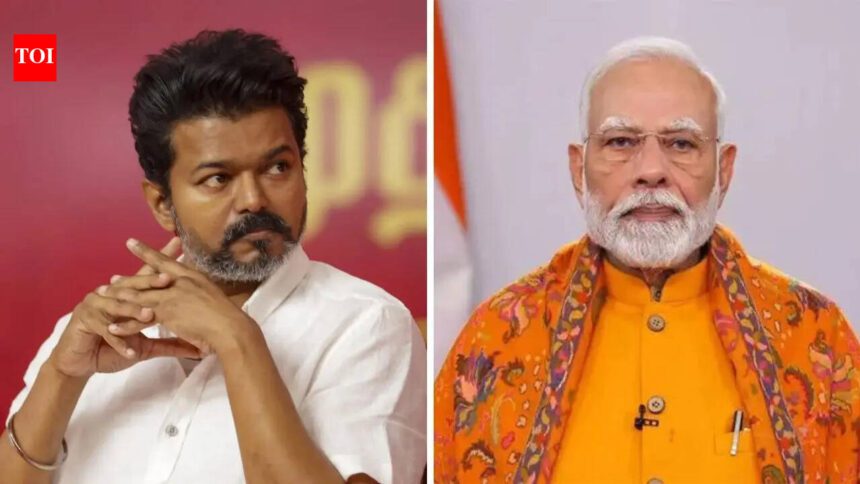

Tamil Nadu Chief Minister Vijay on Tuesday wrote to Prime Minister Narendra Modi, requesting that the Centre intervene to prevent the Karnataka government from constructing the Mekedatu dam across the Cauvery River. This plea comes shortly after the Congress-led government of Karnataka announced its intention to advance the Mekedatu dam project.
In his letter, Chief Minister Vijay asserted that the proposed project was in “clear violation” of a judgment issued by the Supreme Court. He also raised concerns regarding statements made by Karnataka Deputy Chief Minister D. K. Shivakumar. In a meeting held on Monday, Vijay emphasized the importance of protecting the state’s rights and maintaining the welfare of farmers.
The Tamil Nadu government stated that, based on the Supreme Court’s judgment and after extensive legal consultation, immediate legal actions should be pursued. Notably, the previous Tamil Nadu administration had filed petitions against the dam project with the Supreme Court on November 30, 2018, and June 7, 2022. The Supreme Court, during a hearing on November 13, 2025, did not grant permission for the Mekedatu dam and highlighted that the project remained at a preliminary stage. The court noted that only the Central Water Commission could decide if the project adhered to its earlier rulings and subsequently closed the cases.
Vijay’s statements followed remarks from Shivakumar, who indicated that the Detailed Project Report (DPR) for Mekedatu would soon be submitted to the Centre, with plans for a foundation stone ceremony contingent upon receiving approval from the Union government. “The DPR for the Mekedatu project has been prepared, and a project office has been established. We are in the process of identifying alternative land to compensate for the forest area that will be submerged. The DPR will be submitted to the Centre shortly. Once we obtain approval, we will conduct the bhoomi puja for the project,” Shivakumar told reporters.
The dispute over the Cauvery River water has long been contentious among Tamil Nadu, Karnataka, Kerala, and the Union Territory of Puducherry. The issue remains particularly sensitive, often resulting in heightened tensions and protests, especially in Tamil Nadu and Karnataka.