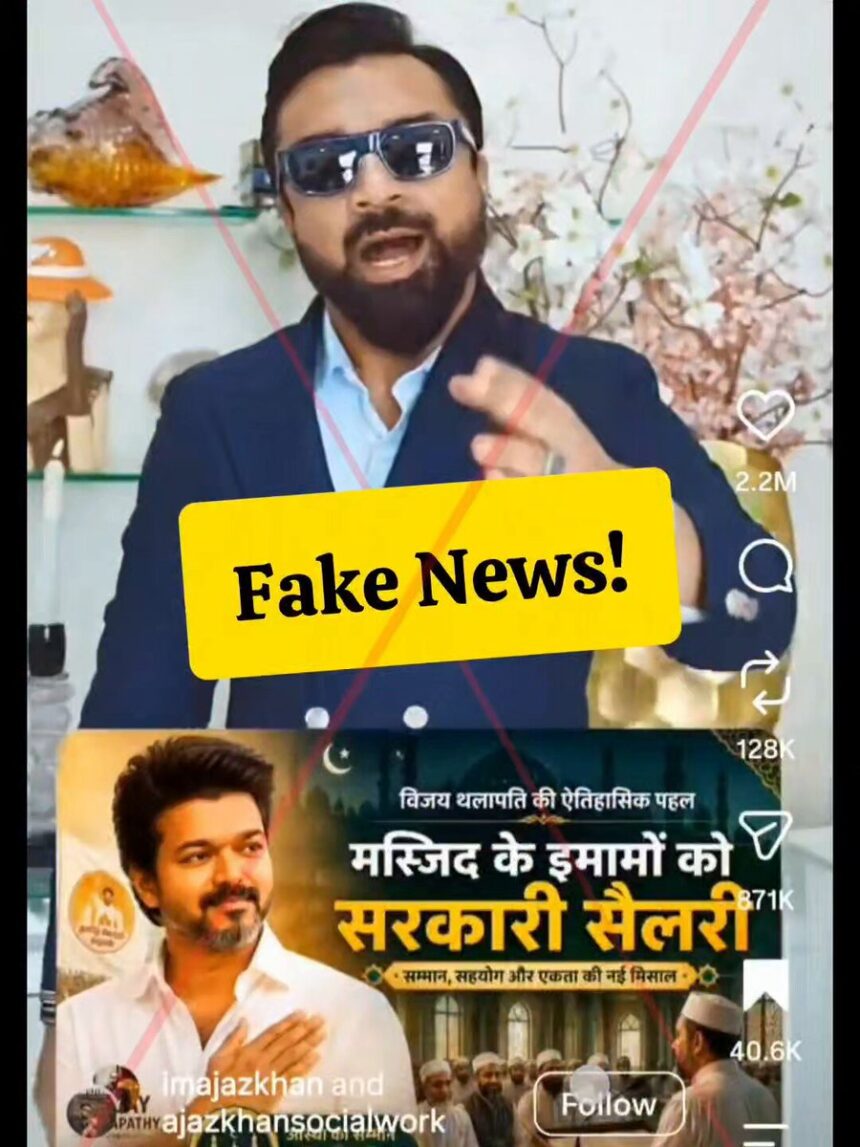

The recent claim that Tamil Nadu Chief Minister Joseph Vijay announced government salaries for mosque Imams is entirely false. This rumor has gained traction on social media, particularly through Instagram Reels, perpetuated by public figures and influencers. A fact-check reveals no official announcements have been made regarding such a salary scheme, debunking the viral narrative.
Understanding the Rumor
The rumor surrounding the supposed announcement of salaries for mosque Imams by Chief Minister Joseph Vijay has been traced back to various social media platforms, particularly Instagram. Influencers, often with substantial following, have shared this information, leading to widespread belief in its authenticity. This rumor is part of a broader trend where misinformation can be rapidly disseminated online, especially when it involves political figures.
Fact-Checking the Claims
Several fact-checking organizations have investigated the claim and found it to be outright false. Neither the Tamil Nadu government nor Chief Minister Vijay has issued any official statements or press releases concerning a salary allocation for mosque Imams. Experts suggest that such claims often arise from misunderstandings or misinterpretations of genuine political actions or statements.
The Role of Influencers in Misinformation
As highlighted by political commentator Mohammed Zubair, many Hindi-speaking influencers are either exaggerating or fabricating claims about Tamil Nadu’s Chief Minister. This phenomenon raises questions about the responsibility of social media figures in accurately reporting political news. The issue is compounded by the fact that misleading videos often attract millions of views and likes, further amplifying the spread of false narratives. Such influencers may inadvertently contribute to misinformation due to a lack of proper verification before sharing.
Why This Matters
The proliferation of misinformation can have serious repercussions in a politically sensitive country like India. In a diverse nation, narratives about religious and socio-political matters can easily escalate tensions. The persistent spread of false claims, particularly involving government actions or policies, undermines public trust in legitimate channels and authorities. Moreover, this case illustrates the vulnerabilities of social media as a news source, necessitating increased awareness and critical assessment from the audience.
Frequently Asked Questions
What initiated the rumor about government salaries for mosque Imams?
The rumor seems to have been instigated by several influencers on Instagram who reported on it without confirming the information through reliable sources. These kinds of unverified claims can quickly spiral out of control, especially when retweeted or shared broadly.
Is there any official government statement regarding this issue?
No, there have been no official orders, press releases, or budget allocations from the Tamil Nadu government or Chief Minister Joseph Vijay regarding salaries for mosque Imams. Fact-checkers have confirmed this information to be unsubstantiated.
Why are influencers often responsible for spreading misinformation?
Influencers may lack the necessary training or commitment to fact-check information before sharing it with their followers. Their primary focus often lies on engagement, leading to a tendency to share sensational or controversial content without due diligence.
What impact does misinformation have on the public?
Misinformation can lead to confusion, distrust in credible news sources, and may even provoke communal tensions within diverse communities. In a period of heightened political sensitivity, such falsehoods can have real-world consequences, potentially influencing voter perceptions and actions.