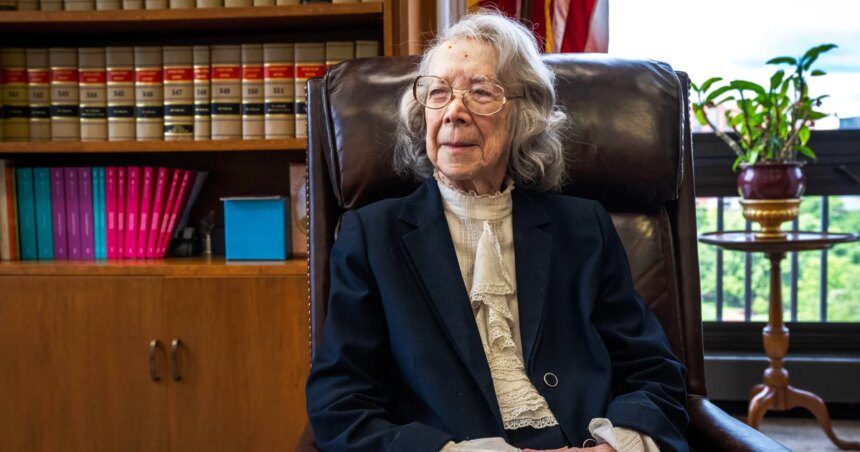

The U.S. Supreme Court recently rejected Judge Pauline Newman’s appeal to reinstate her service on the federal appeals court after her suspension due to concerns about her fitness. The decision has sparked discussions about judicial independence and the rights of judges facing health-related assessments.
Judicial Suspension Background
Judge Pauline Newman, aged 98, has been part of the U.S. Court of Appeals for the Federal Circuit since 1984, making her one of the longest-serving judges in American legal history. Known as the “Great Dissenter,” she has written over 300 dissenting opinions during her career. However, three years ago, concerns about her health led the Judicial Council for the Federal Circuit to suspend her from hearing cases.
Chief Judge Kimberly Moore, who heads the council, suggested that Newman either retire or take senior status—options Newman declined. The council ultimately found “probable cause” to believe that Newman was unfit to serve effectively, citing her health issues and complaints regarding her ability to manage her workload. Such concerns came amidst reports of health challenges, including fainting episodes.
Legal Proceedings and Supreme Court Involvement
Following her suspension, Newman sought a review of her case by the Judicial Conference of the United States, which was ultimately rejected. A special committee investigated her fitness, leading them to recommend a further year of suspension, which was affirmed by the Judicial Council.
Newman responded by filing a lawsuit against Chief Judge Moore and her colleagues, arguing that her constitutional rights were violated. The U.S. Court of Appeals for the District of Columbia Circuit ruled against her, citing protections under the Disability Act that restrict certain constitutional challenges against judicial councils.
Newman’s case was brought before the Supreme Court, where her lawyers contended that the actions taken against her were an attempt to sideline a dissenting judge. They argued that this undermines judicial independence, a foundational principle of the American legal system.
Responses and Implications
The Supreme Court’s decision not to hear Newman’s case has elicited various reactions. Supporters have expressed disappointment, deeming the denial a blow to judicial independence. Mark Chenoweth, president of the New Civil Liberties Alliance representing Newman, criticized the Supreme Court for not addressing her due process complaints, calling it “an inexcusable” oversight.
On the other hand, the Justice Department, representing the Federal Circuit judges, pushed for the Supreme Court to deny the case, emphasizing the procedural integrity upheld by the Judicial Council. This rift between Newman’s supporters and the judicial authorities highlights ongoing tensions regarding health assessments of judges and their right to serve.
Why This Is Trending
The case of Judge Newman is resonating with many in India and around the world as issues surrounding judicial independence and the rights of senior officials come into focus. The discussion touches upon how health concerns in the judiciary are treated and raises questions about the balance between institutional integrity and individual rights. Given that similar debates resonate within the Indian judicial system, particularly regarding the age and health of judges, the topic has gained traction among Indian readers seeking to understand the implications of judicial conduct and governance.
Frequently Asked Questions
What led to Judge Pauline Newman’s suspension?
Judge Pauline Newman was suspended due to concerns regarding her fitness to serve effectively, with reports of health issues and difficulties managing her workload contributing to the decision made by the Judicial Council for the Federal Circuit.
What are the implications of the Supreme Court’s decision?
The Supreme Court’s decision not to hear Newman’s case raises significant questions about judicial independence and the rights of judges, especially regarding how health assessments are conducted and the potential for their misuse in sidelining dissenting voices within the judiciary.
How has this case been received by the public?
The case has sparked a divided opinion, with supporters of Newman criticizing the judicial system for what they see as an infringement on her constitutional rights, while others emphasize the importance of ensuring that judges are fit to serve.
What are the next steps for Judge Newman?
Following the denial of her appeal by the Supreme Court, Judge Newman can continue to seek legal counsel on her situation, although the avenues available to challenge her suspension have been significantly narrowed.