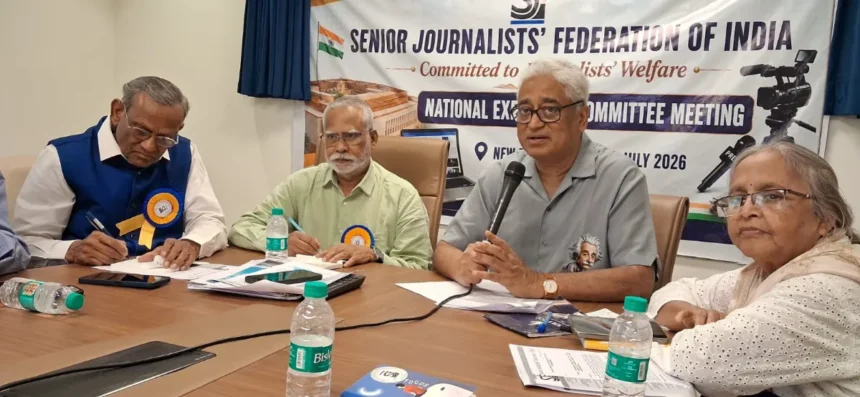

Senior Journalists Federation of India Discusses Welfare and Freedom of Press
The recent national executive committee meeting of the Senior Journalists Federation of India (SJFI) focused on the pressing need for enhanced social welfare benefits for senior journalists while maintaining independence from government influence. Key voices from the media community raised concerns about the implications of seeking governmental support.
Concerns Over Government Intervention
Senior journalist Rajdeep Sardesai, who previously chaired the Editors Guild of India, highlighted the potential dangers of requesting government support. He cautioned that reliance on such aid could jeopardize media freedom. “Requesting government support for welfare measures could end up compromising media freedom for journalists, which could be counterproductive,” Sardesai remarked. Instead, he advocated for exploring corporate social responsibility (CSR) funds as an alternative means to finance welfare activities for retired journalists.
Support for a National Media Commission
Throughout the meeting, participants discussed the growing need for a National Media Commission. This commission could potentially address serious issues affecting both active and retired journalists across India. Neena Vyas, a veteran journalist who served at The Hindu, echoed Sardesai’s sentiments regarding caution when seeking government support. She emphasized that the situation for retired journalists remains critical in many regions of the country.
Collective Voices of Concern
Other notable participants included K V Prasad, a former Press Council of India member, and Vinay Kumar, secretary general of the Press Club of India. The dialogue also featured contributions from senior journalists such as CK Nayik and Pamela Philippose, who participated in discussions surrounding a draft memorandum presented by C Gouridasan Nair. Many senior journalists from diverse states participated, reflecting the widespread nature of the concerns discussed.
Why It Matters
The discussion among senior journalists highlights broader issues of media autonomy and the welfare of individuals who have shaped public discourse in India. The potential pitfalls of seeking government support raise critical questions about independence and the integrity of journalism. A National Media Commission could serve as a safeguard against government overreach, providing a structured approach to address the welfare needs of journalists while maintaining the necessary separation from governmental influence. This is significant not only for journalism in India but also serves as a model for media environments worldwide where government interference is a concern.
Frequently Asked Questions
What is the Senior Journalists Federation of India (SJFI)?
The SJFI is a collective of senior journalists in India, aimed at advocating for their rights and welfare while ensuring independence from governmental constraints.
Why is government support for journalists considered risky?
Seeking government support can compromise the independence of journalists, potentially leading to restricted freedom of expression and influence over media narratives.
What alternative funding sources are suggested for journalist welfare?
Journalists like Rajdeep Sardesai have suggested utilizing corporate social responsibility (CSR) funds as a viable alternative to government support for welfare initiatives.
What is the significance of a National Media Commission?
A National Media Commission could address critical issues affecting journalists, ensuring they receive due attention and care without government interference, thereby safeguarding media freedoms in India.