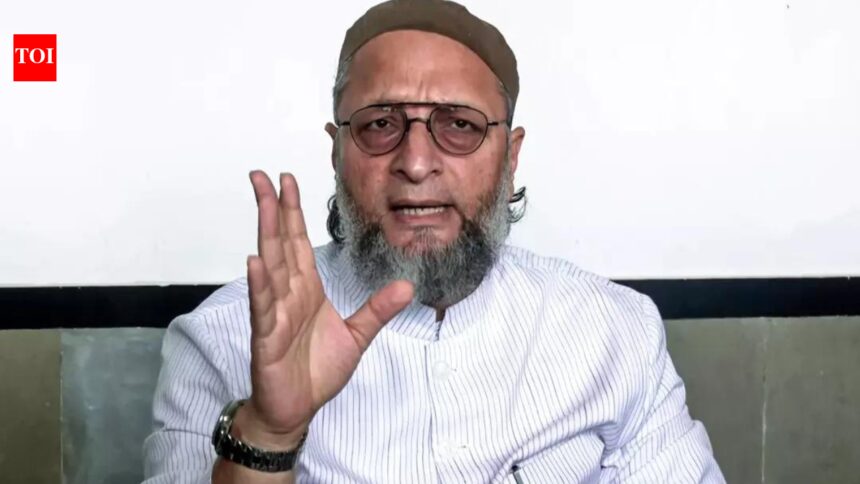

NEW DELHI: Asaduddin Owaisi, chief of the All India Majlis-e-Ittehad-ul-Muslimeen (AIMIM), stated on Friday that if offering prayers on public roads is deemed inappropriate, then similar restrictions should apply to the religious practices of all faiths. He highlighted Article 25 of the Constitution, which guarantees the freedom of religion and the right to practice one’s faith openly.
While addressing an Eid Milap event, Owaisi criticized public objections to namaz (prayer), suggesting it reflects a double standard. He questioned why similar concerns were not raised regarding religious processions and gatherings organized by other communities. “Remember Article 25. If offering prayers on the road is wrong, then it is wrong for every religion’s festival to come out onto the road,” he remarked. He also called for a balance in societal expectations, suggesting that if meat shops should be closed during certain religious festivals, then liquor stores should be closed during the 30 days of Ramadan.
Owaisi accused critics of harboring a bias against Muslims, asserting that societal objections to Azaan (the Islamic call to prayer) and namaz were often raised around significant Muslim festivals, such as Ramadan and Bakrid. He stated, “Your hatred is solely for Muslims… You want to suppress the followers of this religion and marginalize them. You want to make them second-class citizens.”
These comments come amid ongoing political discourse concerning public prayers and directives from state authorities to ensure that religious gatherings do not disrupt traffic or public movement. Uttar Pradesh Chief Minister Yogi Adityanath recently suggested that namaz should be conducted in a regulated manner and possibly in multiple shifts to minimize public inconvenience. Adityanath indicated that authorities would initially seek compliance through persuasion before enforcing public order norms.
In West Bengal, authorities led by Suvendu Adhikari have decided to relocate the traditional Eid congregation from Kolkata’s Red Road to the Brigade Parade Grounds to prevent prayers from spilling onto public roads.
Continuing his argument, Owaisi drew comparisons with religious processions and yatras, stating that roads are often occupied during these events without facing similar objections. He emphasized that namaz on roads typically occurs only on Fridays or during Eid, not daily. “In India, festivals of every religion take place on the road, don’t they? You don’t see those; you go blind to them,” he concluded.