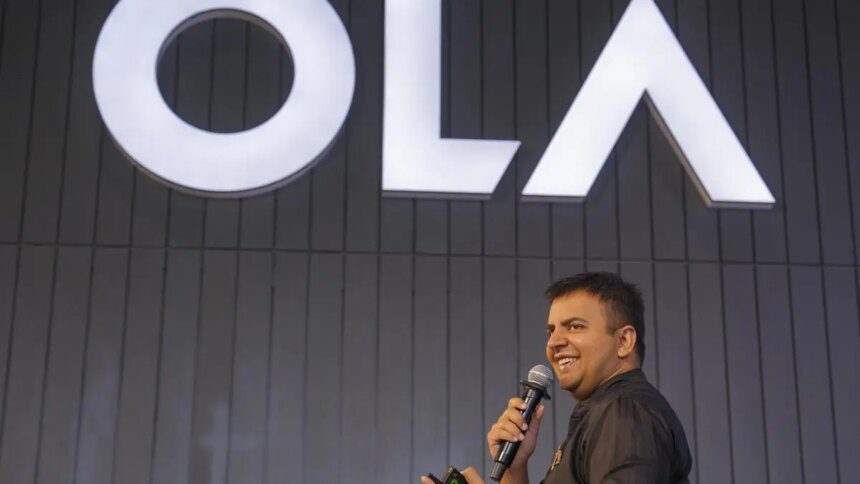

In a May 20 letter to shareholders, Bhavish Aggarwal, Chairman and Managing Director of Ola Electric Mobility Ltd, urged stakeholders to evaluate the company not merely on its financial losses but on the foundational infrastructure, technology, and battery platform built with shareholder investment.
“FY26 was a year of reset for Ola Electric,” Aggarwal noted. He emphasized the company’s commitment to strengthening critical business fundamentals such as service, product quality, gross margins, operating costs, cash discipline, sales productivity, and cell manufacturing.
Aggarwal’s message is that despite a challenging year for scooter sales, Ola Electric is laying the groundwork for a broader business beyond electric scooters. He hopes investors will see FY26 as a transformational period that sets the stage for future success.
While he refrained from directly apologizing to customers and shareholders, Aggarwal did acknowledge operational failures, admitting that service had become “the largest constraint on demand and brand trust.” This acknowledgment highlights the challenges that marred customer confidence and the company’s market standing.
In FY26, significant frustration was experienced by customers as sales plummeted, market share decreased, and many faced service delays and quality issues. Aggarwal argues that these challenges should be viewed as necessary investments for establishing a larger energy business.
Service delays peaked at about nine days in October 2025, with backlogs extending to 14 days before improving to fewer than one day by March 2026. This meant that ownership, which was marketed as part of a technological shift, became a frustrating experience for many.
Financially, the company reported a drastic decline in warranty costs, dropping to ₹59 crore in FY26 from ₹555 crore in FY25. This reduction aligns with decreased sales, but the lower warranty costs also exceeded the rate decline of deliveries, suggesting improvements in product quality and repair efficiency.
Aggarwal indicates that Q4 FY26 demonstrated “the reset working.” The quarter noted the company’s first cash-flow positive result, with consolidated cash flow from operations reaching ₹91 crore. Gross margins also saw an increase to 38.5%, and consolidated operating expenses dropped significantly to ₹428 crore from ₹844 crore.
However, the setbacks were considerable, with deliveries falling by 43.5% and revenues from operations declining 50.1%, from ₹4,514 crore to ₹2,253 crore. The company’s goal of regaining a national market share of 15–20% reflects the substantial ground lost to competitors like TVS Motor, Bajaj Auto, and Ather Energy.
A key theme of Aggarwal’s letter revolves around the battery business. He asserted, “Ola was built for this moment,” citing the company’s strategic position in India’s energy future through electric mobility and battery production.
According to Ola, its Gigafactory boasts an operational capacity of 2.5 GWh, with a 6 GWh expansion nearly complete and expected to be operational shortly. The company describes this as an active manufacturing platform with commercially viable output levels.
A noteworthy detail from the investor presentation revealed Ola’s claim to have commercialized dry-electrode manufacturing technology, which promises a 33% reduction in capital costs, 40-60% lower energy consumption, and a 70% smaller factory footprint compared to traditional methods.
Currently, approximately 15% of vehicle orders utilize Ola-produced cells, with a full transition to in-house batteries anticipated by September 2026. Additionally, Ola has introduced Shakti, a distributed energy storage solution, and is developing Mahashakti, a utility-scale storage system set for launch in 2027.
Ola estimates, based on Avendus Research, that India’s battery market could grow to 420 GWh annually by 2035, representing a potential $30 billion opportunity. The company plans to extend its battery capacity from 6 GWh to 20 GWh through a capital raise aimed at its cell subsidiary, which could pave the way for independent funding and valuation separate from the vehicle business.
In conclusion, Aggarwal’s latest letter to shareholders is a call to assess the company’s potential not just by its recent struggles with scooters, but by the developing battery platform that underpins its future ambitions. He is effectively asking shareholders to place trust in the Gigafactory as the true vessel for future success.