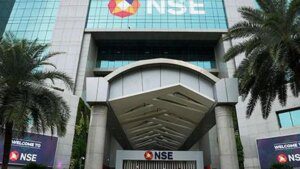

Markets opened cautiously on Friday, with the Nifty 50 trading at 24,130.75, down 42.30 points (0.17%) from its previous close of 24,173.05. The Sensex opened at 77,483.80, against its prior close of 77,664.00, trading at 77,523.55, down 140.45 points (0.18%) as of 9:16 a.m.
Thursday’s trading session concluded with the Nifty falling 205 points and forming a candlestick pattern resembling a Gravestone Doji, indicating selling pressure at higher levels. The India VIX, which measures market volatility, rose 1.58% to 18.59, suggesting elevated uncertainty.
Brent crude oil prices surged to approximately $106 per barrel, marking an 18% increase for the week, driven by a naval blockade of the Strait of Hormuz that has disrupted supply. Dr. V.K. Vijayakumar, Chief Investment Strategist at Geojit Investments, noted that the market has been responding continuously to negative news and optimistic hopes regarding the West Asia conflict. He indicated that a clearer direction for the market is likely contingent on the outcome of this conflict, particularly concerning the reopening of the Hormuz Strait.
In terms of performance, pharma and aviation stocks led the gains on the Nifty 50. Max Healthcare opened at ₹1,009.95 and traded at ₹1,017.00, up 1.02%. IndiGo increased by 0.92% to ₹4,597.90 from its previous close of ₹4,556.00. Other gainers included Grasim Industries, which rose 0.88% to ₹2,759.20, Bajaj Auto, up 0.83% at ₹9,630.00, and Jio Financial Services, which gained 0.77% to ₹250.57.
Conversely, IT and pharma stocks were among the biggest losers. Infosys decreased by 2.93% to ₹1,204.30 from ₹1,240.60, with over 21 lakh shares traded. Cipla fell 2.35% to ₹1,275.20, Sun Pharma dropped 1.74% to ₹1,650.90, Dr. Reddy’s Laboratories declined 1.66% to ₹1,308.90, and TCS experienced a 1.06% drop to ₹2,495.00. Vijayakumar pointed out that lack of positive guidance from major IT companies implies continued weakness for large-cap IT stocks despite low valuations.
Foreign institutional investors extended their selling streak to four consecutive sessions, offloading equities worth ₹3,254 crore. Domestic institutional investors partially offset this by purchasing equities worth ₹941 crore. As a result, the rupee weakened by 32 paise against the dollar, reaching its lowest level in April at 94.11.
Globally, U.S. stocks closed lower on Thursday, with the Nasdaq dropping 0.89%, while the S&P 500 and the Dow both declined by around 0.4%. Technology stocks were particularly hard-hit, with companies like ServiceNow and IBM providing disappointing forecasts. However, in a rare positive note, Intel soared over 20% in after-hours trading due to strong demand related to data centers and AI. Additionally, a ceasefire between Israel and Lebanon was extended for three weeks, though it is seen as a temporary solution rather than a long-term resolution, according to Hariprasad K, Founder of Livelong Wealth.
On the macroeconomic front, the U.S. Federal Reserve is expected to maintain current interest rates amidst inflation pressures driven by rising oil prices. The European Central Bank is anticipated to hold steady, with a potential increase in June, as eurozone inflation hovers between 2.7% and 3%. The Bank of England is also on hold as inflation in the UK rose to 3.3%.
Domestically, upcoming earnings reports are expected to drive stock-specific actions. Reliance Industries is set to report after market close today, with IndusInd Bank and Shriram Finance also in focus. Gaurav Udani, Founder of ThinCredBlu Securities, anticipates a slight uptick in Nifty, projecting an opening around 24,250; however, he cautioned that the market remains cautious unless it reclaims key resistance levels. Analysts generally maintain that the market is in a wait-and-watch phase. Hitesh Tailor, Research Analyst at Choice Equity Broking, emphasized that new long positions should ideally be considered only once the Nifty breaks above and sustains the 24,500 level.
Published on April 24, 2026.