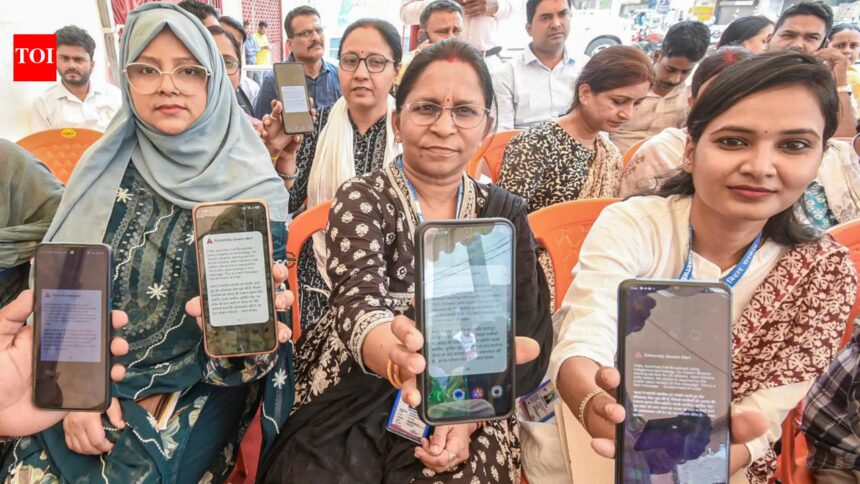

Phones erupted with piercing alarms and screens lit up across India on Saturday as part of a scheduled nationwide test of a new disaster alert system. The alerts, classified as “Extremely Severe,” were sent to millions of users around 11:45 AM, followed by a repeat message shortly thereafter. The text included a stark declaration: “No action required.” However, the public’s response varied widely from alarm to confusion, culminating in panic in some regions.
At Mumbai’s Prithvi Theatre, 40 cell phones rang simultaneously during a children’s play, startling families in attendance. In a suburban train, one passenger attempted to pull the emergency chain before being stopped by fellow commuters. In hospitals, the unexpected alarms disrupted consultations, leaving patients visibly shaken.
“I switched off my phone immediately thinking it was some bug,” said a resident from Bandra. Another visitor from Borivali recounted observing a moment of paralysis among people. “It was annoying to some and scary to others,” he added. Similar reactions were reported across other cities. In Bhubaneswar, many feared the worst, suspecting a cyberattack, while in Bengaluru, individuals mistook it for warnings of a heatwave or earthquake. In Lucknow, a pharmacist noted that the simultaneous ringing of multiple devices caused brief panic.
In New Delhi, Kanika Sharma, a 29-year-old teacher, initially linked the sudden noise during brunch to escalating global tensions before realizing it was a drill. “This system can be useful in case of emergencies,” she remarked. However, others expressed confusion regarding the repeated alerts. Abhishek Dogra, an IT professional from southeast Delhi, reported that all family phones rang at once, causing initial anxiety. “It’s a good move, but test messages should be clearly marked,” he advised.
Authorities later confirmed that the alerts were part of a planned trial by the National Disaster Management Authority and the Department of Telecommunications. The initiative marked the rollout of a real-time public warning system aimed at enhancing emergency responses. Unlike traditional SMS, the new cell broadcast technology transmits alerts simultaneously to all devices in a specific area, bypassing silent and do-not-disturb settings. It operates independently of internet connections or app subscriptions.
The alerts are displayed as full-screen pop-ups accompanied by a loud siren, temporarily halting other phone functions. Built on an indigenous platform known as SACHET, the system is aligned with global alert standards and is operational across all states and Union territories. So far, it has generated over 134 billion alerts in multiple languages for weather and disaster warnings.
The drill was designed to assess the system’s reach, speed, and public response. Messages were disseminated in regional languages alongside English and Hindi to enhance comprehension. However, not all devices received the alerts, exposing certain gaps in the system. Some users reported that while one phone rang, another device next to it remained silent, indicating a need for ongoing calibration.
Officials stated that the system is intended for use in cases of earthquakes, cyclones, floods, lightning, and industrial hazards like gas leaks. Geo-targeting technology will facilitate tailored alerts for specific districts or neighborhoods. In Bihar, authorities are planning follow-up preparedness exercises, including blackout and civil defense drills, to increase public familiarity with the system. “It created awareness among people,” a senior official noted.