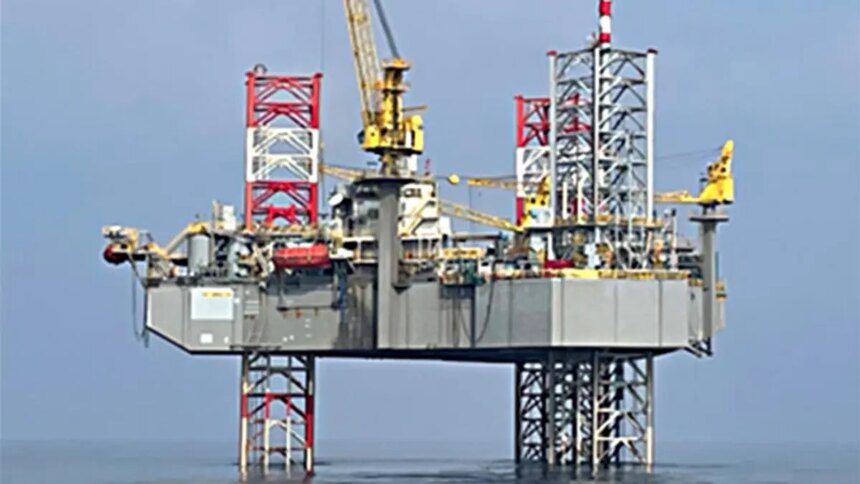

PETRO-ASSET. Hindustan Oil Exploration Company’s Bombay offshore rig
Hindustan Oil Exploration Company Limited (HOEC) has been likened to a plane awaiting air traffic control clearance for an extended period. Established in 1983 by HT Parekh, known for founding the HDFC group, HOEC has undergone several management changes. Progress accelerated in early 2015, when Pandarinathan Elango and Ramasamy Jeevanandam, former colleagues from ONGC, took leadership, rejuvenating operations at the Dirok gas field in Assam and acquiring key hydrocarbon assets, including Kharsang in Arunachal Pradesh and B-80 in Bombay Offshore.
However, initiating production at B-80 has presented greater technical challenges than anticipated, partly due to a decision to undertake cost-saving measures internally. At Dirok, production issues stem from external difficulties: an unfinished connecting gas pipeline project continues to limit output.

Producing more from Dirok and achieving stable operations at B-80 are critical for the company’s profitability, while Kharsang, PY-1 in the Bay of Bengal, and several Cambay assets may take years to become profitable.
Leadership Change
On April 1, HOEC announced a significant leadership change. Managing Director Jeevanandam departed, following Elango’s earlier retirement. Baroruchi Mishra, an independent director with extensive hydrocarbon experience, succeeded him as MD and CEO, raising hopes for an improved trajectory under technically adept guidance.
Mishra has discussed several new initiatives, emphasizing “strategic partnerships” as part of a long-term strategy. He highlighted the importance of unlocking value in existing assets, focusing on digitalization to enhance production efficiency, minimize downtime, optimize reservoir management, and strengthen decision-making processes.
The irony lies in the company’s inability to supply gas at a time when demand is high, due to delays in a crucial pipeline project. The 50 km interconnection between the Duliajan Numaligarh pipeline and the Indradhanush gas grid pipeline, meant to facilitate gas transport from the North-East to consumption centers, was not completed by the anticipated March deadline.
Once operational, production from Dirok could increase to 45 million cubic feet per day—approximately three times the current output—potentially leading to a substantial increase in HOEC’s revenue.
Regarding B-80, Mishra indicated intentions to enhance oil recovery through improved offshore processing facilities, targeted workovers, and the deployment of digital monitoring systems to optimize performance, noting that one of the two wells requires repairs.
Operational challenges at Dirok and B-80 led to a decline in HOEC’s revenue to ₹81 crore in the third quarter of 2025-26, down from ₹156 crore in the same period the previous year. Profits fell to ₹8.28 crore from ₹43.32 crore.
In addition, the newly awarded B-15 offshore field is set to be fast-tracked for commercialization, while production at Kharsang is expected to rise through additional drilling.
The Road Ahead
Looking long term, Mishra aims to acquire more assets to maintain a reserve replacement ratio exceeding 1, ensuring that more reserves are added than extracted. He also plans to pursue “strategic partnerships for exploration and production opportunities,” especially in technically challenging deep-water developments where collaboration may yield significant advantages.
HOEC will also consider integrating green fuels, such as compressed biogas and bio-LNG, into its portfolio, combining its strengths in conventional upstream operations with emerging low-carbon opportunities.
More Like This


Published on April 27, 2026