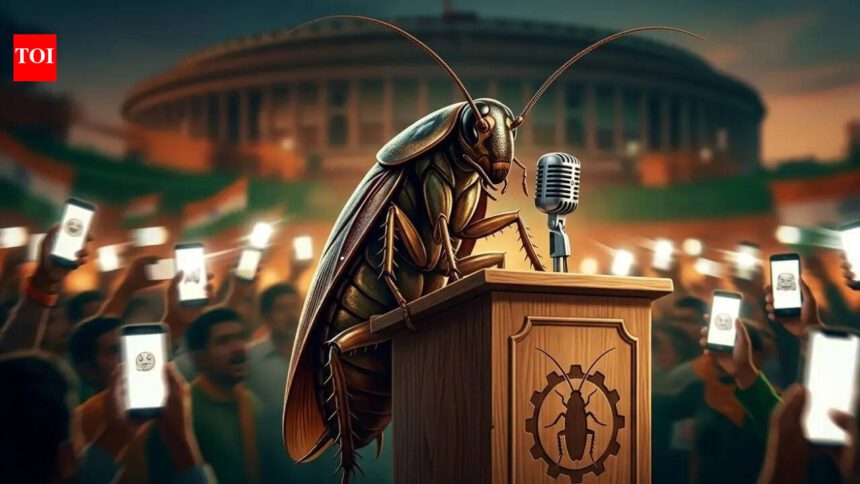

A new political phenomenon has emerged in India, dubbed the Cockroach Janata Party (CJP), which has captured the public’s imagination despite its satirical roots. Initially sparked by a humorous comparison of cockroaches to humans during a court hearing, the CJP’s popularity soared, garnering more followers than both major political parties, the BJP and INC, combined.
The CJP’s manifesto includes a ban on post-retirement Rajya Sabha seats for chief justices, media neutrality, 50% reservation for women in Parliament, and a 20-year election ban for defecting MLAs and MPs. Membership criteria playfully specify that individuals should be “unemployed, lazy, and chronically online,” capable of expressing complaints professionally. Despite criticisms questioning the CJP’s intent, it has resonated with millions, triggering discussions that bridge satire and substantive political commentary.
To understand this phenomenon within the context of today’s attention economy, where the scarcity of human attention dominates over information scarcity, one must acknowledge the evolution of political engagement among youth. Traditional news consumption has drastically declined—most young people no longer start their day with newspapers or tune into TV news. Instead, they scroll through digital platforms for information. Content must be loud enough to stand out against the backdrop of 1.5 billion daily online posts.
Gil de Zúñiga, Strauss, and Huber refer to this engagement pattern as the “News Finds Me” perception. The CJP’s rise can be attributed to this very phenomenon; the original remark about cockroaches was largely shared through memes rather than formal news sources. This virality transformed it into a newsworthy event, perpetuating its popularity. However, questions remain about its sustainability once it breaks from this viral cycle.
From a theoretical perspective, the CJP serves as an example of Bakhtin’s concept of the carnivalesque, wherein traditional hierarchies are temporarily suspended. The term “cockroaches” was initially used disparagingly for unemployed youth. However, the CJP subverts this characterization, transforming it into a movement that critiques perceived flaws in Indian politics. While dissent is commonplace on social media, the CJP’s rapid popularity elevates it to the status of a carnival, but uncertainties surround its long-term aspirations.
Poe’s Law further complicates interpretations of the CJP; online extremism—both satirical and sincere—can appear indistinguishable. The CJP embodies aspects of a legitimate political movement, humor, and performance art simultaneously, with its ambiguity serving as a protective shield against persecution. Legal threats or allegations aimed at suppressing the CJP have, paradoxically, fueled its growth, revealing the Streisand effect: attempts to hide an issue often elevate its visibility, as seen in high-profile censorship battles.
Social identity theory indicates that individuals derive their sense of self from their group affiliations. By identifying as “cockroaches,” many young Indians express a humorous alternative to their shared struggles, indicating a sense of membership in a collective. However, much of this engagement seems to lack depth and understanding, prompting questions about what members genuinely know about the CJP.
Memes have become the prevalent language for political discourse online, making them accessible yet limited in conveying complex ideas. The CJP has effectively created a low-barrier engagement model: joining requires minimal effort, often merely a click or a meme share. While this format enables rapid participation, it raises concerns about the actual meaning of membership and the tangible impacts of collective actions.
The CJP’s membership criteria, which include jokingly labeling participants as ‘unemployed’ and ‘lazy,’ also reflect social realities. The ease of participation generates an illusion of activism, where individuals feel they have contributed simply through meme-sharing or social media engagement. Yet, once the spectacle subsides, it remains unclear what, if anything, will have been achieved in substantive terms.
To view the CJP purely as an inclusive movement overlooks its inherent exclusivity. Its core audience comprises educated, internet-savvy individuals who already possess the means to participate in the digital narrative, reinforcing existing disparities. The humor within CJP appeals primarily to those who understand its references, creating an insular culture that excludes marginalized groups.
In conclusion, while the CJP has emerged as a viral entity, its engagement may ultimately lack the breadth required for meaningful political transformation. Its ongoing success will prompt closer scrutiny regarding who it truly serves and the impact it aims to achieve in India’s complex political landscape.