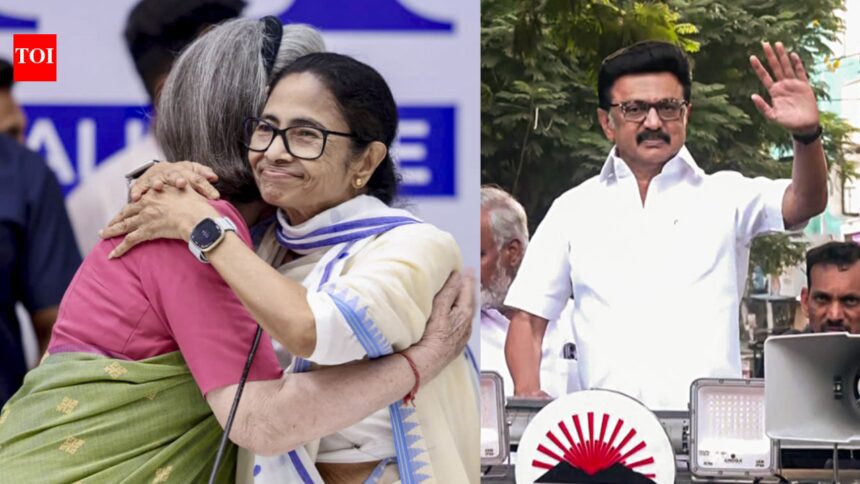

The recent high-level meeting of the opposition INDIA bloc in New Delhi revealed stark divisions among its members, particularly between Trinamool Congress (TMC) chief Mamata Banerjee and DMK’s MK Stalin. While Banerjee showcased her commitment to opposition unity post-election defeats, Stalin’s absence underscored his party’s growing discontent with Congress, raising questions about the future of the alliance ahead of the 2024 Lok Sabha elections.
Opposition Gathering: A Show of Unity and Division
The first high-level meeting of the INDIA bloc since the assembly elections took place at the Constitution Club in New Delhi on Monday. Prominent opposition leaders, including Sonia Gandhi, Mamata Banerjee, and Rahul Gandhi, were present, emphasizing the need for unity against the ruling party. They set five agendas aimed at addressing pressing national issues such as demands for resignations over NEET paper leaks and a letter to the Chief Justice of India regarding electoral integrity.
Despite the show of solidarity, the meeting was overshadowed by DMK’s boycott. MK Stalin’s absence indicates a significant rift and raises concerns about the stability of the alliance, as he signaled a shift away from what he described as a “Congress-led alliance.” This change marks a potential recalibration of power dynamics within the opposition, particularly in light of recent electoral setbacks for several regional parties.
The Divergent Paths of Mamata and Stalin
Mamata Banerjee’s attendance at the meeting contrasts sharply with that of MK Stalin. Banerjee, having lost power in West Bengal to the BJP following a 15-year tenure, is now repositioning herself within the INDIA bloc. Her presence signals an acknowledgment of the importance of opposition unity after significant electoral losses. Recently, internal dissent within her party has forced her to reconsider her strategy, making her participation crucial for both the TMC’s survival and her political relevance on a national scale.
Conversely, Stalin’s decision to withdraw from the meeting can be attributed to the rise of Vijay’s TVK in Tamil Nadu, which has complicated the political landscape. The DMK’s strong relationship with the Congress has faltered, especially after the Congress openly aligned with TVK, seen as a betrayal by Stalin. His absence from the meeting communicates a clear message of discontent and dissatisfaction with how alliances are shifting and evolving.
The Political Ripple Effects
The contrasting strategies of Stalin and Banerjee speak volumes about the broader implications for regional politics in India. Mamata’s renewed focus on the INDIA bloc could offer her the support she desperately needs for relevance and survival in light of recent challenges. The alliance now serves as a political lifeline, allowing her to maintain a foothold in national politics amidst instability within her party.
On the other hand, Stalin’s retreat from collaboration with the Congress potentially jeopardizes the DMK’s influence in Tamil Nadu and its ability to regain power. His explicit resistance indicates that regional parties may no longer view alliances with national parties, primarily the Congress, as beneficial. This friction showcases the ongoing shifts in Indian political power dynamics, where regional leaders are reassessing their relationships based on each party’s fortunes and threats.
What This Means
The immediate impact of these developments is heightened uncertainty regarding the strength and solidarity of the INDIA bloc as it heads into the critical 2024 Lok Sabha elections. The opposing trajectories of Banerjee and Stalin could redefine regional politics. The TMC may become a stronger force within the opposition, advocating for unity against the BJP, while the DMK, if it further alienates itself from the Congress, may struggle to maintain relevance in Tamil Nadu politics against emerging rivals. The broader implication for Indian voters includes the potential emergence of new political alliances that could reshape the electoral landscape.
Frequently Asked Questions
What is the INDIA bloc?
The INDIA bloc is a coalition of various opposition parties in India formed to counter the ruling Bharatiya Janata Party (BJP) in upcoming elections, emphasizing unity among regional and national leaders.
Why did DMK boycott the meeting?
DMK’s MK Stalin chose to boycott the meeting due to dissatisfaction with the Congress’s recent alliance with the newly emerging TVK, which he perceives as a betrayal of their longstanding partnership.
What does Mamata’s participation signify?
Mamata Banerjee’s involvement indicates her shift towards seeking collective opposition against the BJP, recognizing the necessity of alliances to maintain her political relevance following recent electoral defeats.
How might these developments affect the upcoming elections?
The current rifts and realignments within the INDIA bloc could significantly influence voter perceptions and strategies, potentially reshaping the outcome of the 2024 Lok Sabha elections as regional parties reassess their alliances.