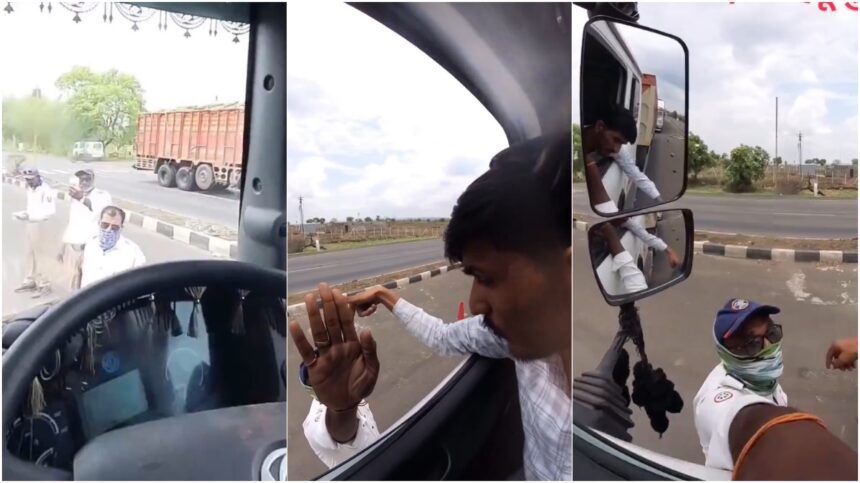

A recent incident from Maharashtra involving a traffic policeman has sparked outrage, primarily due to allegedly discriminatory remarks made concerning the religious identity of a truck driver during a routine roadside inspection. This episode opens a broader conversation about communal attitudes within Indian governance, reflecting systemic issues of discrimination, particularly affecting Muslim communities and other marginalized groups.
Details of the Incident
The viral video depicting the confrontation features Shyamlal Rao, a truck driver from the Hindu Jat community in Rajasthan. The conflict arose during a police roadside check when Rao began recording the interaction on his phone. Tensions escalated when one officer reportedly questioned Rao’s religion by asking, “Are you a Muslim?” This comment was accompanied by an accusation of “gaddari,” or disloyalty, suggesting that Rao’s actions were unbecoming for a Hindu. Rao responded with disbelief, highlighting the inappropriateness of introducing religious identity into a traffic enforcement issue.
Public Response and Social Media Storm
The incident quickly gained traction on social media, igniting a wave of indignation. Users from various religious and social backgrounds condemned the officer’s statements, arguing that law enforcement personnel must uphold ethical standards and neutrality. Many emphasized that public servants, particularly in a pluralistic society like India, have a responsibility to treat all citizens equally without bias based on religion. Civil rights advocates have underscored the need for law enforcement to avoid actions and language that could exacerbate communal tensions, pressing for professional accountability.
The Broader Context of Discrimination
This incident is not an isolated case but part of a larger narrative concerning systemic discrimination faced by Indian Muslims and other marginalized groups. Various reports indicate that such discriminatory practices, whether overt or subtle, have exponentially increased under the aegis of certain political groups, particularly those associated with the Bharatiya Janata Party (BJP) and its ideological affiliates, like the Rashtriya Swayamsevak Sangh (RSS). From economic boycotts to social exclusion, the Muslim community has increasingly found itself positioned on the fringes of mainstream discourse, intensifying feelings of disenfranchisement.
Why It Matters
This incident underscores the vital need for accountability in governance and law enforcement. It highlights how personal biases can infiltrate public services, hindering societal cohesion and security. For developers and AI practitioners, it presents an opportunity to understand the implications of bias in data collection and its potential to perpetuate systemic inequalities. Addressing these biases will be essential for creating equitable AI systems that reflect and uphold values of diversity and inclusion. Recognizing such events allows developers to frame policies and algorithms with greater sensitivity to cultural contexts.
Frequently Asked Questions
What led to the confrontation between the truck driver and the police officer?
The confrontation arose during a routine traffic inspection in Maharashtra when the truck driver, Shyamlal Rao, recorded the interaction on his phone. The situation escalated when an officer made a remark questioning Rao’s religion, which Rao found inappropriate for the context.
What was the reaction to the incident on social media?
The incident prompted widespread condemnation across various social media platforms. Users from different communities criticized the police officer’s conduct, asserting the need for neutrality and professionalism among law enforcement personnel.
What actions were taken following the incident?
A senior police officer intervened, listened to Rao’s complaints, and assisted in de-escalating the situation. Rao demanded an apology from the traffic constable involved, though no official statement regarding disciplinary action has been released as of now.
Why is this incident significant in the context of communal tensions in India?
This incident highlights ongoing issues surrounding discrimination and marginalization faced by certain communities in India, particularly Muslims. It raises critical questions about the impartiality of public servants and the responsibility of the state to uphold democratic values and social justice.