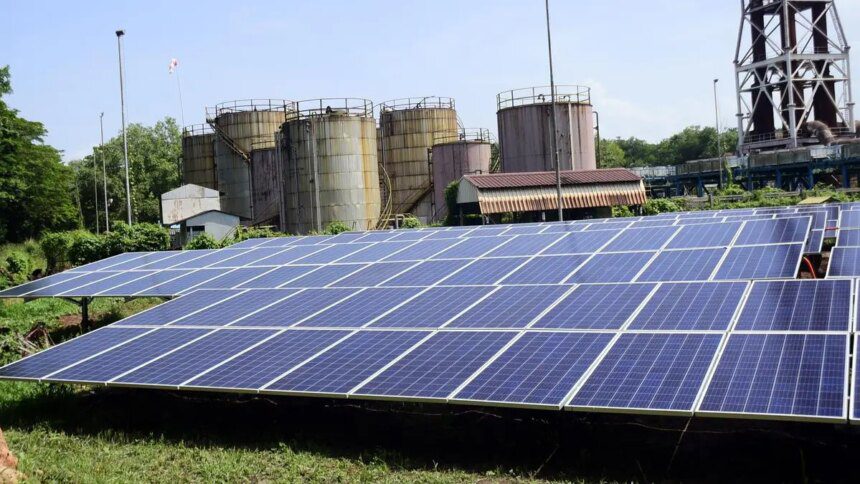

For the Coimbatore-based Natrinai Ventures, the Supreme Court’s order in August 2025, directing electricity distribution companies (discoms) to liquidate their regulatory assets within four years, marks a significant development. Operating under the brand NGE Green, the IPO-bound company plans to construct 350 MW of solar capacity—50 MW by September and the remainder over the next three years—intending to sell power directly to consumers. This ruling has bolstered the company’s confidence in the market.
In essence, liquidating regulatory assets entails raising electricity tariffs, which in turn heightens the appeal of ‘solar-plus-battery’ solutions for consumers. The commercial and industrial (C&I) market is already expanding rapidly, with projections indicating it could reach 80 GW by 2030.
Although the Supreme Court subsequently relaxed the directive, granting discoms seven years instead of four to liquidate accumulated regulatory assets, the ruling has reinforced the argument for open-access renewable energy.
Regulatory assets comprise costs incurred by discoms but not recouped through tariffs within a specific time frame, deferring recovery to the future. Over time, these deferred costs have accumulated to nearly ₹3 lakh crore among Indian discoms, with states like Tamil Nadu, Uttar Pradesh, Rajasthan, and Delhi bearing a significant portion. The Supreme Court asserted that tariffs should, as a “first principle,” accurately reflect actual costs, citing Rule 23 of the Electricity Rules that limits regulatory assets to 3% of approved annual revenue requirements.
Following the Supreme Court’s order, ratings agency ICRA projected that discoms might need to implement tariff increases of 20-40% to eliminate regulatory assets.
Additionally, the Supreme Court directed the Appellate Tribunal for Electricity (APTEL) to monitor adherence to its directives. Last month, APTEL criticized the Delhi Electricity Regulatory Commission for postponing the liquidation of regulatory assets, asserting that its actions appeared “mala fide.”
Discoms have two options for eliminating regulatory assets: hiking tariffs or receiving support from state governments; a combination of both seems probable. Regardless, consumers—particularly industrial users—are expected to face increased tariffs in the coming years.
The renewable energy sector perceives an opportunity arising from this shift. Eazhil Sudharman, Whole-time Director and CEO of Natrinai Ventures, indicated that the company has already secured agreements with customers for the first 50 MW of projects slated for completion by September, with tariffs ranging from ₹4.20 to ₹4.60 per unit. After accounting for additional costs such as cross-subsidy levies, the effective tariff approximates ₹6.5 per unit, remaining attractive for many industrial consumers.
The ₹430-crore company anticipates enhanced realizations for future projects, which could support its planned ₹130-crore IPO.
Other industry leaders express similar optimism. “We are witnessing the end of the era of subsidized grid stability,” stated Vinay Pabba, CEO of Hyderabad-based Vibrant Energy. He explained that as legacy costs transition from discom balance sheets to consumer bills through mandatory surcharges, the economics of renewable energy for the C&I sector become increasingly favorable. Renewable power is evolving into a “long-term hedge” rather than merely a procurement option.
Ashwitha Tunga, policy analyst at the Winnipeg-based International Institute for Sustainable Development (IISD), characterized the liquidation of regulatory assets as a “welcome step” that has long been overdue.
“Discoms have historically struggled to raise electricity tariffs, resulting in a significant increase in electricity subsidies—amounting to ₹2.4 lakh crore, or 1.3% of real GDP, in FY25,” Tunga noted via email. According to IISD estimates, between FY19 and FY25, discoms’ reliance on subsidies to meet operational costs escalated in 23 out of 30 states and Union territories.
“Regular tariff revisions can facilitate financial viability for discoms while preventing abrupt tariff increases for consumers,” Tunga emphasized, adding that disciplined tariff-setting practices would help avert future accumulations of regulatory assets.