
“The destiny of India is being shaped in her classrooms.” This assertion, highlighted in the Kothari Commission report, emphasizes the decisive role of education in determining the trajectory of modern India. It underscores that education is not merely a tool for knowledge dissemination but a structural force that shapes national identity, civic consciousness, and the socio-political future of the country. Against this backdrop, the signing of a Memorandum of Understanding (MoU) between the Kerala government and the Union government’s PM-SHRI (Pradhan Mantri Schools for Rising India) initiative represents far more than a procedural or political exercise; it is a strategically consequential decision with deep and far-reaching implications.
PM-SHRI and the National Education Policy (NEP 2020)
The PM-SHRI initiative aims to renovate and transform over 14,500 schools across India into model institutions. These schools are designed with distinct approaches to infrastructure, pedagogy, curriculum, and other foundational elements. Central to this initiative is the implementation of the 2020 National Education Policy (NEP 2020).
If NEP 2020 is understood as a conceptual policy framework, then PM-SHRI schools exemplify one of its tangible instruments of execution. This renders the initiative not merely a program for improving educational infrastructure but part of a coordinated strategy to mold India’s education system into a singular cultural-political project.
While the superior infrastructure and academic standards of these “model schools” are often highlighted, they simultaneously operationalize NEP’s broader agenda, which many critics interpret as a mechanism for cultural homogenization.
Official documents related to PM-SHRI consistently position NEP 2020 as the foundational guiding principle. Even a cursory reading of the Ministry of Education’s framework clarifies this connection. The introductory pages explicitly note that the schools under the project will showcase various dimensions of NEP. Subsequent sections describe how these schools facilitate the policy’s implementation, while publicly available documentation elaborates on the alignment of curriculum, pedagogy, and syllabi with NEP’s directives.
The MoU signed by Kerala reflects similar commitments, stipulating that state governments must fully implement all provisions of NEP 2020. In practice, this means that the operation of PM-SHRI schools cannot be reconciled with an uncompromising stance against NEP, a point acknowledged even by the leadership of Students Federation of India (SFI), the student wing of CPI(M), the ruling party in Kerala.
The saffronisation of education
Hindutva-aligned organizations have historically prioritized education as a tool for ideological influence. For decades, institutions under the Sangh Parivar have strategically shaped the national education system to align with a narrow nationalist agenda.
The NEP 2020, released after a 34-year policy hiatus, reflects the cumulative influence of these long-term efforts. According to K.G. Suresh, spokesperson of the Bharatiya Shikshan Mandal (BSM), approximately 60–70% of the recommendations advanced by such organizations were incorporated into NEP 2020 in one form or another.
Journalist Ashmita Nandi has further documented the explicit role of Hindutva forces in shaping the policy. From its inception, NEP 2020 has faced strong criticism for embedding elements that saffronise India’s educational framework. Key features include: the indigenisation of education, the promotion of Hindu values, the prioritization of Sanskrit, and the deliberate marginalization of minority educational rights.
Beyond ideological content, these agendas manifest in curriculum revisions, research directives, and centralized student-data systems. The recent removal of the Mughal and Delhi Sultanate periods from the NCERT 7th-grade history textbook illustrates this trend. Similarly, research topics guided by NEP’s “Knowledge of India” framework are being introduced in higher-education institutions across India, including Kerala.
PM-SHRI schools must, therefore, be interpreted within this broader trajectory of systematic educational saffronisation.
Contradictions in the CPI(M)’s stand
When NEP 2020 was released, the Left-led CPI(M) government in Kerala undertook research, campaigns, and reports highlighting its alignment with Hindutva interests. Yet despite these efforts, CPI(M) leadership has paradoxically reiterated its opposition to NEP in recent public statements, revealing a dissonance between historical positions and current political practice.
Even prominent leaders who had once offered detailed critiques of the policy, such as then DYFI All-India President and current Public Works Minister P.A. Mohammed Riyas, continue to maintain their earlier analyses publicly. The SFI, CPI(M)’s student wing, still holds an uncompromising anti-NEP stance.
However, CPI(M) was reportedly caught off guard by the MoU signing for PM-SHRI, which was executed without consultation with coalition organs. This has led to both internal dissent and public criticism, with student and youth wings protesting what they see as the quiet transfer of Kerala’s educational autonomy into the hands of Hindutva influence.
Through its involvement in PM-SHRI, CPI(M) appears to have compromised its own ideological history, current principles, and declared policies.
Economic and political justifications
The Kerala government’s justification for signing the MoU centers on Union government pressure and the coercive nature of center-state fiscal relations. Kerala’s central allocation for public education stands at ₹1,466 crores, while Tamil Nadu and West Bengal have faced even greater financial restrictions, ₹2,151.60 crores and ₹1,745.80 crores, respectively, in 2024–25. Tamil Nadu has challenged such pressures by the Union government legally in the Supreme Court.
Resistance to PM-SHRI by other states has largely been grounded in objections to full NEP implementation. Proponents in Kerala, however, highlight the supposed superiority of PM-SHRI schools in academic standards and infrastructure, even though Kerala’s average public schools had already reached comparable standards decades ago.
Additionally, the government views PM-SHRI as a means to bypass complete NEP implementation while still establishing mechanisms for comprehensive student-data collection, such as the APAAR “One Nation, One Student ID” initiative, a strategy that Kerala has so far resisted or partially implemented.
The secrecy surrounding these decisions, taken without consultation with key party leadership, casts serious doubt on CPI(M)’s claims of offering a principled alternative.
A structural shift in Kerala’s educational politics
The Kerala government’s signing of the PM-SHRI MoU represents a significant step toward aligning the state’s education system with Hindutva-aligned policy frameworks. Multiple incentives, administrative, fiscal, and political, may have influenced CPI(M)’s decision.
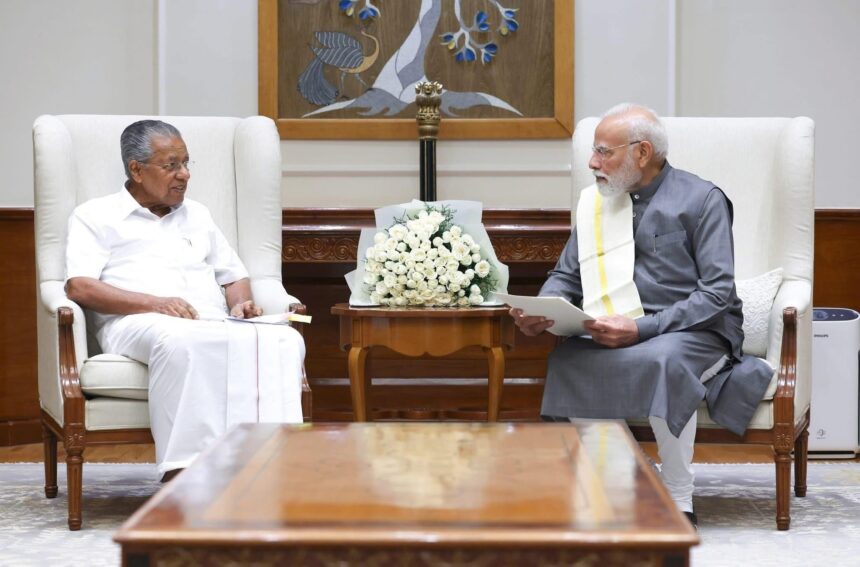
The timing and secrecy of the signing, reportedly following high-level meetings in Delhi, suggest that this was not a bureaucratic oversight but a deliberate political choice.
Emerging patterns hint at an evolving CPI(M)–RSS coordination, which may influence future electoral and governance strategies. The PM-SHRI project must, therefore, be viewed as more than an educational reform; it is a deliberate policy instrument aimed at saffronising India’s education system, extending beyond the ruling party’s immediate political interests.
The author is the State Secretary of SIO Kerala.
The post How Kerala’s PM SHRI pact opens the gates for the saffronisation of education appeared first on Maktoob media.