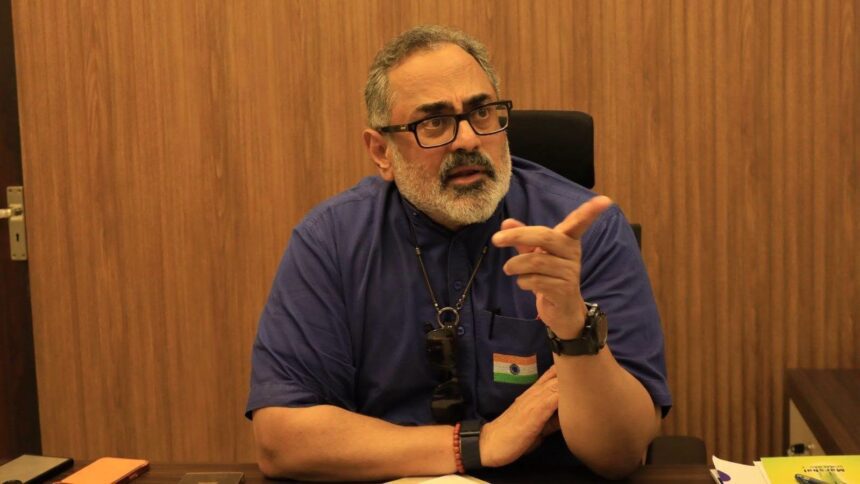

In a contentious political landscape, Kerala BJP president Rajeev Chandrasekhar has raised alarms about the Indian Union Muslim League (IUML), an ally of the Congress party, alleging the introduction of Sharia law-like systems. This criticism follows shocking remarks by Kerala Grand Mufti Sheikh Abubakr Ahmad, who suggested that women should remain confined to domestic spaces. The situation ignites a debate on women’s rights and political alliances within the state.
Political Tensions Erupt Over Women’s Rights
Rajeev Chandrasekhar vocalized his discontent after Sheikh Ahmad’s comments, urging citizens to recognize the implications of an alliance he perceives to be undermining constitutional values. “I appeal to every citizen of the country to see what is happening in Kerala under the Congress and Muslim League alliance,” he urged, expressing concern over a perceived regression in social norms, particularly regarding women’s roles. “The Indian Union Muslim League is crossing constitutional boundaries,” he stated, asserting that the IUML is advancing a foreign ideology detrimental to women’s status in society.
Chandrasekhar’s stance also indirectly critiques Congress leader Rahul Gandhi, questioning how Gandhi can endorse the Muslim League’s agenda while speaking against patriarchy. “An Indian Union Muslim League minister says that religion is their priority. If this is the thinking of the Muslim League, then how can Rahul Gandhi… certify the Indian Union Muslim League as a secular party?” This rhetorical framing seeks to position the BJP as a defender of women’s rights in contrast to what it frames as a regressive alliance.
Grand Mufti’s Controversial Remarks
The controversy erupted after Grand Mufti Sheikh Abubakr Ahmad compared women to a “gold necklace,” arguing their value is preserved when they are kept safe at home. His analogy suggested that exposing women to public life could diminish their worth: “If a gold necklace were left on the street, passers-by could touch it, potentially affecting its appearance and value.” Critics immediately labeled this viewpoint as discriminatory and a direct affront to women’s autonomy.
While Sheikh Ahmad asserted that his intention was to highlight women’s safety and dignity, many interpreted his comments as perpetuating a patriarchal narrative that opposes gender equality. This analogical framework has ignited scrutiny not only of his statements but also of the broader cultural attitudes that enable discriminatory ideologies.
The Broader Implications for Society
The remarks by both Chandrasekhar and Sheikh Ahmad have further intensified discussions surrounding women’s freedom and the role of religion in politics. Critics point out that such dialogues may engender social exclusion, especially for Muslim women, who may face heightened marginalization due to political affiliations that seemingly position them against progressive social models.
The BJP has positioned itself as a champion of women’s rights through this discourse, asserting that the Grand Mufti’s comments are an attack on equality. Meanwhile, the IUML and its supporters claim their assertions are misconstrued, focusing on the intent of preserving cultural norms rather than denigrating women. This back-and-forth reflects not just a local political struggle but also a national conversation about identity, power, and rights.
Why It Matters
This evolving narrative encapsulates a critical intersection between religion, politics, and gender in contemporary India. The BJP and its allies leverage incidents like these to reinforce their political stance and garner support while aiming to marginalize voices they see as regressive. In contrast, the Muslim League and Congress face pressure to define their positions on gender issues more clearly amid allegations of hypocrisy. The outcome of this discourse holds the potential to reshape political alliances and influence broader societal attitudes towards women and minority rights in India.
Frequently Asked Questions
What did the Grand Mufti say about women’s role in society?
The Grand Mufti suggested that women should stay at home instead of participating in public life, equating their value to that of a gold necklace that is best kept safe rather than exposed.
What is Rajeev Chandrasekhar’s stance on the IUML?
Chandrasekhar has accused the IUML of attempting to introduce a Sharia law-like system in Kerala, arguing that this poses a threat to women’s rights and constitutional values.
How has the political climate in Kerala responded to these comments?
The remarks have led to a significant political and social debate over women’s rights, equality, and the role of religion in governance. The BJP and IUML’s respective positions have sparked discussions about patriarchal ideologies and social exclusion.
What are the implications for women’s rights in India?
This situation underscores the ongoing struggle for gender equality in India, particularly within Muslim communities, highlighting the need for inclusive dialogues and action towards women’s empowerment.