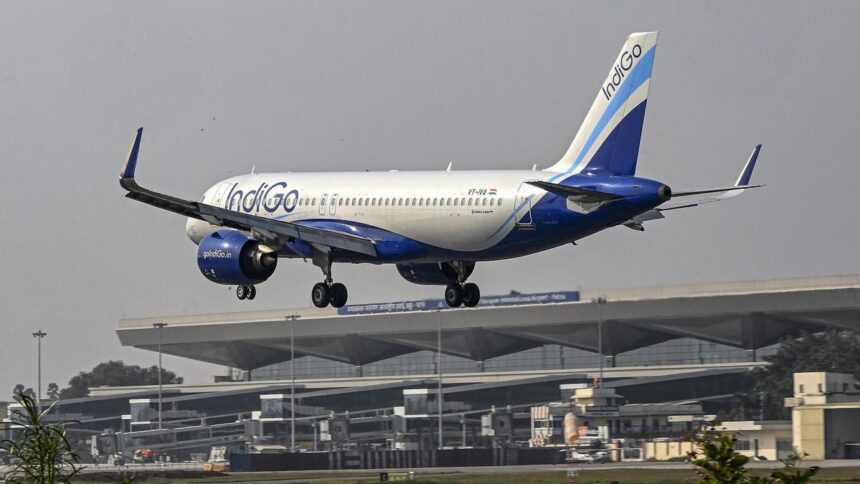

InterGlobe Aviation shares experienced an increase on Monday as investors shifted their focus from the airline’s loss in the March quarter to positive fare trends, industry capacity constraints, and optimistic reports from brokerages.
The stock rose as much as 5.2% to ₹4,633.90 on the NSE in early trading, compared to the previous close of ₹4,405, before ultimately settling at ₹4,453.30.
For the quarter ending March 2026, IndiGo’s parent company reported a consolidated net loss of ₹2,536.9 crore, a significant drop from a net profit of ₹3,067.5 crore during the same period last year. This decline is attributed to increased fuel costs, rupee depreciation, foreign exchange losses, and operational disruptions linked to Middle Eastern airspace issues and aircraft groundings.
Despite these setbacks, brokerages noted that the market is focusing on IndiGo’s long-term earnings outlook, fueled by supply shortages in the aviation sector, rising airfares, and the airline’s continued market share growth.
Elara Capital pointed out that InterGlobe Aviation shares have fallen about 25% over the past six months, while the Nifty index has only declined around 10%. They attributed this drop to temporary operational disruptions and macroeconomic concerns like crude oil prices and currency depreciation, emphasizing that a lasting industry capacity shortage supports higher airfares.
According to Elara Capital’s analysis of around 400 domestic routes, 15-day advance fares rose roughly 17% year-on-year during April-May 2026, while 30-day advance fares on IndiGo’s international network surged approximately 40% year-on-year. They noted a nearly 6% decline in domestic departures year-on-year in the summer schedule, as competitors reduced capacity, creating favorable conditions for pricing and market share expansion. Elara reiterated a buy recommendation with a target price of ₹6,020.
Motilal Oswal also maintained a buy rating, setting a target price of ₹5,600, citing confidence in IndiGo’s long-term growth strategy despite facing near-term challenges. They highlighted the management’s commitment to accelerating the aircraft ownership strategy, backed by total cash reserves of ₹51,600 crore, including ₹36,200 crore in free cash.
The brokerage noted that IndiGo prepaid loans on 17 aircraft in FY26 and currently owns 36 unencumbered aircraft valued at over ₹9,500 crore. They also pointed out the company’s planned $820 million investment in its GIFT City entity for aviation asset acquisition.
On operations, Motilal Oswal mentioned that the conflict in the Middle East resulted in about 160 daily flight cancellations, though international capacity has recovered from 20% to nearly two-thirds. Full normalization is anticipated by the end of June, with demand expected to improve quarter-on-quarter in the second quarter of FY27.
They mentioned that cases of Pratt & Whitney aircraft grounded remain in the “40s” and are predicted to decrease to the “30s” by the end of FY27. During FY26, IndiGo added 72 aircraft to its fleet, bringing the total to 441, with A321XLR deployments supporting expansion into European destinations such as Athens and Istanbul.
Motilal Oswal forecasts a compound annual growth rate of 13% for revenue and 46% for EBITDAR from FY26 to FY28.
Global brokerages Jefferies and Goldman Sachs also maintained buy ratings with target prices of ₹5,380 and ₹5,200, respectively. Jefferies stated that IndiGo’s near-term outlook remains “clouded,” despite the airline retaining its long-term leadership position in the Indian aviation market. They noted that elevated fuel, foreign exchange, and maintenance costs may impact profitability in upcoming quarters, even as fares are increased to offset these expenses.
Jefferies observed that IndiGo is adopting a more measured, profitability-focused growth strategy, reducing its planned capacity expansion in favor of network optimization and fleet efficiency. Although they revised downward their earnings estimates for FY27 and FY28, they retained their buy rating, citing confidence in IndiGo’s dominant market share and long-term growth potential.
Bank of America and Kotak Institutional Equities also reaffirmed their buy ratings at target prices of ₹5,100 and ₹5,400, respectively. Kotak noted that the reported loss was less severe than expected, despite a significant mark-to-market foreign exchange loss, and mentioned that current pricing trends suggest successful testing of demand elasticity. They expect substantial relief from aircraft groundings by FY28.
Published on June 1, 2026.