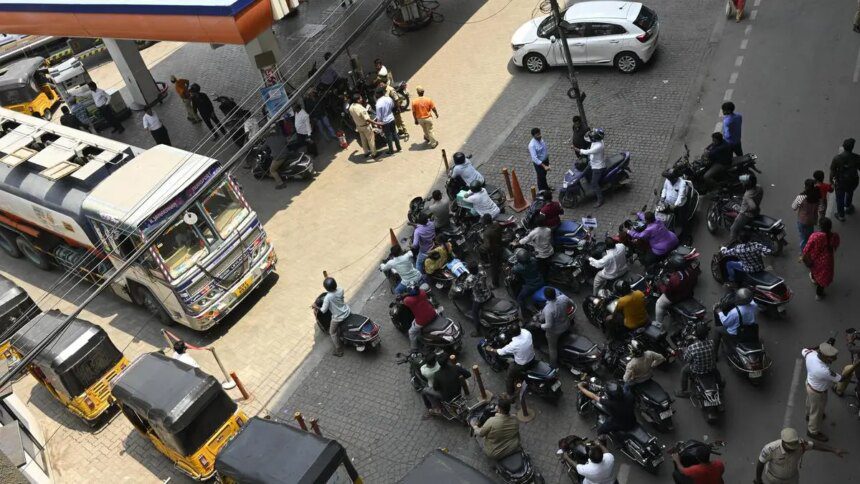

India has no intentions to ration fuel supplies amid ongoing global energy market disruptions, according to a senior official from the oil ministry. Oil Secretary Neeraj Mittal stated on Monday that the country has maintained sufficient stockpiles of crude products and liquefied petroleum gas (LPG) while diversifying its import sources to mitigate supply risks.
“There is no need to panic. There are sufficient supplies. There is no rationing in place. It’s not going to happen,” Mittal affirmed at the CII’s Annual Business Summit. He highlighted that India has approximately 60 days’ worth of fuel stocks and about 45 days’ worth of LPG inventories during the past 67 days of market instability.
This announcement followed Prime Minister Narendra Modi’s recent call for fuel conservation and reduced imports, in light of surging global energy prices that threaten India’s foreign exchange reserves. Modi also urged for less gold purchasing to alleviate external vulnerabilities, a move that some analysts interpreted as a precursor to potential fuel price increases.
Currently, petrol and diesel prices remain unchanged despite a 50% rise in international costs since the onset of the conflict in West Asia over the past 10 weeks. Maintaining these prices has led to oil companies incurring losses estimated between ₹1,000 crore to ₹1,200 crore, raising concerns over their financial stability. However, a top government source emphasized that the government’s default approach is to preserve price and supply stability.
In response to the crisis, Mittal mentioned that the government has secured additional energy shipments, boosted procurement from existing suppliers, and absorbed some of the price increases through fiscal measures, including excise duty reductions on petrol and diesel.
As the world’s third-largest oil importer and consumer, India is also accelerating domestic exploration, strategic storage initiatives, and alternative energy programs—such as green hydrogen, ethanol blending, and sustainable aviation fuel.
“For a country like India that consumes 5 million barrels a day, maintaining a 90-day reserve would mean locking up a lot of capital,” he explained. The government is seeking “creative ways” to expand its strategic reserves while generating returns from stored crude.
Mittal noted that the country has effectively managed supply disruptions stemming from geopolitical conflicts and limitations in global energy transportation over the past 67 days. He stated that the situation remains challenging, but India has successfully dispatched 14 ships from the war-affected Strait of Hormuz.
He reiterated that India has sustained 60 days’ worth of fuel stocks and roughly 45 days of LPG resources throughout the crisis. “We have procured from a variety of other sources and increased procurement from existing suppliers, which has kept us afloat in terms of supply management in the short term,” he said.
India’s extensive refining capability has also helped cushion the effects of supply shocks, enabling the nation to meet domestic demands while continuing to export refined petroleum products. The government has implemented targeted demand-management strategies, including prioritizing LPG supplies for household cooking and allowing 70% of industrial LPG to be supplied after industry requests for eased restrictions.
Mittal highlighted that nearly complete digital tracking of LPG cylinder deliveries has significantly curtailed diversion and black-market sales. “There is no need to panic. There’s sufficient supply. There is no rationing in place. It’s not going to happen,” he assured attendees.
Regarding strategic reserves, Mittal expressed that India is assessing “creative ways” to expand stockpiles without excessively tying up capital, given the nation’s daily oil consumption of around 5 million barrels. He noted that the government is exploring commercial partnerships and trading models to ensure that strategic crude inventories can yield returns as well.
Additionally, Mittal remarked that the government has absorbed a significant portion of the price shock through fiscal policies, including excise duty cuts on petrol and diesel, which have had a revenue impact of approximately ₹1.6 lakh crore. He emphasized that India has remained “a relative oasis of calm” compared to other nations that have implemented fuel rationing or stricter demand restrictions.
Published on May 11, 2026.