
India’s jewellery consumers are increasingly shifting from impulse buying to a more measured, research-oriented approach in their shopping habits. As digital platforms gain prominence, many customers are now browsing extensively rather than making immediate purchases. This trend has resulted in elevated traffic to jewellery sites, yet conversions remain sluggish.
Gaurav Singh Kushwaha, Founder and CEO of Bluestone, remarked on this behavioral change, highlighting that while foot traffic in stores is still significant, the frequency of purchases is declining. “You cannot walk into a jewellery store 10 times a month and not buy anything. Online works beautifully for browsing, and the behavioural change we’re seeing is that women are browsing a lot more than they are buying—10 to 30 times more,” he stated.
This transformation is echoed across the industry. Suvankar Sen, MD and CEO of Senco Gold and Diamonds, noted that shoppers are now more research-driven. “Customers are comparing designs, tracking prices, and planning purchases more consciously. Intent remains strong, but the journey has become more research-oriented,” he explained.
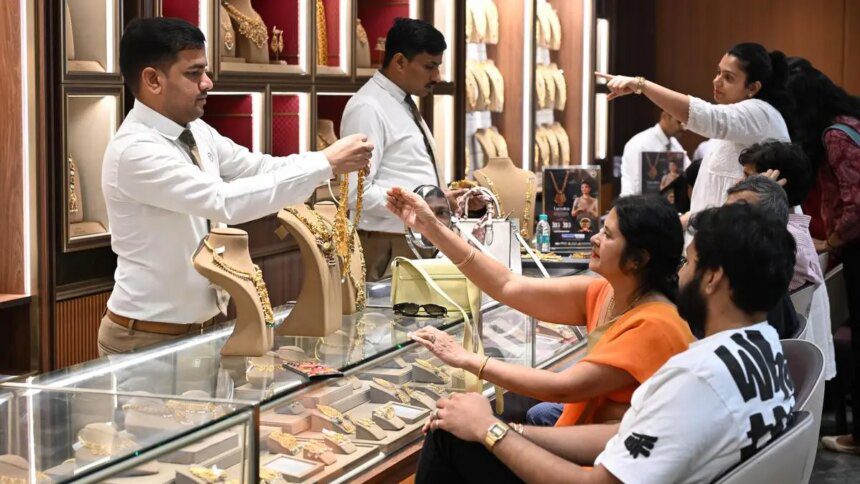
Gold price volatility is a crucial factor influencing consumer behaviour. With prices fluctuating and remaining high, many buyers are opting to postpone purchases or wait for price corrections. “Consumers are still emotionally attached to gold, but when prices move sharply, they prefer to wait or buy closer to an occasion,” added Sen. This change has expanded the purchase cycle, with healthy footfalls and digital interactions but slower conversion rates. Increasingly, consumers are using multiple channels—researching online and completing purchases in-store, where the tactile experience enhances trust.
Tanishq executives assert that this rise in browsing activity is a positive development. CEO Arun Narayan emphasized that online platforms are becoming essential for consumer engagement, regardless of where the final purchase occurs. “Traffic to our website is growing strongly. It reflects high consumer interest, even if the final purchase may happen elsewhere,” he noted.
A distinct trend in purchasing patterns has emerged, showcasing a preference for lighter, lower-cost jewellery items such as 9K and 14K gold for daily wear, as well as coins and smaller investments. While consumers are still engaging in gold transactions, they are doing so within more constrained budgets and with sharper focus.
Even in the context of weddings and festive occasions—traditionally significant motivators for jewellery sales—buyers are opting for more deliberate decision-making, often waiting until the event is closer for their purchases. For jewellers, this shift necessitates adapting to a clientele that is informed, patient, and increasingly oriented towards digital channels. The challenge now lies in transforming well-researched browsers into actual buyers, frequently at the last moment.
This article was published on May 3, 2026.