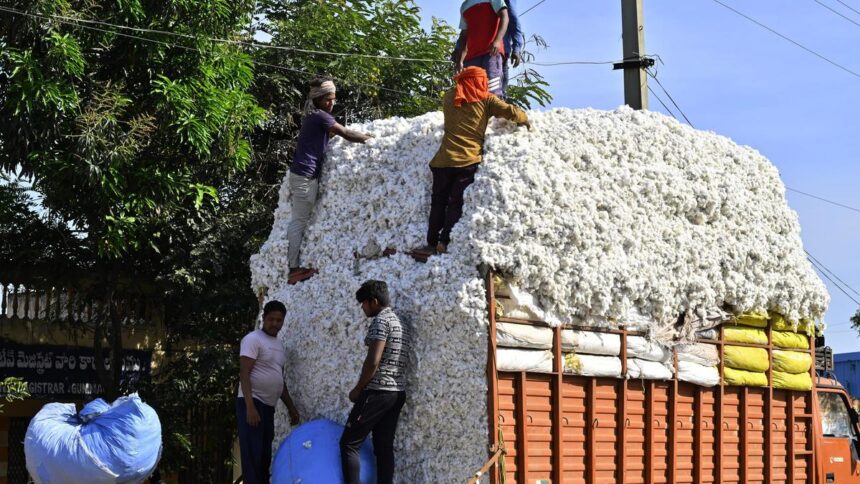

Union Agriculture Minister Shivraj Singh Chouhan has proposed a compromise following demands from the Ministry of Textiles and industry stakeholders to permit zero-duty cotton imports until December 2026. This request was met with opposition from the Ministry of Agriculture and Farmers’ Welfare, which argued that such a move would send a detrimental message to farmers, especially since cotton sowing has already commenced.
Chouhan suggested two alternative options: one would allow zero-duty imports in September-October, given that current domestic stocks are adequate to meet demand until August. The second option would reduce the import duty from the current 11% to about 6-7%, according to official sources.
Last week, Chouhan convened a meeting with representatives from the Federation of Indian Export Organisations (FIEO) and officials from the textiles, agriculture, commerce, and finance sectors to assess garment exporters’ needs. It was reported during the meeting that approximately 47 lakh bales of cotton are currently held by the public sector Cotton Corporation of India. Combined with private sector stocks, domestic supply is expected to satisfy industry demand through at least August.
Regarding local cotton prices, industry representatives have indicated that current rates are excessively high. As the new cotton harvest is anticipated to begin in October, it is believed that adequate supplies will be available for September-October, pending government decisions weighed against both short-term and long-term forecasts.
In Punjab, state officials noted that cotton sowing is largely completed, having started around mid-April. In contrast, major growing states, such as Gujarat, Madhya Pradesh, and Maharashtra, typically begin planting in May, while southern states follow suit in July.
Cotton acreage has seen a decline, with production in 2025-26 recorded at 290.91 lakh bales, down from 297.24 lakh bales in 2024-25, despite a stable cultivation area of 114.8 lakh hectares in the past two years. This area has decreased from a peak of 129.27 lakh hectares in 2022-23, influenced by more reliable returns from crops like maize and paddy, as well as risks associated with the pink bollworm pest affecting cotton yields. Data indicates that cotton acreage has decreased more than any other crop over the past six years, dropping by 20 lakh hectares.
According to estimates from the Cotton Association of India (CAI), production for the 2025-26 season (October-September) is projected at 324 lakh bales, with a consumption forecast of 315 lakh bales. The association also estimated imports at 47 lakh bales and exports at 15 lakh bales, with closing stocks expected to be around 292 lakh bales by March 31.
Earlier reports indicated that the Textile Ministry had advocated for a temporary suspension or reduction of import duties on raw cotton. This measure aims to alleviate input costs for apparel exporters, especially in light of recent crises in West Asia. Rising yarn and fabric prices have increased production costs for the industry, diminishing the competitiveness of Indian exports despite sustained global demand. The Apparel Export Promotion Council (AEPC) has noted a 2.2% decrease in textiles and garment exports, totaling $35.8 billion in 2025-26, attributed to declining shipments across key segments, including cotton.
Published on May 3, 2026.