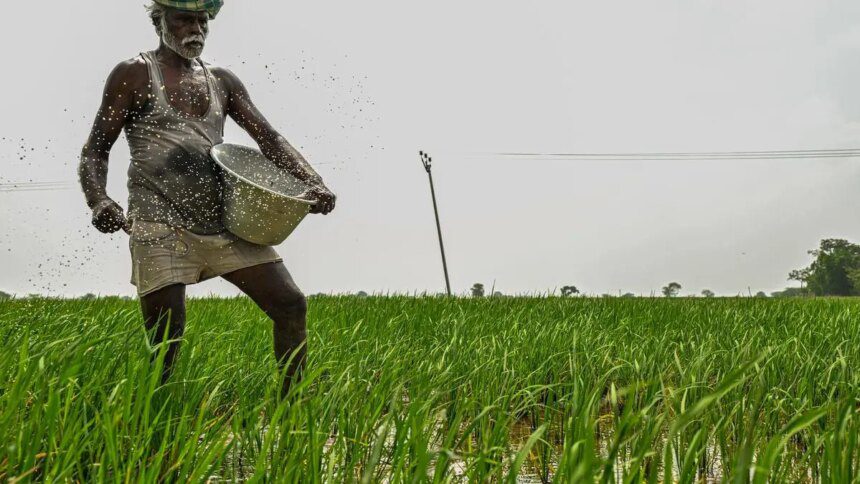

In a bid to address price distortions in specific crops highlighted in the Economic Survey, the Indian government announced a Rs 10 per quintal increase in the minimum support price (MSP) for maize and a 3 percent rise in the MSP for paddy for the kharif season of 2026. The MSP for pulses (excluding moong), oilseeds, and nutri-cereal crops has experienced hikes ranging from 4 to 9 percent compared to the previous year.
Following the Cabinet Committee on Economic Affairs’ (CCEA) approval of price recommendations from the Commission for Agricultural Costs and Prices (CACP), Information and Broadcasting Minister Ashwini Vaishnaw stated that the new MSPs are designed to ensure favorable prices for farmers, set at a minimum of 50 percent above the cost of production (A2+FL formula) across all 14 crops.
The government estimates that the overall payout to farmers will reach Rs 2.60 lakh crore following the MSP revisions, with annual procurement projected at 824 lakh tonnes. The margin over costs is expected to be highest for moong at 61 percent, followed by bajra and maize at 56 percent each, and tur/arhar at 54 percent.
Specifically, the MSP for paddy has been increased by Rs 72 per quintal to Rs 2,461 per quintal, while the maize MSP has been raised by 0.4 percent to Rs 2,410 per quintal, and moong by 0.1 percent to Rs 8,780 per quintal. The MSP for common grade paddy has also been adjusted upward by Rs 72 to Rs 2,441 per quintal from Rs 2,369 per quintal. Notably, over 85 percent of paddy procured for the Central Pool consists of Grade A varieties.
In further adjustments, the MSP for tur (arhar) has increased by Rs 450 to Rs 8,450 per quintal, urad by Rs 400 to Rs 8,200 per quintal, soyabean by Rs 380 to Rs 5,708 per quintal, and groundnut by Rs 254 to Rs 7,517 per quintal. Moreover, the sunflower seed MSP is up by Rs 622 to Rs 8,343 per quintal, that of niger by Rs 515 to Rs 10,052 per quintal, and sesamum by Rs 500 to Rs 10,346 per quintal.
The Economic Survey presented by the government in January 2026 attributed the increased maize cultivation partially to the ethanol program, which impacts oilseeds and pulses negatively, despite a rise in paddy acreage. The report noted that the price of ethanol derived from maize had increased at an annual rate of 11.7 percent over three years up to FY25, but it did not effectively reduce paddy acreage as anticipated. Meanwhile, the production of millets, pulses, and oilseeds either stagnated or declined.
In the 2025-26 period, the MSP for maize was raised by 8 percent, leading to an acreage expansion to 120.91 lakh hectares from 112.41 lakh hectares, and an increase in production from 377 lakh tonnes to 434 lakh tonnes. Farmers extended the cultivation area to 138 lakh hectares in 2025-26, even though maize prices averaged 27 percent below the MSP at Rs 1,739 per quintal between October 2025 and April 2026.
The MSP for cotton (long staple), which remains a preference for many farmers, increased by Rs 557 to Rs 8,667 per quintal, while the medium staple cotton MSP rose by the same amount to Rs 8,267 per quintal. The MSP for jowar (sorghum) saw the highest percentage increase of 8.8 percent among the listed crops, moving to Rs 4,023 per quintal from Rs 3,699 per quintal. The MSP for bajra (millet) increased to Rs 2,900 per quintal, up from Rs 2,775 per quintal in 2025-26, and ragi’s MSP rose by Rs 319 (6.5 percent) to Rs 5,205 per quintal.
Dharmendra Malik, spokesperson for the Bharatiya Kisan Union (apolitical), responded to the new MSP announcements, stating that production costs for crops have surged by over 30 percent due to geopolitical tensions in the Gulf region. He deemed the 3 percent increase in paddy MSP as insufficient and urged the government to reconsider the decision, citing concerns over a potential increase in the debt burden for rice-producing farmers. Malik highlighted the need for the government to heed apprehensions regarding lower production in view of a forecasted below-normal monsoon as El Niño approaches.
Published on May 13, 2026.