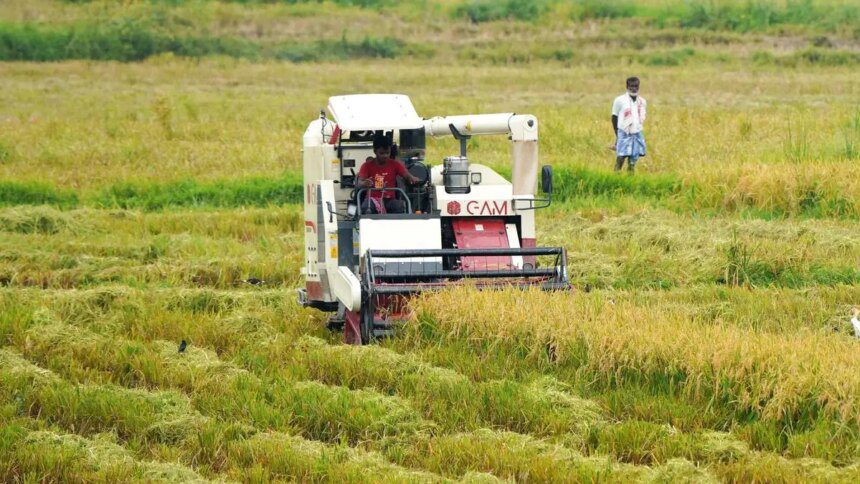

According to a weekly update from the Agriculture Ministry, paddy sowing has decreased by 4 percent to 31.05 lakh hectares (lh) from 32.42 lh in the same period last year. The total area for summer (Zaid season) crops, which is expected to conclude this week, has reached 86.02 lh, a 3 percent increase from the 83.50 lh reported during the previous year. The Zaid crop is cultivated prior to the kharif sowing season and follows the rabi harvest.
While areas for most crops have increased this year, both paddy and moong (green gram) have shown declines. The Madhya Pradesh government’s decision to offer a bonus above the minimum support price (MSP) for urad (black matpe) has led to an increase in the area planted for this crop. However, the overall acreage for summer moong has seen a decrease.
The Agriculture Ministry’s report indicates that while paddy sowing is down, the area under nutri/coarse cereals has risen by 12 percent to 16.01 lh from 14.25 lh a year earlier. Specifically, maize acreage has increased by 18 percent to 10 lh, while bajra has grown slightly to 5.4 lh from 5.2 lh. Ragi and jowar also reported minor increases.
Pulses Area Increases
The area under summer pulses has climbed to 27.91 lh, up from 27.26 lh a year ago. Moong coverage is at 23.01 lh, down from last year’s 23.49 lh, while urad has increased by 29 percent to 4.60 lh from 3.58 lh. Major producers of summer pulses include Madhya Pradesh, Bihar, Odisha, Tamil Nadu, Uttar Pradesh, and Gujarat. Summer pulses play a critical role in offsetting declines seen in kharif crops. Estimates for Kharif pulse production for 2025-26 are at 7.63 million tonnes (mt), down from 7.73 mt in 2024-25, while Rabi-grown pulses are projected at 16.24 mt, compared to 15.23 mt last year.
With a bonus of ₹600 per quintal over the MSP of ₹7,800/quintal for urad, the Madhya Pradesh government aims to incentivize farmers to shift from moong to urad during the summer season.
Additionally, oilseeds have also seen an increase in area, rising to 11.04 lh from 9.58 lh. This includes groundnut at 5.51 lh, up from 4.20 lh, and sesamum at 5.07 lh, compared to 4.96 lh last year.
The government has set a target of 19.67 mt for foodgrain production from summer crops for the 2025-26 crop year (July-June). This target encompasses 12.15 mt of rice, 4 mt of maize, 1.14 mt of nutri cereals, and 2.39 mt of pulses. The specific targets include 1.10 mt for bajra, 0.32 mt for urad, 2.07 mt for moong, and 1.37 mt for oilseeds.
Separate Data Collection
Last year’s summer crops produced 19.11 mt of foodgrains, with breakdowns including 11.28 mt of rice, 3.85 mt of maize, 1.26 mt of nutri cereals, and 2.72 mt of pulses. The outputs also included 1.23 mt of bajra, 0.35 mt of urad, and 2.37 mt of moong, along with 1.33 mt of oilseeds.
Historically, summer crop areas were included in kharif or rabi season data; however, the government began separate data collection a few years ago. The average area covered for summer crops over the past five years stands at 75.37 lh, with an all-time high of 83.92 lh recorded in 2024-25. Summer crops contributed to 5.3 percent of the total foodgrain production, which reached 357.73 mt in 2024-25.
Published on May 26, 2026.