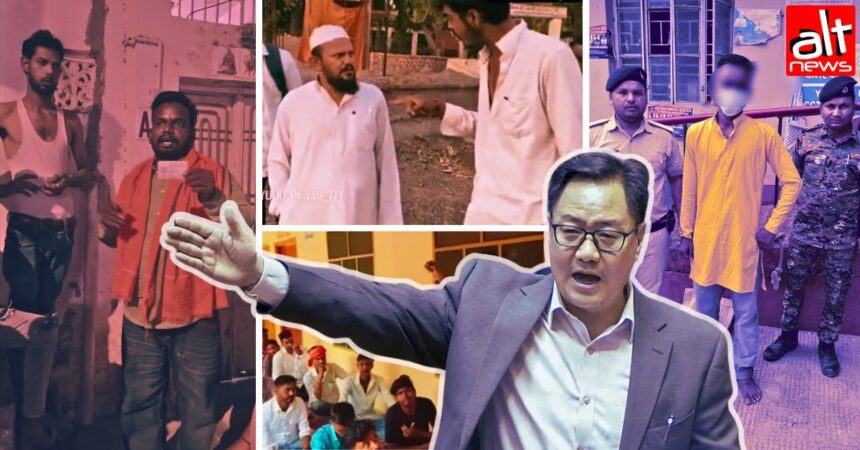

Recent statements made by Union Minister of Minority Affairs Kiren Rijiju asserting that Muslims are safe in India stand in stark contrast to a series of incidents revealing systemic discrimination and violence against the community. Events occurring shortly before and after his remarks highlight a troubling climate of fear and hostility directed at Muslims by hardline nationalist groups in India.
Rijiju’s Claims Versus Ground Realities
During an interview at the Indian Express Idea Exchange on June 15, 2026, Kiren Rijiju stated, “You are maligning the character of the nation by saying that Muslims are not safe in India.” He suggested that the situation of religious minorities in the country has improved since the Modi administration took office, alluding to the phrase ‘Sabka Saath, Sabka Vikas’. However, this assertion is undermined by multiple incidents of violence and intimidation against Muslims reported within days of his statements.
Exclusive Union Minister Kiren Rijiju Interview|
“Don’t target your own nation by saying Muslims are not safe in India,” said Union Minister of Parliamentary Affairs and Minority Affairs Kiren Rijiju…
— The Indian Express (@IndianExpress) June 14, 2026
Despite Rijiju’s claims, the climate of fear is palpable. For instance, on June 15 in Ahmedabad, Ganesh Vanzara, associated with right-wing groups, confronted a Muslim tenant and demanded he vacate his home, invoking the discredited ‘love jihad’ conspiracy theory. Such incidents raise questions about the government’s narrative regarding the safety and welfare of minorities.
Incidents of Violence and Harassment
Instances of targeted harassment against Muslims have surged, leading to serious concerns about their safety. Videos surfaced in recent days showcasing various forms of intimidation:
- Ahmedabad, June 15: Ganesh Vanzara confronted a Muslim man, demanding his Aadhaar card and ordering him to leave the area under threats linked to communal conspiracy theories.
- Lakhimpur, June 12: At a Rashtriya Bajrang Dal meeting, a leader made alarming claims that Muslim vendors were tracking Hindu women, resulting in calls to be vigilant against supposed ‘love jihad’ threats.
- Gwalior, June 14: Participants at a Hindu Raksh Dal event dehumanized Muslims and incited hate, calling them “jihadi pigs” and discussing the purported need for Hindus to unite against them.
Location: Naroda, Ahmedabad, Gujarat…
A man named Ganesh Vanzara and his associates ordered a Muslim man to vacate his rented house…
— The Muslim (@TheMuslim786) June 15, 2026
These incidents illustrate a systematic trend of harassment and violence targeting Muslims in various Indian states, indicating a broader societal issue rather than isolated events.
The Broader Political Context
The Hindu nationalist BJP government’s long-standing support for policies that marginalize Muslims is critical to understanding these incidents. The narratives promoted by political leaders often echo through grassroots organizations and local communities, leading to increased hostility. Right-wing factions are becoming emboldened to openly express anti-Muslim sentiments, resulting in physical assaults and public humiliation directed at individuals from the community.
जलगांव जिले के मारुल गांव के हाफिज कासिम साहब के साथ हुई कथित बदसलूकी…
— Waris Pathan (@warispathan) June 11, 2026
Analyses of these events reveal a troubling convergence of political rhetoric, societal attitudes, and acts of violence. Not only do they threaten the safety of Muslims, but they also undermine the socio-political fabric that supports a diverse and inclusive society, which is fundamental in a democracy like India.
Why It Matters
This series of incidents and the government’s minimization of these threats pose significant implications for social cohesion, human rights, and the stability of Indian democracy. The rising tide of communal violence exacerbates divisions within society, fostering an environment where discrimination becomes normalized. It raises critical questions about the Indian government’s commitment to protecting its minority communities, which is essential for maintaining peace and harmony in a pluralistic society.
Frequently Asked Questions
What actions have been taken in response to the recent incidents of violence against Muslims?
Authorities have filed FIRs in several cases, with some arrests made. However, the enforcement of laws remains inconsistent, and incidents of violence continue.
What is the ‘love jihad’ theory, and why is it controversial?
The ‘love jihad’ theory alleges a conspiracy by Muslim men to convert Hindu women through deception. This idea is widely discredited and criticized as a fabrication used to incite communal tensions.
How are minority rights protected in India?
While the Indian Constitution guarantees equality and the right to practice religion, the reality often differs, particularly for Muslims, whose rights are increasingly under threat from societal and systematic discrimination.
What can be done to address discrimination against Muslims in India?
Encouraging dialogue, enforcing laws against hate crimes, and fostering educational initiatives aimed at promoting tolerance and understanding are crucial steps toward mitigating discrimination.